Medicine on the Radio

On February 18, 1922, B.J. Palmer took to the airwaves of radio station WOC:

“WOC is coming to you from the Up-E-Nuf tower atop the Palmer School of Chiropractic, the Chiropractic Fountain Head, in Davenport, Iowa, where the west begins and in the state where the tall corn grows!  Broadcasting by authority of the Federal Radio Commission…”

Palmer at the WHO mic

Palmer was the son of chiropractic’s founder, D.D. Palmer. A lover of technology and a savvy businessman, Palmer quickly saw the potential of this new technology to communicate messages to a large audience. He hoped that by spreading the message of chiropractic that he could “broaden listener’s intellectual power” and ultimately, “uplift the American standard of intelligence.” Although the station call letters were arbitrarily assigned, Palmer seized on a marketing opportunity when he saw one and proclaimed that WOC stood for “Wonders of Chiropractic.” It became the nation’s first commercial radio station west of the Mississippi.

Broadcasting from the Palmer School of Chiropractic, the Wonders of Chiropractic” drew nearly one million listeners daily. Programming extended beyond spines and adjustments to include sports, news, farm reports, stock updates, music, and church services. In fact, one of its early sportscasters was a young Ronald Reagan who recreated sports events for fans in the Quad Cities. Games weren’t called live as they are today. Instead, sportscasters would dramatize the game based on information picked up from the tele-type. So the job required an interest in sports as well as decent storytelling skills.

But chiropractic education remained a big part of the schedule and Palmer would take to the airwaves each evening to explain the benefits of chiropractic care. “The Mission of WOC is to establish Good Will for Chiropractic,” Palmer explained. “WOC is educating millions to a favorable mental receptivity to Chiropractic.” He proudly proclaimed that the name chiropractic was said on air an average of 28 times daily.

Thousands of people came to visit the WOC studios, anxious to see radio in action. Visitors saw the recording studios but also the music room where the Palmer School of Chiropractic Orchestra performed.

Palmer later went on to purchase another station in Des Moines. Its call letters were WHO, or “With Hands Only,” the standard method of chiropractic adjustment.  Palmer also wrote a book for radio broadcasters called Radio Salesmenship in 1942 that became a standard in broadcasting schools. He later added television stations to his broadcasting venture, truly embracing all avenues to spread the gospel of chiropractic.

Both stations are still around today, though chiropractic education has slipped from the schedule. Palmer’s story is a fascinating piece of early radio history.

Colorful Pills for Colorful People

In the 19th century, Pink Pills for Pale People offered hope. And if that didn’t work, there was always Dr. Wilson’s Blue Pills for Blue People. Or Red Pills for Pale and Weak Women.

Directions for use of the Pink Pills for Pale People

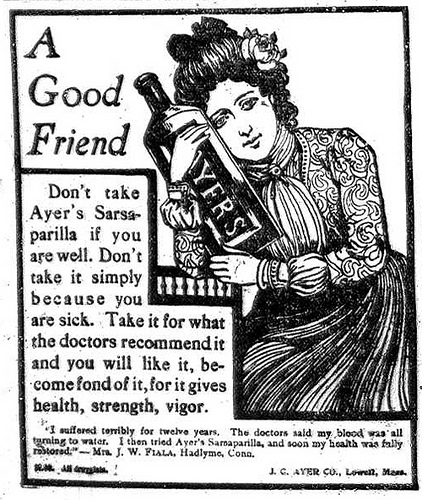
At a time when little about the human body or medicine was understood, millions of people sent away for patent medicines. These remedies were sold on street corners and in theaters, and in the pages of newspapers and periodicals. Despite the name, few were actually patented. To do so would have meant revealing the secret ingredients that made these pills, powders, and elixirs so appealing. Instead, the names were trademarked and the ingredients proprietary.

These patent medicines are what most people think of when they hear the word “quack.” Bottles filled with dangerous mixes of alcohol or opium, aromatics, and coloring, sold by charlatans masquerading as doctors or scientists preying on the innocent and uninformed. But the actual story is a bit more fuzzy.

Sure, some people out to make a quick buck sold potentially lethal remedies. But many were sold by people who truly believed in the remedies they sold. Lydia Pinkham, for instance, sold a vegetable compound for female complaints based on a remedy she had used for years that riffed on several recipes found in John King’s American Dispensatory, a popular botanical handbook. Pinkham’s remedy contained a lot of alcohol – 18% – a not uncommon phenomenon among these remedies, but it’s harder to say if she was a true charlatan. As medical historian Roy Porter has written, “The historian cannot peer into the souls of ‘quacks’ and find foolproof evidence of fraud.”

Many other proprietary remedies were sold by actual doctors. Doctoring didn’t quite pay in the 19th century what it does today (in fact, as unbelievable as it sounds today, many doctors had two jobs to get by) so some doctors came up with their own remedies to sell and support their families. Others believed they had found a truly miraculous remedy that they wanted to offer to the public. Still other doctors prescribed patent remedies to patients.

All of this is to say that patent medicines, the realm of the quack in the popular imagination, are far more complicated than they at first appear.  Right or wrong, patent remedies promised affordable relief to many people who could not afford or did not have access to medical care.

World Posture Queen

I have a bit of a “thing” for beauty queens. Not Ms. America or Ms. Universe. But agricultural queens like Alice in Dairyland and the Wisconsin cranberry queen, food product queens like the Swiss Miss (an actual “Miss” at one point), and my newest discovery, the World Posture Queen.

The World Posture Queen was the queen of chiropractic, a way to publicize the fledgling healing system. The contest began in Michigan in 1955 as a way to bring attention to the annual meeting of the Michigan Academy of Chiropractic. The young woman with the straightest spine and the most perfect poise and personality would win. Contestants were given X-rays to determine whose spine was the straightest. Crooked spines were grounds for elimination. While strictly a local event the first year, the World Posture Pageant went national in year two, and international by year three.

Posture queens appeared on TV, including “What’s My Line” and “The Tonight Show.” In 1967,  World Posture Queen Ruth McCarter visited the White House and got a personal tour of the Rose Garden by President Johnson.

For fifteen years, World Posture Queens brought attention to chiropractic, prompting the 1958 issue of Chiropractic Economics to announce that “Posture Contests are BIG Business.” Despite its apparent success, the contest for perfect posture was discontinued in 1969. The demands of the contest were simply too much for its organizers.


An Ode To Bloomers for Women’s History Month

March is women’s history month, and in honor of the month (though really, every day is about women’s history for me), I recorded an essay about Amelia Bloomer and her bloomers for Wisconsin Life. 

Curing the (Historic) Common Cold

Toads for colds? It sounds like a joke. Or a witch’s brew. But in the mid-19th century, Madison doctor Hugh Greeley recommended a powder of toads for fever. “Take toads as many as you will, alive, [and] put them in an earthen pot,” he instructed. The toads were then set over an open flame. Once sufficiently cooked, they were cooled and then ground to a dark powder, mixed with a liquid – hopefully something strong and alcoholic – and drunk. For prevention, “half a dram will suffice,” counseled the good Dr. Greeley.

Winter in Wisconsin means snow, ice, and frigid temperatures. But it’s also the peak of the cold and flu season. The case was just the same more than a century ago, though the remedies were a little different.

George Howard, the first pharmacist in La Crosse, mixed many of his own special medicinal blends in the 1850s. He had remedies for everything from runny noses and headaches to something far more exciting: love potions. The lovelorn sent Howard letters begging for help. In return, he sent them powders to match a popular 19th century nursery rhyme. Women got “sugar and spice” and all that’s nice, while men got “snips and snails” (no one is quite sure what “snips” mean, though, the original line may have been “snips of snails” with “snips” meaning a little bit). Howard claimed to have received nothing but grateful “thank yous” in return.

A few decades later, Fond du Lac resident Wyman Towns began selling bottles of his special Cold Killer to cold sufferers through the mail. It wasn’t his only offering. He also sold Towns’ Healing Snuff and Towns’ Rheumatic Liniment among other patent medicines. The ingredients of these remedies were kept secret – that’s what made them patent medicines – so we don’t know if Towns shared Dr. Greeley’s affection for powdered toads.

In the early 20th century, reporter Marcelia Neff remarked in the pages of the Milwaukee Journal that traditional Indian remedies could be very effective in curing what she called “neurotic white people.” Most of these remedies were made of native plants ground into powders or pastes or drunk as tea. A poultice of sumac leaves could relieve a sore throat: as could a mixture of bloodroot juice and maple syrup. Headache relief came with a tincture of aster leaves. The boiled bark of red maple did wonders for sore, red eyes.

Botanical cures had a long history in American medicine. European colonists relied on herbal remedies. They cultivated local plants for their healing powers often with the help of Native Americans. So important was the need for medicinal plants that the British crown ordered the 17th century Virginia colony to cultivate gardens of native plants for relief of coughs, colds, and worse.

And if none of those worked, there was always alcohol. Appleton resident Alfred Galpin recalled that his grandfather kept a healthy supply of brandy in his settler’s cabin in case of colds. While the alcohol surely didn’t cure, it could certainly dull or at least distract from sinus pain and pressure.

Sure, many of these remedies may seem ridiculous to us today, but the answer to the common cold still alludes us. So if you get a cold this winter, just know you have lots of company, both in the past and today.


A Water Cure of Their Own

An escape to the country for rest, relaxation, and lots of water was just what many people seeking water cures in the mid-19th century wanted. And when we think of our own habits of escaping to somewhere watery and cool in hot weather, it seems crazy that water cures actually advertised the opposite – that winter, or at least more temperate times of year, were the best time to take the cure.  It certainly had its perils. The cold could quickly freeze the wet blankets wrapped around patients. One patient complained of icicles raining down on his head when he stopped at the outdoor shower for his daily wash. It was all part of the cure, though.

While all kinds of people traveled to water cures, women found them particularly attractive. For many, it was one of the few times in their life when they could put the needs of their husbands, children, and homes aside. A stay at the cure was a chance for women to be pampered at a time when womanhood offered little in the way comfort for any but the very wealthy.

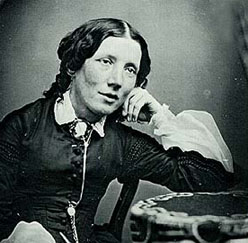
Writer Harriet Beecher Stowe (of Uncle Tom’s Cabin fame) discovered the wonders of the water cure on her own visit to the Brattleboro Hydropathic Institute in Brattleboro, Vermont. Suffering from the death of her brother, a recent miscarriage, chronic mercury poisoning (from previous medical care), and cholera, Stowe described herself as reduced to a state of “uselessness,” and in dire need of some medical attention. So she traveled to Brattleboro in 1846 to try the water cure. She liked it so much, her husband Calvin feared she might never come home.

“Not for years, have I enjoyed life as I have here,” Stowe admitted, “real keen enjoyment – everything agrees with me.” She loved the daily exercise – “I walk habitually five miles a day – at intervals between my baths, never in my poorest days less than three – and in some good days I have walked 7 – & not suffered for it.” It was some of the most vigorous activity she’d had in years. As a married woman, her mobility had become insular and mostly indoors, limited to the movements of the housewife and mother. She also loved the companionship of her fellow patients. In January, Stowe wrote “We still splash on here & it grows colder & colder.” The bar she held on to during her outdoor shower was covered with a half-inch of ice but she still took 5 or 6 showers a day and walked miles in the cold Vermont countryside.

Calvin grew less enthused with the water cure, though, as his wife’s absence stretched on for more than a year. He couldn’t wait for her to return,  reminding her that it had been “almost 18 months since I have had a wife to sleep with me. It is enough to kill any man.”

Stowe did eventually come home, but she never forgot the pleasures of the water cure and the brief space she had that was all her own.

Winter Thickens the Blood (or so they say)

There’s an old saying that “winter thickens the blood.” It’s an old wives’ tale, though, as temperature doesn’t have much to do with the thickness of blood – at least in humans. Some hibernating animals do get thicker blood in the winter to help them prepare for the cold. It’s one winter survival strategy.

Me? I like to get my blood pumping in the winter for physical and mental health. No hibernating here. Course, it helps to be 2,000 miles from home in the much milder climes of the Pacific Northwest.

The misty forests flanking Mt. Constitution

The Coffee Cure

T.S. Eliot measured out his life in coffee spoons. Scottish historian and philosopher Sir James Mackintosh claimed that “the powers of a man’s mind are directly proportioned to the quantity of coffee he drinks.” Many other coffee drinkers would probably agree.

In 1803, German physician Samuel Hahnemann claimed that coffee was purely medicinal and nothing more. The founder of homeopathy, Hahnemann drew a careful distinction between ‘food’ and ‘medicine.’ “Medicinal things are substances that do not nourish, but alter the healthy condition of the body,” Hahnemann wrote in On the Effects of Coffee. Medicines taken by a healthy person “deranges the harmonious concordance of our organs, undermines health and shortens life.” For Hahnemann, coffee fell into this category of harmful substances, potentially responsible for all of man’s suffering and ill health. Coffee was the cause of impotence, sterility, rickets, insomnia (pretty true actually), stammering, melancholy, and malicious envy among other conditions.

Hahnemann - No black coffee for him

Hahnemann’s feelings about coffee seem to stem from his personal dislike of its flavor rather than anything scientific, though. “No one ever smoked tobacco for the first time in his life without disgust,” he wrote, and “no healthy person ever drank unsugared black coffee for the first time in his life with gusto – a hint given by nature to shun the first occasion for transgressing the laws of health.” Hahnemann clearly needed to ask for “room” with his order.

Hahnemann certainly wasn’t blind to the benefits of coffee, though, especially in the morning. His description seems to describe several people I know and to explain the Starbucks empire: “In the first moments or quarters of an hour after awaking…everyone who is not living completely in a state of rude nature, has a disagreeable feeling of not thoroughly awakened consciousness, of confusion, of laziness, and want of pliancy in the limbs.” He goes on to explain how coffee “removes this disagreeable situation” as “we suddenly become completely alive” with each sip.

Two decades later, Hahnemann realized that perhaps he’d been too hasty in his condemnation of coffee. He wasn’t ready to fully embrace coffee but maybe it wasn’t the sole cause of man’s fall from health.

Millions of coffee drinkers agree.

Apples for Health

A new study in the journal Stroke asks if “an apple a day keeps stroke away?” The study authors say yes. It turns out that the old 1904 apple industry marketing campaign to rebrand apples as healthful may be more true than J.T. Stinson knew when he coined the now famous adage “an apple a day keeps the doctor away.” The consumption of apples (as well as pears) appears to lower your risk of stroke more than any other fruit and vegetable, leading the editorial writer to suggest that perhaps there will finally be an “apple a day” clinical trial.

I guess Eve knew was on to something when she grabbed that apple.

Apple Cures

Thomson's Home Healing Guide

American physician Samuel Thomson was a big fan of apples. The founder of his own 19th century medical system, a method of natural, botanic remedies known as Thomsonianism, Thomson prescribed apples for stomach aches and advised mixing emetics with cider for those who needed a little something sweet to help the medicine go down. His medical journal, the Thomsonian Recorder, included articles on planting and tending apple orchards. For cholera, though, apples should be avoided at all costs warned Thomson.

Apples have long played a role in medicine. Even when people wouldn’t eat the raw fruit, they were more than willing rub some apple pulp on their skin or to swallow a tincture containing apples. Apples were prescribed for disturbances of the bowels, lungs, and nervous systems in 12th century Italy. In the 14th century, apple cures often called for apples cooked with sugar and spice, a kind of medical apple pie. Seventeenth century English doctors advised cider for depression, though it may have been the alcohol rather than the healing power of apples that did the cheering.

Thomson likely championed apples because they were natural, not to mention easily accessible to most Americans. Nearly everyone had an orchard in the yard. They also had a long history in medicine. Thomson’s ideas of the healing power of plants and herbs weren’t necessarily new – but he managed to capitalize them so successfully as to present the first serious challenge to regular medicine in the 19th century.