March is women’s history month, and in honor of the month (though really, every day is about women’s history for me), I recorded an essay about Amelia Bloomer and her bloomers for Wisconsin Life. 
Author: eljanik
The World Underfoot
“To know the world, some people need to travel the globe; others simply examine their own piece of ground entirely.” – Tom Montag, The Idea of the Local
Can your backyard ever be as exciting as the Alps? Your city streets as fascinating as Paris?
I knew I loved history early. Way early. Like elementary school early, decades before some kind of historical trigger seems to twitch in middle aged adults that transforms many of them into history buffs (and my readers, thank you!). Teachers matter (thanks Mr. Bloomhuff, Mr. Clay, Mr. Meyers, Ms. Engdahl). Have you ever loved a subject taught by a teacher you hated?
But for me, growing up in the Northwest, history was always something that happened over there. Over there and way back when because the history I loved was colonial, filled with tricorn hats, and dotted with perfect New England towns. I knew next to nothing about my home state. A few names and dates but little else. History was all around me but I couldn’t see it.
Then I moved to Wisconsin, got a job at the Wisconsin Historical Society, and started learning state history, like it or not. And suddenly my new home took on new dimensions. The hill up to the capitol was no longer just the cause of my sweatiness at work on humid summer days, but was a drumlin left by the massive glacier that covered two-thirds of the state 15,000 years ago. When my beloved Puritans were setting up households, negotiating with Indians, and fending off witches in 17th century New England, the French were trading and exploring in Wisconsin. Learning this history, this local knowledge, made my experience of living in Wisconsin so much richer and my connection deeper than any place I had ever lived before.
This is the power of local. Knowing a place so well that you begin to see yourself reflected back in it. Understanding that the history and stories of your place are just as important as – and connected to – the history and stories of another place.
This certainly doesn’t mean that I don’t continue to long to travel the world – I can barely keep myself from dreaming of hikes in the Alps or of the highlands of Scotland. Or that I’ve lost my love of colonial America. But it does mean that I try to lavish at least the same attention to place at home as I do abroad. Because there’s a lot I can learn about the world here, too. It’s why I walk as much as I do, thousands of miles down the same streets every year. And why my husband and I are now visiting all the county and city parks, part of an effort to know my own ground entirely.
Eating Out of Season
Some people feel guilty about eating too much. Others about eating “bad” foods – you know, the ones that taste delicious usually because they are too fatty, too salty, too sugary, or some combination of all three. “Bad” is, of course, relative.
For me, my letter A of shame comes from eating out of season. Or perhaps worse still – eating foods that will never have a season here in Wisconsin. Foods from thousands of miles away. Bananas. Avocados. I hide them away when company comes, outwardly virtuous to my local seasonal eating plan but hiding a terrible damning secret.
It’s a foolish worry. Food shouldn’t inspire guilt. That’s part of what makes eating so pleasurable. Not to mention the dozens – literally dozens – of bunches of kale and pounds and pounds of winter squash, potatoes, carrots, parsnips, and rutabagas I’ve virtuously eaten (and loved) this winter. My mettle is proven – a real medal, perhaps one made from a massive slice of carrot, should hang ’round my neck.
Even so, it’s one I think about every time I go to the grocery store or order from a menu. What’s in season? What’s possibly local? How will that asparagus really taste in February as opposed to the tender bundle I can barely keep out of mouth in June? Is it worth it? Sometimes the answer to that last question is “yes.”
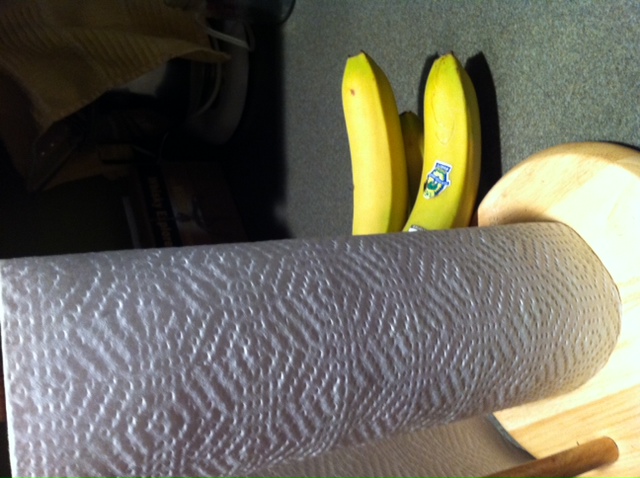
Bananas cower in fear of being discovered behind the paper towels
In some ways, I feel less remorse eating those never seasonal foods than the ones that are just out of season. I know what a really ripe, really delicious tomato tastes like so it’s wan, well-traveled winter cousin is a poor substitute. Even the apple I ate today tasted off – my fall apples finally ran out a month ago so this store-bought apple from South America tasted of a season that didn’t match the view out my window. An avocado, on the other hand, is always foreign – at least until I move somewhere with an avocado season – so I have no comparisons, no trade-offs for a potential pleasure now over the benefits of waiting until spring or summer.
I’m trying to let the guilt pass. You’ll know how well I’ve succeeded if you see a bunch of bananas on my counter.
Cross-Country Skiing on the Radio
My essay on cross-country skiing was featured this morning on Wisconsin Public Radio’s “Wisconsin Life.”
And last week, I had a great conversation with CSA farmer Kristen Kordet about planning for the farming season. We looked at seed catalogs and talked about her favorite varieties. She’s a delight to talk to and I think the edited piece turned out really well.
Lessons of Adulthood
Have you ever looked at your life – really stopped everything and took a good look around – and thought, “how did I get here?” It can be disorienting in some ways, if you think back on where you thought you’d be when you were 8 years old or 15 or even two weeks ago when I was only 31 and do a real evaluation.
This thought passes through my mind nearly every time I give a talk. A talk. Me. Where I stand up in front of people and speak about history (usually) for 45 minutes. Into a microphone. The lights down low. With people staring at me. And I actually like it.

Growing up, I did everything I could to avoid public speaking. And when I did have to give talks, I gripped the podium (if there was one) until my knuckles turned white and my fingers ached from the strain, my knees shaking, my face buried in my notes, and my words tumbling out on par with that guy from the Micromachine commercials. I hated it. I hated being on display even if really, no one was really listening or frankly, cared all that much in school. I just needed to get out of school, get through this class, and then I would never have to give a speech again. Never!
But then I became a professional writer.
And I learned the cold, hard truth about the writing life: there’s speaking involved. You can’t just sit in your garret all day, turning out pages of prose for the world to lap up in eager anticipation. Readers want to see you. Or more accurately, readers learn they want to be your readersby seeing you and hearing you speak. And so you speak. And hopefully with time, you get better at it and maybe even start to enjoy it.
Five years on of fairly steady speaking engagements, I’ve discovered something earth-shattering: I like to speak publicly. The realization came slowly, so slowly that at first I didn’t recognize it. One day, in the middle of a talk, I found myself walking up and down the aisle with a microphone in hand. Who was I, Phil Donahue?! I felt suddenly disembodied, like I was watching someone who looked a lot like me but couldn’t possibly be me because I hate public speaking, talking, laughing, smiling, having a great time. But it was me and it is me.
I never thought I’d be up there, much less by choice. Wasn’t the great promise of adulthood as a child the freedom to do what you wanted?
I’m still surprised every time I stand up to give a talk. Surprised at who I’ve become but pleased to know that I could do it all along.
Curing the (Historic) Common Cold
Toads for colds? It sounds like a joke. Or a witch’s brew. But in the mid-19th century, Madison doctor Hugh Greeley recommended a powder of toads for fever. “Take toads as many as you will, alive, [and] put them in an earthen pot,” he instructed. The toads were then set over an open flame. Once sufficiently cooked, they were cooled and then ground to a dark powder, mixed with a liquid – hopefully something strong and alcoholic – and drunk. For prevention, “half a dram will suffice,” counseled the good Dr. Greeley.
Winter in Wisconsin means snow, ice, and frigid temperatures. But it’s also the peak of the cold and flu season. The case was just the same more than a century ago, though the remedies were a little different.
George Howard, the first pharmacist in La Crosse, mixed many of his own special medicinal blends in the 1850s. He had remedies for everything from runny noses and headaches to something far more exciting: love potions. The lovelorn sent Howard letters begging for help. In return, he sent them powders to match a popular 19th century nursery rhyme. Women got “sugar and spice” and all that’s nice, while men got “snips and snails” (no one is quite sure what “snips” mean, though, the original line may have been “snips of snails” with “snips” meaning a little bit). Howard claimed to have received nothing but grateful “thank yous” in return.
A few decades later, Fond du Lac resident Wyman Towns began selling bottles of his special Cold Killer to cold sufferers through the mail. It wasn’t his only offering. He also sold Towns’ Healing Snuff and Towns’ Rheumatic Liniment among other patent medicines. The ingredients of these remedies were kept secret – that’s what made them patent medicines – so we don’t know if Towns shared Dr. Greeley’s affection for powdered toads.

In the early 20th century, reporter Marcelia Neff remarked in the pages of the Milwaukee Journal that traditional Indian remedies could be very effective in curing what she called “neurotic white people.” Most of these remedies were made of native plants ground into powders or pastes or drunk as tea. A poultice of sumac leaves could relieve a sore throat: as could a mixture of bloodroot juice and maple syrup. Headache relief came with a tincture of aster leaves. The boiled bark of red maple did wonders for sore, red eyes.
Botanical cures had a long history in American medicine. European colonists relied on herbal remedies. They cultivated local plants for their healing powers often with the help of Native Americans. So important was the need for medicinal plants that the British crown ordered the 17th century Virginia colony to cultivate gardens of native plants for relief of coughs, colds, and worse.
And if none of those worked, there was always alcohol. Appleton resident Alfred Galpin recalled that his grandfather kept a healthy supply of brandy in his settler’s cabin in case of colds. While the alcohol surely didn’t cure, it could certainly dull or at least distract from sinus pain and pressure.
Sure, many of these remedies may seem ridiculous to us today, but the answer to the common cold still alludes us. So if you get a cold this winter, just know you have lots of company, both in the past and today.
Solace of Tortillas
Growing up, I never ate Mexican food. Never did a tortilla, refried bean, or dab of guacamole cross my lips – at least until I was in college. But now, it’s all I want in uncertain, tired, stressful, and even many joyous occasions. It’s a comfort food I found only as an adult.
On a recent trip, my husband and I drove for hours – days really – looking for something we just couldn’t find. We hit every small town, walked the main streets, searching for a bit of local culture and charm – the kind we run into a lot in Wisconsin. But it was not to be. After another day of side roads and diversions, pulling into a town that promised a historic waterfront with a charming downtown that actually yielded a few mostly closed businesses (and the open ones all empty, rather charmless bars), boarded up buildings, and a large cement wall between the town and the water, we dejectedly realized our search was likely in vain. Tired and disappointed, we headed to the nearest Mexican place, for there’s solace in tortillas.
It wasn’t the first time. Many trips, even ones a little more rewarding, often find us in a Mexican restaurant at some point. A long day of driving or the excitement and stress of being in a big crowded city for several days straight often leave me craving fajitas. Tired and a little dehydrated, we ate Mexican after my first triathlon. A visit to the emergency room after a bee sting was followed by tacos. Our engagement dinner a few years back found us in a Mexican restaurant after a long afternoon and early evening driving around the Olympic Peninsula. My now-husband was a little embarrassed – it wasn’t what he’d hoped our first meal as an engaged couple would be – but to me it was perfect. Perfectly us to end up eating Mexican.

Engagement Mexican - tired and dirty from hiking and driving
Comfort can come in nearly any food, found at any time. It isn’t always something you grew up with or remember having at certain times as a child or teenager. Sometimes your comfort food is something that appears at just the right time and place.
Embracing Winter
Before I moved to Wisconsin, I’m not sure I’d ever even seen a cross-country ski. As a kid growing up near Seattle, winter was a destination, not a season. On Monday mornings, my classmates returned to school with creased lift tags dangling from the zippers of their coats, and their red, sunburned faces raccoonishly imprinted with goggles. But my parents, Chicagoans by birth, didn’t ski, had never skied, and certainly weren’t about to start downhill skiing in their late 30s. So winter remained more of an abstraction to me, a snowy realm I could see on the flanks of the Cascades – far off in the distance.
Things were different in Wisconsin. Winter was unavoidable, an elemental part of life. Even so, I often overheard people talking about how they “got through it” as if it were a messy divorce or a one-hundred-year flood rather than an annual occurrence. I learned to “get through” winter on cross-country skis.
Once you get the motion right – the kicking and gliding, riding the driving ski with your body floating above – you discover the grace of skimming through still air and snow. Sliding and poling your way along, cross-country skis make no more noise than a kayak slipping through flat water.
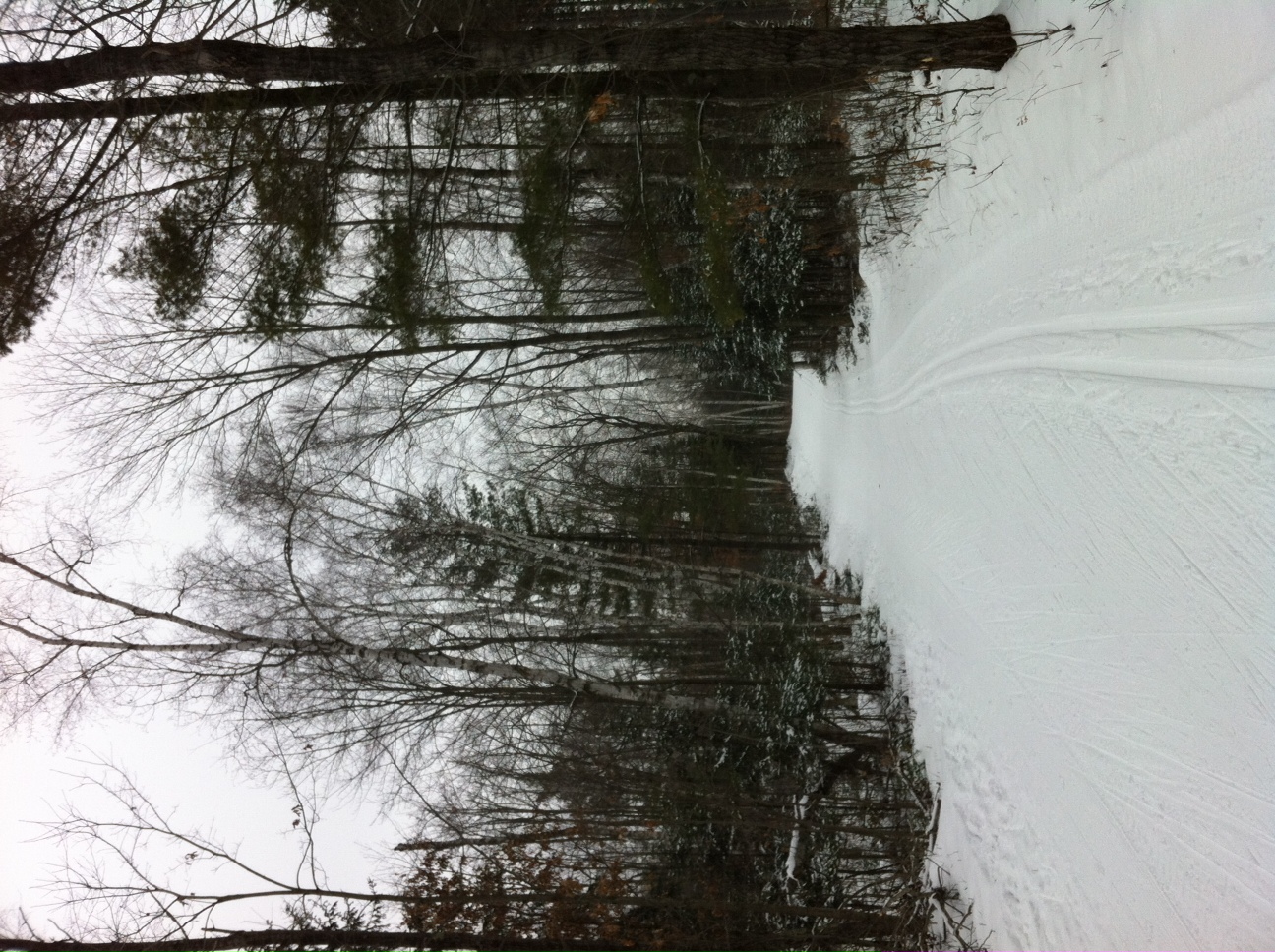
Even the first awkward tries can have grace. My first cross-country skis were rentals. Stepping onto the strips of what seemed to me unimaginably thin plastic, my feet slid forward and I fell backward. Three falls later, I was off, shuffling and jerking my arms and puffing the arctic air. Despite myself, I soon fell into a rhythm, sloppily syncopated but forward marching, punctuated by my growing elation.
With snow and skis, I can go anywhere, over a frozen pond and through the interior of the woods. In the spring and summer, I’d worry about my path, anxious to find a trail map to keep from getting lost. But in the winter, my ski tracks are reassurance, guiding me back to my start.
When Lake Mendota freezes, I glide out onto its surface, a wide expanse of flat, snow-covered ice that feels eerily empty yet magical before the packed shoreline of the city. Part of the spell is skiing past the ghosts of summer – boathouses, sections of dock, lawn chairs, a life preserver. The Memorial Union Terrace, the center of summer in Madison, sits unobtrusively under a blanket of snow. The bright paint of upturned boats now splotched with snow seem a bit more solemn in the stark winter light. Yet at the same time, the sky rarely feels so large or so vivid.
There’s peace on two skis. The muffled quiet of the snow seems to magnify every other sound. The rustle of dried branches, bird calls, the swirl of my thoughts. Now I’m the one with the weekend winter stories, of quiet wonders found skiing in snowy woods and fields. It’s not showy but more exhilarating than anything I could imagine.
A Water Cure of Their Own
An escape to the country for rest, relaxation, and lots of water was just what many people seeking water cures in the mid-19th century wanted. And when we think of our own habits of escaping to somewhere watery and cool in hot weather, it seems crazy that water cures actually advertised the opposite – that winter, or at least more temperate times of year, were the best time to take the cure. It certainly had its perils. The cold could quickly freeze the wet blankets wrapped around patients. One patient complained of icicles raining down on his head when he stopped at the outdoor shower for his daily wash. It was all part of the cure, though.
While all kinds of people traveled to water cures, women found them particularly attractive. For many, it was one of the few times in their life when they could put the needs of their husbands, children, and homes aside. A stay at the cure was a chance for women to be pampered at a time when womanhood offered little in the way comfort for any but the very wealthy.
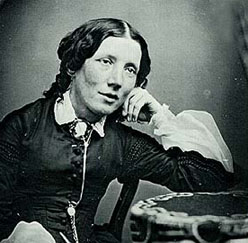
Writer Harriet Beecher Stowe (of Uncle Tom’s Cabin fame) discovered the wonders of the water cure on her own visit to the Brattleboro Hydropathic Institute in Brattleboro, Vermont. Suffering from the death of her brother, a recent miscarriage, chronic mercury poisoning (from previous medical care), and cholera, Stowe described herself as reduced to a state of “uselessness,” and in dire need of some medical attention. So she traveled to Brattleboro in 1846 to try the water cure. She liked it so much, her husband Calvin feared she might never come home.
“Not for years, have I enjoyed life as I have here,” Stowe admitted, “real keen enjoyment – everything agrees with me.” She loved the daily exercise – “I walk habitually five miles a day – at intervals between my baths, never in my poorest days less than three – and in some good days I have walked 7 – & not suffered for it.” It was some of the most vigorous activity she’d had in years. As a married woman, her mobility had become insular and mostly indoors, limited to the movements of the housewife and mother. She also loved the companionship of her fellow patients. In January, Stowe wrote “We still splash on here & it grows colder & colder.” The bar she held on to during her outdoor shower was covered with a half-inch of ice but she still took 5 or 6 showers a day and walked miles in the cold Vermont countryside.
Calvin grew less enthused with the water cure, though, as his wife’s absence stretched on for more than a year. He couldn’t wait for her to return, reminding her that it had been “almost 18 months since I have had a wife to sleep with me. It is enough to kill any man.”
Stowe did eventually come home, but she never forgot the pleasures of the water cure and the brief space she had that was all her own.
Wassailing the New Year
Here we come a-wassailing
Among the leaves so green;
Here we come a-wand’ring
So fair to be seen.
Love and joy come to you,
And to you your wassail too;
And God bless you and send you
a happy New Year.
We all know the song, as familiar as nearly any other holiday song. And while I often happily sing along to songs that I have no idea what they mean (or perhaps I’m just singing all the wrong words – a post for another time), this one made me pause. I’m coming a-what? And we’re wishing it love and joy?
Wassailing is the practice of thanking the deity of the apple orchards to encourage fertility and ensure next year’s crop. The term wassail probably comes from the Old Norse ves heil and the Old English was hal meaning to “be in good health.” It was originally used as a greeting but became so integrated into drinking rituals in England that the invading Normans who arrived in 1066 thought it was a toast distinctive to the island. Wassail also came to mean the drink used for the toast, which was usually a spiced wine known as Renwein. Because the wine and the spices had to be imported, it was a precious commodity among early English families. Recipes varied among families based on who could afford which ingredients. Later, beer became an acceptable and widely used wassail.

Dancing in the Cider Orchard
Wassailing became an important practice (and the seeming social event of the season) in cider growing areas of England at least as far back as the 18th century. Held on the eve of Twelfth Night in early January, revelers placed a jug of cider or a piece of cider-soaked bread or cake on the biggest apple tree to honor the gods. In other places, trees are sprinkled with cider. A chant or song nearly always accompanied the offering, and the ceremony generally concluded with the banging of pots and kettles, the firing of guns, and the blowing of horns. These noises were either intended to awake the tree gods or to scare away evil spirits – or maybe a little bit of both. Some people still celebrate today.
So next time you hear the song, bless the apple trees for the coming of spring and maybe make yourself some wassail to ward off evil spirits.
Wassail
Recipes for wassail vary widely, and can have a base of beer, wine, or cider. This recipe is based on a Tudor concoction.
10 small apples
10 teaspoons brown sugar
2 bottles dry sherry or dry Madeira
1/2 teaspoon grated nutmeg
1 teaspoon ground ginger
3 cloves
3 allspice berries
1 stick cinnamon
2 cups superfine sugar
1/2 cup water
6 eggs, separated
1 cup brandy
Heat oven to 350°F. Core the apples and fill each with a teaspoon of brown sugar. Place in a baking pan and fill the bottom with 1/8-inch of water. Bake for 30 minutes or until tender. Set aside.
Combine the sherry or Madeira, nutmeg, ginger, cloves, allspice berries, cinnamon, sugar, and water in a large, heavy saucepan and heat without letting the mixture come to a boil. Leave on very low heat.
Meanwhile, beat the egg yolks until light and lemon-colored. Beat the whites until stiff and fold them into the yolks. Strain the wine mixture and add gradually to the eggs, stirring constantly. Add the brandy. Pour into a metal punch bowl and float the apples on top. Makes about 10 servings.
 Erika Janik