A Trip to the Water Cure

I just got back from my first water cure.

The Greenbrier Resort is a period film brought to life

Okay, so maybe it wasn’t really a water cure of yore, but the Greenbrier Resort in White Sulphur Springs, West Virginia, began as a resort for people seeking the healing power of the sulphur water that bubbled up from its mountainous ground. People first began coming in 1778, and the visitors only increased in the 19th century as people drank and bathed in hopes of curing everything from headaches to arthritis. All of this water bubbles up from a green-domed, white-columned spring house to the side of the main resort. On top is a statue of Hygeia, the Greek goddess of health and medicine. The spa still uses water from the spring house, though, most people probably think of it as spa rather than a medical facility these days.

Presidents came to the Greenbrier. Lawyers, bankers, and others hoping to escape the summer heat came, too. The construction of the large main hotel in 1858 made the White Sulphur Springs not only a place of healing but also the place to be seen for social elites. That seemed about right. Hydropathic institutes attracted many people who were just looking for a break from the city. They tended to be built in beautiful places (West Virginia is gorgeous) and to offer outdoor activities to relax and rejuvenate.

I was there to attend the Symposium for Professional Food Writers, a multiday extravaganza of great food and great food talk. I met some fantastic and talented people many of who (and many of them are already) are sure to be famous. I’ll be sure to remember that I knew them when.

Today, a visit is like a step back in time–and for me, a step into another social class. Famed decorator Dorothy Draper redid the place in outsize florals, massive colored stripes, and bright colors after World War II (I should have taken more pictures. Heidi Swanson of 101Cookbooks took some nice ones). Everything you could ever need is taken care of as employees swirl around you in the lobby and at every meal. Afternoon tea brought live piano music and a well-dressed couple dancing in the lobby before tea sandwiches and cookies were brought out on silver trays carried high above the heads of the servers. It was a little like stepping into the “Be Our Guest” number from Disney’s Beauty and the Beast.
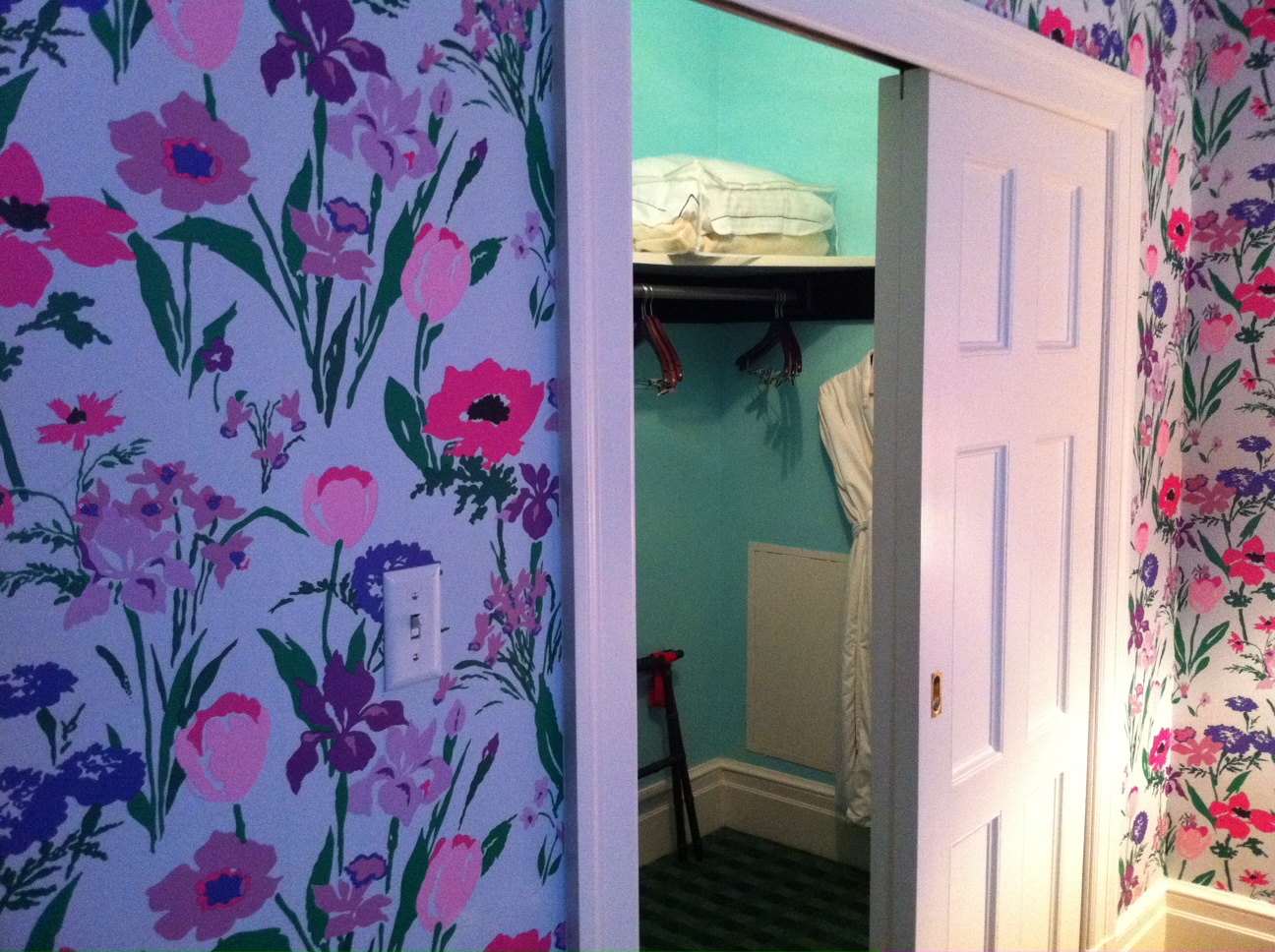
Wow, look at the wallpaper. Our curtains were the same pattern and even the ceiling was wallpapered.


It’s also probably the closest you can get to the hydropathic experience of the past. A well-appointed resort attracting people from all over the country to take in the fresh air, exercise, and of course, as much of that healing water as you could handle.  

Women Doctors and Healers

Nearly all of the medical sects that emerged in the 19th century gave unprecedented professional and leadership opportunities to women. Women had long been responsible for their family’s health, growing medicinal plants in kitchen gardens, tending to the sick, and serving as midwives for family and neighbors. Home healing was part of her domestic responsibilities: caring and tending being largely female character traits.

But for the most part, women couldn’t be doctors. That was a role for men who could enroll in medical schools or apprentice with trained doctors. For various reasons, it wasn’t deemed suitable for women, and women were mostly kept out of mainstream medicine until the 20th century.

Medical reformers had a different view of women, though. Most not only welcomed female practitioners, they allowed them to attend their medical schools and training programs. Women became leaders of alternative medicine associations and opened their own private medical offices. Mary Gove Nichols opened her own water cure, and Lydia Folger Fowler, only the second woman to graduate with a medical degree in the United States, had a private medical office in New York City.

Hydropathy, or the water cure, took a particularly liberating view of women. Contemporary medical theory viewed being female as a disease in of itself. Women were irrational and ruled by their wombs. The natural processes of a woman’s life–menstruation, pregnancy–were seen as diseases that needed to be controlled, usually by men. To be female was to be a problem in need of a solution. Hydropaths took a different path, choosing not to medicalize women. They instead viewed women’s life events as natural and normal, and argued that hydropathy gave women control over their bodies; something they rarely had in any part of their lives. This was an empowering and radical idea that attracted a large number of women eager to exert control over their own bodies and their own lives.

Hydropath Mary Gove Nichols

Homeopathy, osteopathy, Thomsonism, and phrenology were among the many others that welcomed women into their fields. And doing so, allowed their movements to grow exponentially.

Many women wouldn’t talk about health issues with a male doctor. Women in alternative medicine discussed topics and introduced health concepts that many women would never have learned about otherwise. These women doctors gave lectures on women’s and children’s health, and wrote books geared specifically toward women. At water cures, women were needed to serve as attendants and doctors to female visitors.

This more open attitude toward women was, in part, a reflection of the times. Middle class reformers of all kinds worked to make the world a better, cleaner, safer, free-er, happier place in the 19th century. Women played a particularly active role in reform efforts, as they were one way that women could be politically active and still maintain their womanly “virtue.” Many of the same people that were attracted to abolition and woman’s rights were also attracted to medical reform. The lines between all these reformers blurred and overlapped in innumerable ways, so it wasn’t too surprising that women would become such prominent players in alternative medicine.

Perhaps it’s just more surprising, and disappointing, that it took so long for mainstream medicine to come around.

Mark Twain’s head reading

Everyone had their head examined in the 19th century. Phrenologists read the heads of common people and famous people, from President Ulysses S. Grant and poet Walt Whitman to nurse and Red Cross founder Clara Barton. Even Mark Twain, who was never quite sure what to make of phrenology.


Visiting London in 1873, Mark Twain saw an advertisement for the services of a fellow American who had hung his shingle on Fleet Street. Inspired and not a little skeptical, Twain appeared under a fictitious name in the offices of Lorenzo Niles Fowler, “practical phrenologist.”
Phrenology wasn’t new to him. It had captured the imagination of millions of Americans and made everyone a little head conscious. Twain remembered the itinerant phrenologists from his years in Hannibal, Missouri, giving demonstrations and offering advice.
Entering, Twain “found Fowler on duty, amidst the impressive symbols of his trade…all about the room stood marble-white busts, hairless, every inch of the skull occupied by a shallow bump, and every bump labeled with its imposing name, in black letters.”
Twain paid Fowler for a reading. It’s not clear whether he attempted to disguise his physical appearance or if he at least chose to wear something other than his trademark white suit. Either way, Fowler gave no indication that he recognized Twain.
The reading was fairly typical, a balanced stew of mostly generic, positive traits, save for one spot particularly galling to the famed humorist. “[H]e found a cavity, in one place; a cavity where a bump would have been in anyone else’s skull,” recalled Twain. “He startled me by saying that that cavity represented the total absence of the sense of humor!”

Eavesdropping

Sometimes I think it might be fun to start recording everything I hear while walking around town or waiting in line at the store. At the farmer’s market this morning, I heard a man tell his friends: “I think I slept on my kidney wrong. It’s really sore this morning.” I’m pretty sure that’s not possible.

Sleep is a common prescription for good health today. Getting enough of it, that is. In the 19th century, many alternative health movements promoted things we now think of as common sense: eating a heathy diet, drinking water, getting fresh air, and exercising. But few health reformers actively promote sleep. It seems that sleep wasn’t the same issue that it is today. Scientists and doctors speculated on what sleep was for and what happened while you slept (especially what you were dreaming) but didn’t seem to worry so much about the amount of sleep people were getting.

In part, this may be due to technology. Electricity wasn’t widespread until the 20th century so working late into the night or before dawn wasn’t an issue in many cases. There were certainly many other things to keep people up at night, however, from lice and other bed bugs to stinky chamber pots.

Or maybe it was, as historian Roger Ekirch suggests, that sleeping through the night wasn’t expected. He proposes that interrupted sleep was the norm and that it’s only now that we equate a good night’s rest with uninterrupted sleep. He says–and many others seem to agree–that artificial lighting has changed us. Harvard chronobiologist Charles A. Czeisler has compared artificial lighting to a drug in its physiological effects. Among other things, it alters our levels of melatonin, the hormone that regulates our circadian clock. In the past, we may have slept in segments, sleeping for a few hours, waking and doing something, and sleeping some more.

It’s certainly always been possible to sleep in an awkward position and wake up with sore muscles. I’m just not sure that extends to body organs.


Homeopathy, Alive and Well

Homeopathy is alive and well in its birthplace. On a recent trip to Germany, I was surprised to see so many homeopathic pharmacies and doctors’ offices. But maybe I shouldn’t have been since Germany (and Austria) seems to have given rise to so many alternative medical theories: hydropathy, phrenology, homeopathy, to name a few. 
One of many homeopathic apothecaries

Premade homeopathic remedies for sale in a store window in Lubeck

The area we visited, northwest Germany, seemed filled with all kinds of “alternative” doctors. There were chiropractors, herbalists, naturopaths, and homeopaths around every corner, a concentration I might expect to find in certain areas of the United States that have a hippie-ish reputation like San Francisco, Austin, and Berkeley. We saw them in Hamburg, Lubeck, and Luneborg, cities of very different sizes and characters. Perhaps the German medical system takes a more broadminded view than mainstream American medicine toward their alternative cousins, and perhaps the German people do, too. Seeing so many of these places, I could almost imagine being in the 19th century United States when such a range of medical options was prominent.

Medical Poetry

A few months ago, I published my first poem. Co-authored, I should say, with my creative husband. It was a medical poem, and it was published not in some literary magazine but in the journal Neurology. That’s right, a medical journal with a humanities section.

Medical poetry has a long history, it turns out (and I’m not talking about the poetic musings of patients on their illnesses and suffering, though that probably has an even longer history). In the 19th century, a botanical medical movement known as Thomsonianism, after its founder Samuel Thomson, created a vast library of medical poetry related to their beliefs. Unlike most 19th century poetry which was penned by women, the majority of Thomsonian poems were composed by men for medical purposes rather than for any moral or ethical objectives. Some poems provided medical instruction, teaching people how to monitor sickness and to administer medicines.

Samuel Thomson himself, the movement’s founder, wrote many poems decrying the professionalization of medicine and the pretensions of the university educated. Thomson believed that every man could be his own physician and sought to demystify medicine by making it easy to understand and use. He advocated for natural remedies made of plants, roots, and barks, rather than the mineral and chemical-based medicines used by regular doctors. Disease for Thomson was caused by a lack of heat that needed to be restored through scrubbing and warming agents. Thomson’s poems reflected his democratic leanings, carrying anti-elitist messages and simplified explanations of his medical system.

Thomson and his followers wrote poems that stretched from the epic to the patriotic, satirical, and romantic. Most contained some element of ridicule aimed at regular doctors, gaining friends and followers through wit and calculated reason.

Here’s an 1840 poem written by Thomson that captures the significance of heat and the numbered system in his course of remedies.

ODE ON HEALTH
If you desire a length of days,
Then follow Wisdom’s pleasant ways:
Beware you shun the tempting lures
Of poisonous bait and death.
Health is a blessing all must prize,
True wealth in it, tho’ hidden lies,
We must beware of quack’ry’s cries,
Or else resign our breath.
Our nature’s may be understood,–
The wise, the blest, the truly good,
Have all combined to ease life’s load
Of poisons, kin to earth.
Shall laws make inroads on our peace?
Shall crafty Doctors never cease?
Shall stern oppression mar our ease?
Oh, no! we’ve rights by birth.
Is heat the friend of life in man?–
Then Thomson’s is the wisest plan
To lengthen out life’s feeble span,
And walk in nature’s truth.
If numbers, one to six be used,
Nor natural sent’nels be abused;
Then health with you shall ne’er be loos’d,
While heat you hold enough.

I’m not sure our poem was witty or as mission-driven as the Thomsonian works. But it’s still nice to know that poetry has long had a place at the bedside.

Hydropathy in the Family

I drink a lot of water every day. And I walk a lot, everywhere in fact, many, many, many miles a day. So when I first started reading about hydropathy, I could easily see myself fitting right in with the hydropaths. They instructed patients to drink at least 12 glasses of water (actually “tumblers”) a day and to walk as far as possible between treatments. One guy, James Wilson, took the advice to drink a lot of water a little overboard–he drank more than thirty glasses before breakfast while staying at the original hydropathy institute in Grafenberg, Germany. When he started his own water cure in England, he gave everyone glasses so they could follow his lead.

As it turns out, I’m not the only one with hydropathic sympathies in the family. On a recent trip to visit my parents, I discovered that my great-grandmother graduated from the Kellberg Institute for Hygiene, Massage, and Medical Gymnastics in Chicago with a specialty in water-therapeutics. She was a 20th century hydropath! No wonder I love all this medical history!

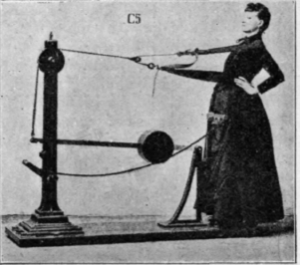
Medical gymnastics is what we would think of as just exercising today. It was the use of physical exercise as a therapy to restore or stay healthy. The medical and health benefits of exercising don’t need to be justified today, but until the 20th century, many people were not sure that exercise wasn’t harmful, especially to women.

From my very limited initial research, it appears that the Kellberg Institute was founded by Swedish immigrants (my great-grandmother was also a Swedish immigrant to Chicago). This makes sense as the Swedes had been particularly interested in the use of gymnastics for health since the early 19th century. They used gymnastics to improve the physical fitness of the general public in schools, in the military and as a medical healing process. 

Medical gymnastics in action


Per Henrik Ling developed the Swedish gymnastic system in the early 19th century. He was a fencing master, and with his son Hjalmer, he developed a program of functional physical gymnastics training. They founded the Central Gymnastic Institute in Stockholm in 1813 to provide training for teachers and members of the military. Ling’s Swedish gymnastics programs had four parts: medical, aesthetic, military and pedagogic. Training involved the correct performance of prescribed gymnastic movements under the watchful eye of a trainer.


Other European countries followed Sweden’s lead and instituted gymnastics programs to aid physical healing and to promote health from the early 19th century onward. This was likely the program taught at the Kellberg Institute to graduates like my great-grandmother.  


By the 20th century, hydropathy in its original form had virtually disappeared, morphed into an overall system of hygiene and exercise that would be quite recognizable as the keys to good health today: exercise, a sensible diet, plenty of sleep, and lots of water. 


Bloomers and the Water Cure

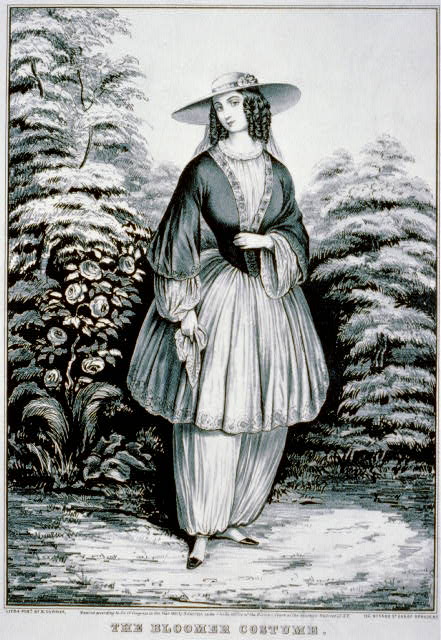
Amelia Bloomer is a name that many people who study women’s history even a little bit tend to know. She’s the namesake of “bloomers,” a style of dress that became popular among women’s rights advocates and dress reformers in the 19th century. Bloomer, the woman, didn’t invent the costume, but she was an early and ardent advocate of them and as a result, gave her name to the style. Bloomers consisted of a loosely fitting coat or dress that reached below the knees and a pair of billowing pants similar to Turkish trousers (picture MC Hammer or the Disney-fied Aladdin) gathered at the ankles.

Although widely associated with women’s rights, bloomers were actually one of the treatment outfits for those taking a water cure. Hydropathy, as the water-cure system, was known was a popular form of medical therapy in the United States from the 1820s to the 1860s. The basic idea was that cold water was pure and clean and could therefore cure just about any disease. People “took” water in any number of ways but the most common was a wet sheet that would be wrapped around a patient for several hours until he or she sweated. An alternative to the sheet was a wet dress, which was introduced at a hydropathic institute and later became the model of the bloomer costume. Women who took the water cure often sometimes cut their hair short for easy drying and felt themselves free from the prevailing and restrictive women’s fashion.

The wet dress was introduced to the fashion world by Elizabeth Smith who displayed her fashion to women’s rights leader Elizabeth Cady Stanton. Amelia Bloomer discovered it when Stanton came for a visit and she soon began writing about it enthusiastically in her magazine, The Lily. Articles on the bloomer trend were soon picked up by other publications and it came to be dubbed “bloomers” for Bloomer’s advocacy of it for women. Bloomer herself along with other wearers of bloomers suffered merciless ridicule for their fashion choice.

The bloomers adoption by the women’s rights movement also damaged its reputation among hydropaths. Bloomers came to be associated with female radicalism and its followers were suspected of free love and of a desire to be free of all feminine graces.

Amelia Bloomer mostly abandoned the bloomer in 1859 but she continued to fight for women’s rights and for more sensible, less restrictive clothing for women for the rest of her life.

Hair of the Dog

Having a morning drink after a night of too much drinking is one cure for a hangover. Although it’s unlikely that “hair of the dog” works, the idea of treating yourself with what caused the problem in the first place is a homeopathic idea.

One of the primary tenets of homeopathy is that like cures like. The right treatment for an illness is the treatment that produces the same symptoms in a healthy person. So if you have a headache, whatever herb or drug causes a similar headache in a normal person is the right treatment. This idea forms the foundation of homeopathy.

Homeopathy was an extremely popular medical movement in the 19th century, rivaling orthodox medicine for supremacy. A big part of its appeal was its simplicity–you could buy a homeopathy kit that would help you match symptoms to treatment–and the minimal pain inflicted by its therapies.

At the time, many doctors and patients believed that a drug needed to cause a lot of pain to be effective. How else were you to know that it was working if you weren’t bleeding or passing out? Homeopathists proposed an alternative: that drugs don’t have to hurt to work. Homeopathists treated patients with very small doses of medicine diluted at least 30 (and often many more) times. While many critics derided the use of small doses, claiming that they could never treat anyone, homeopathists at least knew that they were causing no more harm. The same could certainly not be said of regular doctors and their regimen of bleeding, puking, blistering, and sweating.

Homeopathy also claimed some successes in treating people during cholera epidemics in 1832 and 1849, leading many regular doctors to defect to homeopathy. Cholera sufferers got small doses of camphor and were urged to seek out clean air and water. While homeopathy may have done little to cure these people, they also didn’t cause more pain to people already suffering as bleeding, blistering, and sweating likely did.

Homeopathy fell out of mainstream favor in the 20th century, but some of its ideas live on in things like “hair of the dog.” Homeopathists didn’t invent or even endorse the idea of treating a hangover with alcohol, but the idea of like curing like is imbedded in that urban myth. Homeopathy also changed our view of what medicine is supposed to feel like. Today, we look for drugs with few side effects, not the painful, visible signs of treatment from the past.

Get your head examined

Today, when you tell someone to “get his or her head examined,” you are usually implying that they are crazy. But the phrase had real currency in the 19th century. People really did get their heads examined–but not to find out they were crazy.

The phrase actually comes from the antebellum phrenology fad when people–all kinds of people, from president James Garfield to Walt Whitman–got their heads “read.”Phrenologists could read your character, including what you are good at and what weren’t, by looking at the bumps on your head. Supposedly, Clara Barton, founder of the Red Cross, and Ulysses S. Grant even picked their careers based on a head reading. Forget What Color is Your Parachute? In the 19th century, it was What Bumps are on My Brain?

Phrenology offered physical “proof” of your internal self. That was part of its appeal in an age when everyone was driven to “know thyself.”Your whole self could be understood by the landscape of your scalp, a powerful idea with incredible potential for making the world work better.

Not everyone thought phrenology was a great idea, though. Lots of people thought it was a crazy idea, which is likely where the phrase “getting your head examined” got it’s uncomplimentary overtones.