The Flow of Electricity

Did you know that we used to think electricity was a fluid? That’s why we use words like “current” and “flow” to describe what is clearly not a liquid. But in the 19th century, electricity was a force that many believed had the power to heal and recharge humans.

In the early years of scientific medicine, many doctors came to believe that nervous diseases had physical causes and could only be cured by physical means. Some compared humans to batteries, saying that we sometimes suffered from a low charge that needed a jolt of energy to recharge. This idea seemed to offer a legitimate explanation for the worn out businessman, the languishing youth, and the excitable, swooning woman of the 19th century. This “disease” came to be called “neurasthenia,” a name popularized by physician George M. Beard who combined all of the so-called symptoms of the disease under one named cause.

The solution? Electricity (it also probably didn’t hurt that Beard happened to be friends with Thomas Edison, the electric wizard of Menlo Park).  Many doctors came to believe that we could recharge our “neural batteries” with electricity. And so various devices purporting to soothe weary brains began to appear with increasing frequency. My favorite is Dr. Scott’s Electric Hair-Brush, which claimed to both make hair more glossy and calm worn-out brains.
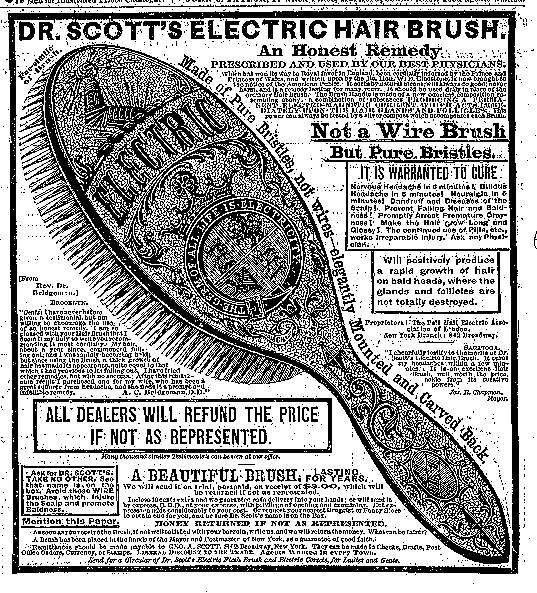
The era of electric medicine began to come to an end by the turn-of-the-20th century. Because neither neurasthenia nor electricity actually exhibited physical changes–only proclamations of change (suggestion is powerful)–skepticism about its power began to emerge in the medical community. We also had new theories about mental illness and the mind as scientific research advanced. Electricity remained a magical force, though, its enigmatic nature and invisible power provoking the imagination to ever more fantastical heights.

Rediscovering Apples

Even though I grew up in a state known for its apples, I’d never really loved an apple until I moved 2,000 miles away—to a place known more for its cheese, beer, and brats, than its delectable fruit. And yet, even though images of apples were plastered all over any mention of Washington state, the apples of my childhood were tasteless, boring, almost cottony in my mouth. 

Oh my god, look at that interior!

Red Delicious, the virtual symbol of the state, was never delicious. It was the apple you got in the school lunch line while desperately wishing you had brought something from home. Or sometimes, even the apple your own mother put in your lunchbox, clearly a sign of aggression. So I never ate them unless forced to by mother who was too busy to notice that they were really terrible. These Washington apples weren’t the fruit of kings as apples once were, but rather the fruit of mediocrity.

The apples I discovered in Wisconsin, however, were altogether different. They weren’t uniformly dark red or bright green or buttery yellow but were mixes of all of those shades and more. They snapped when you bit into them, releasing a shower of juice that the skin could barely contain, rather than sagging and finally giving way under the pressure of your teeth like those so-called Delicious.

My first transcendent apple experience occurred in the fall of 2002. I remember it like other people remember their first kiss. It was called Pink Pearl, though there was nothing pink or pearly about its skin which was a homely yellow-brown. Its flesh was like nothing I had ever experienced before, marbled pink and white like those Pilsbury birthday cake mixes I’d always begged for as a kid. And the taste? The taste literally brought tears to my eyes it was so incredible and unknown to me.

It was also slightly embarrassing, as I was standing in front of the farmers’ booth, surrounded by other shoppers at the farmers market. I had no idea apples could taste like this—that really any
fruit could be that perfumed, sweet-tart, and delicious. And that that fruit could grow in Wisconsin rather than the Apple State.


I’ve since learned that thousands of apple varieties exist around the world. Someday I hope to try them all.

Loving Susan B.

I love Susan B. Anthony. And Elizabeth Cady Stanton…even though I’m probably not supposed to. As a women’s historian, the heroes of women’s suffrage are no longer the heroes of the professional study of women’s history. Studying suffrage is old, something the field has supposedly moved past–or at least that’s how it certainly felt when I was a graduate student. And while it certainly makes some sense as we try not to focus on “great white woman history” as we had for so long with men…it still makes loving Susan B. feel a little illicit.

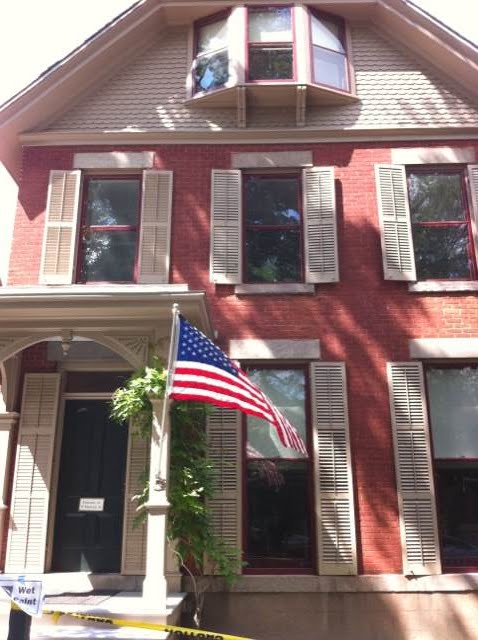
Last week, I visited Susan B. Anthony’s house in Rochester, New York, (fittingly, on the 90th anniversary of the Susan B. Anthony amendment, the 19th) and the week before, Seneca Falls. Both were wonderful, though, I was disappointed that we couldn’t go inside the restored church where the first Women’s Rights Convention was held. Even so, both were magical places. The Seneca Falls convention often gets relegated to a historical footnote when it was, in fact, a truly revolutionary event–for the first time in history, women publicly gathered to proclaim their rights. As a woman–as a person–, I don’t think you can help but be moved by that idea, though, I also think the true enormity of that call to arms at that time is hard to grasp. Women were basically invisible before the law, unable to own property of any kind, vote, to call for a divorce, or even have a say over the fate of their children in case of divorce; only the wealthy were educated. So to say that women had rights was truly shocking and revolutionary for 1848. By the way, historian Gerda Lerner has an excellent essay on the importance of Seneca Falls to women in her book Living With History, Making Social Change.


I’m not sure you can visit Susan B. Anthony’s house and fail to be impressed by her determination. She lived and breathed women’s rights–and I’m so thankful to her.