Defining Home and Region

Where’s home? Is it where you live now or where you’re from? And if you’ve moved, when does your new place transition to “home?”

I’m staring down nearly nine years in Madison, Wisconsin, this summer. I came for school but stayed for… work and friends and then love. And even though I’ve never felt more connected to a place than I do Madison, I still feel surprise when people refer to me as a “Wisconsinite” or a “Madisonian.” Obviously, I’ve made the cut in their minds but for some reason I’m not sure I’ve made it in mine. What I think of as my “formative years” happened somewhere else even if I’m not all that different from the people in my new home.

My husband and I have been talking about the Midwest as a region a lot lately. Where is it? What is it? Who considers themselves part of it, Midwesterners, and who doesn’t? Midwest Living magazine includes Oklahoma in the Midwest but I’d venture to say that many people in Wisconsin wouldn’t consider Oklahoma Midwestern (no offense to those Oklahomans who do). And what about Ohio? It kind of is and isn’t, straddling the line between the Midwest and the East but firmly in the eastern time zone.

I was born in the Midwest and live there again now so does that make me a Midwesterner? Even though I spent two-thirds of my life in the Northwest?

All of these things–home and region–are really choices we each make about where we choose to identify some part of ourselves. For some, not choosing can be a regional identity, too: rootlessness. And maybe that’s my choice right now.

Homeopathy, Alive and Well

Homeopathy is alive and well in its birthplace. On a recent trip to Germany, I was surprised to see so many homeopathic pharmacies and doctors’ offices. But maybe I shouldn’t have been since Germany (and Austria) seems to have given rise to so many alternative medical theories: hydropathy, phrenology, homeopathy, to name a few. 
One of many homeopathic apothecaries

Premade homeopathic remedies for sale in a store window in Lubeck

The area we visited, northwest Germany, seemed filled with all kinds of “alternative” doctors. There were chiropractors, herbalists, naturopaths, and homeopaths around every corner, a concentration I might expect to find in certain areas of the United States that have a hippie-ish reputation like San Francisco, Austin, and Berkeley. We saw them in Hamburg, Lubeck, and Luneborg, cities of very different sizes and characters. Perhaps the German medical system takes a more broadminded view than mainstream American medicine toward their alternative cousins, and perhaps the German people do, too. Seeing so many of these places, I could almost imagine being in the 19th century United States when such a range of medical options was prominent.

Every Dairy State Needs a Queen

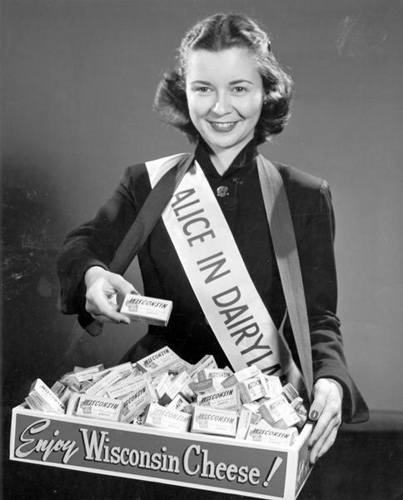
June in Wisconsin means June Dairy Month. That’s right, “America’s Dairyland” has a special month devoted to dairy. It’s perfectly reasonable to think this unnecessary since isn’t every month about dairy in a state that has chosen to label itself as such? Well, no, apparently it’s not enough. We need to have dairy farm breakfasts all over the state, to put cows up by the state capitol, and to have the opportunity to meet Alice in Dairyland, Wisconsin’s dairy royalty.

Alice in Dairyland peddles cheese

I recently recorded an essay for “Wisconsin Life” about Alice, linking these agricultural queens to fertility goddesses of yore (thankfully, I didn’t actually use the word “yore” in my story). Sure, she began as a kind of beauty queen but the role has evolved into more of a marketing job. You can’t just represent dairy anymore–you actually have to work for it.

Talking about Alice at work, a coworker wondered why there’s no male dairy royalty. Perhaps Albert in Dairyland? I wouldn’t want to unseat Alice from her absolute reign so perhaps he could be a consort ala Prince Philip, Duke of Edinburgh?

Genealogy Heist

I shoved a handful of tattered papers and black and white photos in a plastic box. Opening another drawer, I found another stack of papers that I quickly removed and added to my haul. My husband worked the drawers on the other side of the room, quickly and silently unrolling and uncovering treasures lost to time, disinterest, and forgetfulness.

This wasn’t a bank or museum heist. It was a genealogy rescue mission.

It all began innocently enough. I married a man obsessed with his genealogy. We were both soon busily tracing our family’s story, hunting for hints of who we are and where we came from.

I had never known much about my family. Asked to create family trees in elementary school, I managed to produce saplings while my classmates came with sprawling oaks.

Tell me about your grandparents, I’d ask my dad. “I don’t know anything about them. We barely saw them growing up,” he’d say. They were Polish, I knew that, and spoke little, if any English, in their small town south of Chicago. Most of the time, my dad remembered their names.  Sometimes, he forgot that, too.

My mom wasn’t much better. She’d point to an old water-stained photograph in a faded gold frame that used to hang in my grandparents’ garage and now hangs in her dining room and say, “That’s Petronella Wilhelmina Verhoven.” Who’s that? I’d ask. A relative, she’d say, before quickly adding, “but it might not be her and I don’t know how we are related to her.” My mom just liked the photo, whoever she was. Sometimes I would stare into her forlorn eyes under a floppy cap, trying to see a resemblance. Was that my nose, my forehead?

My mom had a habit of finding old photos and proclaiming them relatives. We had an old 1890s velvet album in the living room filled with late 19th and early 20th century studio portraits of baby boys and girls in frilly white gowns reclining on tufted chairs and young women encased in corsets and bustles. The best one to my childhood eyes was of a circus company that included a dog-faced girl, a fat lady, and two tiny Tom Thumb-like people on chairs on front. Who wouldn’t want to be related to them?
So I had little to start with when I began my research, but I made headway quickly thanks to the wonders of the internet. I discovered for the first time that I was fairly equal parts Polish, German, Norwegian, and Swedish. I’ve even managed to find some of the towns where many of my great-greats came from in Europe.

My parents even proved to be helpful in their own way. Once, I found an article in a small Indiana newspaper describing a bicycle accident my great-grandfather Stanley Janik got in when he was 74 years old. It turns out my dad knew more than he had let on all these years about his Polish grandparents. “Oh yeah, that was a big deal. He had to have his leg amputated,” he said when I told him about it.

But despite these kernels of information, my parents were tightfisted with any photos and documents that might aid my research. I’d ask them for any birth certificates or marriage certificates they might have, even their own, and received only vague promises to look. I’m pretty sure I only got my own birth certificate because I needed it to get married. It wasn’t that my parents were interested in genealogy themselves or even knew what they had squirreled away. My offers to scan everything and store it in archival boxes for protection were met with hard stares and vague promises to scan everything and send it to me.

Which is what led us to thievery. Visiting my parents one weekend, my husband and I took advantage of their absence to take as many photos and documents as we could and ship them to our home in Wisconsin. I knew my parents would probably never notice they were gone.  Even so, I felt a little guilty.

But it somehow didn’t seem so bad when I considered that these things belonged to me, too. This was my family and my history, the place where I come from and the people that made my life possible. I wasn’t just stealing; I was reclaiming my history and honoring the lives of my ancestors by choosing to remember them rather than purchasing members of other people’s families.

Maybe it’s just an excuse, a concocted justification for my actions, but all I know is that it sure feels good to finally have a family tree with spreading limbs rather than a stunted sapling.


Medical Poetry

A few months ago, I published my first poem. Co-authored, I should say, with my creative husband. It was a medical poem, and it was published not in some literary magazine but in the journal Neurology. That’s right, a medical journal with a humanities section.

Medical poetry has a long history, it turns out (and I’m not talking about the poetic musings of patients on their illnesses and suffering, though that probably has an even longer history). In the 19th century, a botanical medical movement known as Thomsonianism, after its founder Samuel Thomson, created a vast library of medical poetry related to their beliefs. Unlike most 19th century poetry which was penned by women, the majority of Thomsonian poems were composed by men for medical purposes rather than for any moral or ethical objectives. Some poems provided medical instruction, teaching people how to monitor sickness and to administer medicines.

Samuel Thomson himself, the movement’s founder, wrote many poems decrying the professionalization of medicine and the pretensions of the university educated. Thomson believed that every man could be his own physician and sought to demystify medicine by making it easy to understand and use. He advocated for natural remedies made of plants, roots, and barks, rather than the mineral and chemical-based medicines used by regular doctors. Disease for Thomson was caused by a lack of heat that needed to be restored through scrubbing and warming agents. Thomson’s poems reflected his democratic leanings, carrying anti-elitist messages and simplified explanations of his medical system.

Thomson and his followers wrote poems that stretched from the epic to the patriotic, satirical, and romantic. Most contained some element of ridicule aimed at regular doctors, gaining friends and followers through wit and calculated reason.

Here’s an 1840 poem written by Thomson that captures the significance of heat and the numbered system in his course of remedies.

ODE ON HEALTH
If you desire a length of days,
Then follow Wisdom’s pleasant ways:
Beware you shun the tempting lures
Of poisonous bait and death.
Health is a blessing all must prize,
True wealth in it, tho’ hidden lies,
We must beware of quack’ry’s cries,
Or else resign our breath.
Our nature’s may be understood,–
The wise, the blest, the truly good,
Have all combined to ease life’s load
Of poisons, kin to earth.
Shall laws make inroads on our peace?
Shall crafty Doctors never cease?
Shall stern oppression mar our ease?
Oh, no! we’ve rights by birth.
Is heat the friend of life in man?–
Then Thomson’s is the wisest plan
To lengthen out life’s feeble span,
And walk in nature’s truth.
If numbers, one to six be used,
Nor natural sent’nels be abused;
Then health with you shall ne’er be loos’d,
While heat you hold enough.

I’m not sure our poem was witty or as mission-driven as the Thomsonian works. But it’s still nice to know that poetry has long had a place at the bedside.

Showing Laura Ingalls Wilder Around

I really loved Laura Ingalls Wilder when I was growing up.  I used to imagine that she came to visit the late 20th century and I was charged with showing her around. Why she would want or even need to be shown my particular slice of the century–the outskirts of Redmond, the height of gentrifying Northwestern suburbia, with your tour guide, a book-aholic only-child with an already well-developed affinity for public broadcasting and history books (my grandma always said I was “born old,” like George Bailey in It’s a Wonderful Life. It only reinforces the point that I knew that reference even as a 10 year old)–was unimportant. All that mattered was that I loved Laura’s life and her story so I liked to imagine what would happen if she was dropped into my world like I was in hers through her stories.

Laura! Welcome to Redmond!

First stop, television. Then the car. If we were lucky, I might have been able to convince my dad to drive us to the airport. “Remember all those long weeks in your wagon moving to a new place?” I’d say.  I played “Oregon Trail.” I knew the dangers of wagon travel: people were always falling out and drowning, or getting bit by snakes. “We have flying wagons now. You’d be on the banks of Plum Creek in no time.”

I also imagined myself in her world. The dugout house in Minnesota held particular appeal. I couldn’t believe people could actually live in a hillside with walls made of dirt. I once tried to dig my own house in the side of a mound of topsoil my parents got to build flower beds. Let’s just say it didn’t quite work out.

I had a very vivid historical imagination.

In grad school, I met a woman from Japan who chose the University of Wisconsin history program, in part, because of its relative nearness to Pepin, Wisconsin, aka Little House in the Big Woods. She told me that people in Japan loved Laura and they especially loved the 1970s and 1980s television show. When she told her parents she had chosen Wisconsin for school, the only thing they knew about Wisconsin was that Laura Ingalls Wilder had lived here. A good enough reason as any for choosing a school, right? Once, my friend even dressed up as Laura and went to the Laura Ingalls Wilder festival in Pepin. She was concerned that she might look foolish–a Japanese woman in her 30s wearing braids and a bonnet–but instead she found people who loved Laura just as much as she did.

There’s just something about Laura Ingalls Wilder. Wendy McClure has even written a book about the enduring appeal of Laura called  The Wilder Life.

Despite all the love for Laura, I’m probably the only one who saw herself as Laura’s tour guide to the future.

Hydropathy in the Family

I drink a lot of water every day. And I walk a lot, everywhere in fact, many, many, many miles a day. So when I first started reading about hydropathy, I could easily see myself fitting right in with the hydropaths. They instructed patients to drink at least 12 glasses of water (actually “tumblers”) a day and to walk as far as possible between treatments. One guy, James Wilson, took the advice to drink a lot of water a little overboard–he drank more than thirty glasses before breakfast while staying at the original hydropathy institute in Grafenberg, Germany. When he started his own water cure in England, he gave everyone glasses so they could follow his lead.

As it turns out, I’m not the only one with hydropathic sympathies in the family. On a recent trip to visit my parents, I discovered that my great-grandmother graduated from the Kellberg Institute for Hygiene, Massage, and Medical Gymnastics in Chicago with a specialty in water-therapeutics. She was a 20th century hydropath! No wonder I love all this medical history!

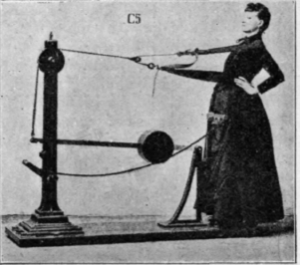
Medical gymnastics is what we would think of as just exercising today. It was the use of physical exercise as a therapy to restore or stay healthy. The medical and health benefits of exercising don’t need to be justified today, but until the 20th century, many people were not sure that exercise wasn’t harmful, especially to women.

From my very limited initial research, it appears that the Kellberg Institute was founded by Swedish immigrants (my great-grandmother was also a Swedish immigrant to Chicago). This makes sense as the Swedes had been particularly interested in the use of gymnastics for health since the early 19th century. They used gymnastics to improve the physical fitness of the general public in schools, in the military and as a medical healing process. 

Medical gymnastics in action


Per Henrik Ling developed the Swedish gymnastic system in the early 19th century. He was a fencing master, and with his son Hjalmer, he developed a program of functional physical gymnastics training. They founded the Central Gymnastic Institute in Stockholm in 1813 to provide training for teachers and members of the military. Ling’s Swedish gymnastics programs had four parts: medical, aesthetic, military and pedagogic. Training involved the correct performance of prescribed gymnastic movements under the watchful eye of a trainer.


Other European countries followed Sweden’s lead and instituted gymnastics programs to aid physical healing and to promote health from the early 19th century onward. This was likely the program taught at the Kellberg Institute to graduates like my great-grandmother.  


By the 20th century, hydropathy in its original form had virtually disappeared, morphed into an overall system of hygiene and exercise that would be quite recognizable as the keys to good health today: exercise, a sensible diet, plenty of sleep, and lots of water. 


Micronations

The 2010 documentary “How to Start Your Own Country” explores what happens when people decide to declare their little piece of the earth (or in the case of The Principality of Sealand, a platform six miles off the coast of Britain) an independent country. The film raises fascinating questions about what makes a country a country, a question you may have never thought to ask (I hadn’t). What’s perhaps most surprising is that even the United Nations doesn’t have a clear idea of what constitutes a legitimate country–they can’t even say for certain how many countries there are in the world: who considers what legitimate is highly variable it turns out. The Czech Republic, for example, doesn’t recognize Lichtenstein as a country and yet Lichtenstein is a member of the U.N. so does that make it a country or not?


The film made me think of my longstanding interest in utopias. Most utopias are communities, not countries. I wonder why someone chooses a community rather than a country to make the world anew? Sure, it’s easier to start a utopian community. You don’t have to print new money or establish any of the other public services and supports like a telephone system, post office, or financial system. But it’s also harder to subvert the existing social, cultural, and economic order, which many utopias, especially in the 19th century sought to do. It’s hard to break free of something you are dependent on, which must be part of the great appeal of micronations.


I was pleased to learn that Wisconsin has a micronation. It’s called Talossa and it’s located in Milwaukee. This isn’t Wisconsin’s first micronation, though.


In 1847, a breakaway Mormon leader named James Strang established a kingdom with himself as ruler (of course) on Beaver Island in Lake Michigan. This was in the years before the Latter Day Saints had moved to Utah. After the death of Mormon founder Joseph Smith in 1844, Strang produced a document (that he forged) claiming that he had been selected by Smith to be his successor. The community split on the question of who to follow: Strang or Brigham Young. The majority followed Young but a group took Strang’s word for it and followed him to Wisconsin. They first founded a colony called Voree near Burlington, Wisconsin, and later established a kingdom on Beaver Island. It was there, on July 8, 1850, that Strang had himself crowned king, the only man in American history to have achieved that title. 


Attacks and in-fighting doomed Strang’s kingdom, however, and Strang himself was assassinated in 1856. The community soon broke up, ending an early chapter in Wisconsin micronation history. 

Bloomers and the Water Cure

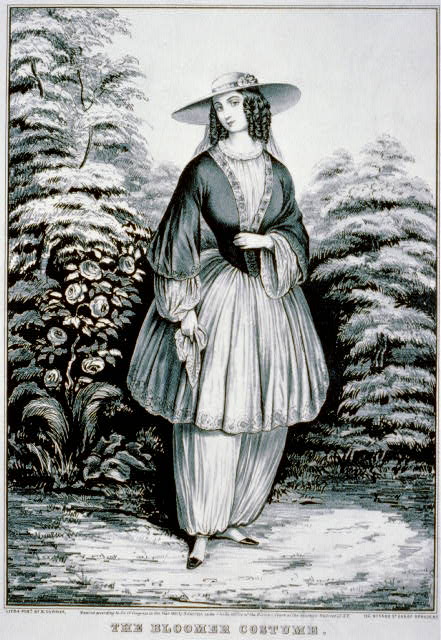
Amelia Bloomer is a name that many people who study women’s history even a little bit tend to know. She’s the namesake of “bloomers,” a style of dress that became popular among women’s rights advocates and dress reformers in the 19th century. Bloomer, the woman, didn’t invent the costume, but she was an early and ardent advocate of them and as a result, gave her name to the style. Bloomers consisted of a loosely fitting coat or dress that reached below the knees and a pair of billowing pants similar to Turkish trousers (picture MC Hammer or the Disney-fied Aladdin) gathered at the ankles.

Although widely associated with women’s rights, bloomers were actually one of the treatment outfits for those taking a water cure. Hydropathy, as the water-cure system, was known was a popular form of medical therapy in the United States from the 1820s to the 1860s. The basic idea was that cold water was pure and clean and could therefore cure just about any disease. People “took” water in any number of ways but the most common was a wet sheet that would be wrapped around a patient for several hours until he or she sweated. An alternative to the sheet was a wet dress, which was introduced at a hydropathic institute and later became the model of the bloomer costume. Women who took the water cure often sometimes cut their hair short for easy drying and felt themselves free from the prevailing and restrictive women’s fashion.

The wet dress was introduced to the fashion world by Elizabeth Smith who displayed her fashion to women’s rights leader Elizabeth Cady Stanton. Amelia Bloomer discovered it when Stanton came for a visit and she soon began writing about it enthusiastically in her magazine, The Lily. Articles on the bloomer trend were soon picked up by other publications and it came to be dubbed “bloomers” for Bloomer’s advocacy of it for women. Bloomer herself along with other wearers of bloomers suffered merciless ridicule for their fashion choice.

The bloomers adoption by the women’s rights movement also damaged its reputation among hydropaths. Bloomers came to be associated with female radicalism and its followers were suspected of free love and of a desire to be free of all feminine graces.

Amelia Bloomer mostly abandoned the bloomer in 1859 but she continued to fight for women’s rights and for more sensible, less restrictive clothing for women for the rest of her life.

Hair of the Dog

Having a morning drink after a night of too much drinking is one cure for a hangover. Although it’s unlikely that “hair of the dog” works, the idea of treating yourself with what caused the problem in the first place is a homeopathic idea.

One of the primary tenets of homeopathy is that like cures like. The right treatment for an illness is the treatment that produces the same symptoms in a healthy person. So if you have a headache, whatever herb or drug causes a similar headache in a normal person is the right treatment. This idea forms the foundation of homeopathy.

Homeopathy was an extremely popular medical movement in the 19th century, rivaling orthodox medicine for supremacy. A big part of its appeal was its simplicity–you could buy a homeopathy kit that would help you match symptoms to treatment–and the minimal pain inflicted by its therapies.

At the time, many doctors and patients believed that a drug needed to cause a lot of pain to be effective. How else were you to know that it was working if you weren’t bleeding or passing out? Homeopathists proposed an alternative: that drugs don’t have to hurt to work. Homeopathists treated patients with very small doses of medicine diluted at least 30 (and often many more) times. While many critics derided the use of small doses, claiming that they could never treat anyone, homeopathists at least knew that they were causing no more harm. The same could certainly not be said of regular doctors and their regimen of bleeding, puking, blistering, and sweating.

Homeopathy also claimed some successes in treating people during cholera epidemics in 1832 and 1849, leading many regular doctors to defect to homeopathy. Cholera sufferers got small doses of camphor and were urged to seek out clean air and water. While homeopathy may have done little to cure these people, they also didn’t cause more pain to people already suffering as bleeding, blistering, and sweating likely did.

Homeopathy fell out of mainstream favor in the 20th century, but some of its ideas live on in things like “hair of the dog.” Homeopathists didn’t invent or even endorse the idea of treating a hangover with alcohol, but the idea of like curing like is imbedded in that urban myth. Homeopathy also changed our view of what medicine is supposed to feel like. Today, we look for drugs with few side effects, not the painful, visible signs of treatment from the past.