Lefse in the Family

“It just isn’t Christmas without lefse.” It’s a phrase I’ve been known to say many times over the years as I eagerly tear into the foil wrapped package of lefse sent express from my grandma’s kitchen in Illinois to my childhood home near Seattle.

Growing up, the tortilla-like Norwegian flatbread (often made with potatoes, especially in Scandinavian-American communities, but not necessarily in Scandinavia itself) was a special treat – even if my uncle often compared it to a cloth napkin in flavor and texture. He just didn’t get it.

Like her Norwegian ancestors, my grandmother usually makes lefse once, maybe twice, a year, freezing small packets of lefse to last throughout the year. Truth be told, lefse making is chaos incarnate, which perhaps explains why a year’s supply is made in one fell swoop. The sticky, gummy dough sticks like library paste to the grooved rolling pin and counter tops, while a thin layer of flour covers every horizontal surface in addition to your face, hair, clothes, and the inside of your eyelids.

The dough is no match for my grandmother, though, whose slight frame masks a fierce rolling skill. The dough quickly becomes thin enough to “read the newspaper through,” her constant refrain as she rolls and watches my feeble attempts to match her dexterity. Good lefse requires careful discernment of the right amount of flour, the proper temperature of the griddle or pan, and the perfect temperature of the dough, neither too warm nor too cold.

I helped her some years, though I may have messed it up more than I helped. The grilling is one area that I’ve managed to master with aplomb, lifting the dough in one swift swoop of my sword-like stick, laying down the edge, and rolling it out quickly so it lies flat on the round lefse griddle. Thirty seconds or so later, the lefse needs to be flipped. Timing is everything in achieving the perfect balance of knobby brown flecks and bubbles on the pale rounds. A whole batch can take all day.

Moving to Wisconsin, I was shocked to learn you can buy lefse in the grocery store – nearly all of them in Madison have at least one brand. As with all things, though, homemade – grandma-made -is best.

It turns out lefse skill runs in my family. While scanning some newspaper articles my grandma had saved, I found an article in a Minnesota paper featuring my great-grandmother and her lefse recipe. It turns out, according to the article, that she, too, didn’t think it was “Christmas without lefse.”

My great-grandmother, Anne Anderson, lefse superstar
 

Cooking up the Past

Lifting weights had not prepared me for the strain of beating eggs to stiff peaks with a hand crank beater. Turning and turning and turning, switching arms every few minutes, until the translucent whites began to froth and then, finally, turn to a foamy mass, a moment my husband and I feared might never come. Making breakfast 19th century-style is hard work.

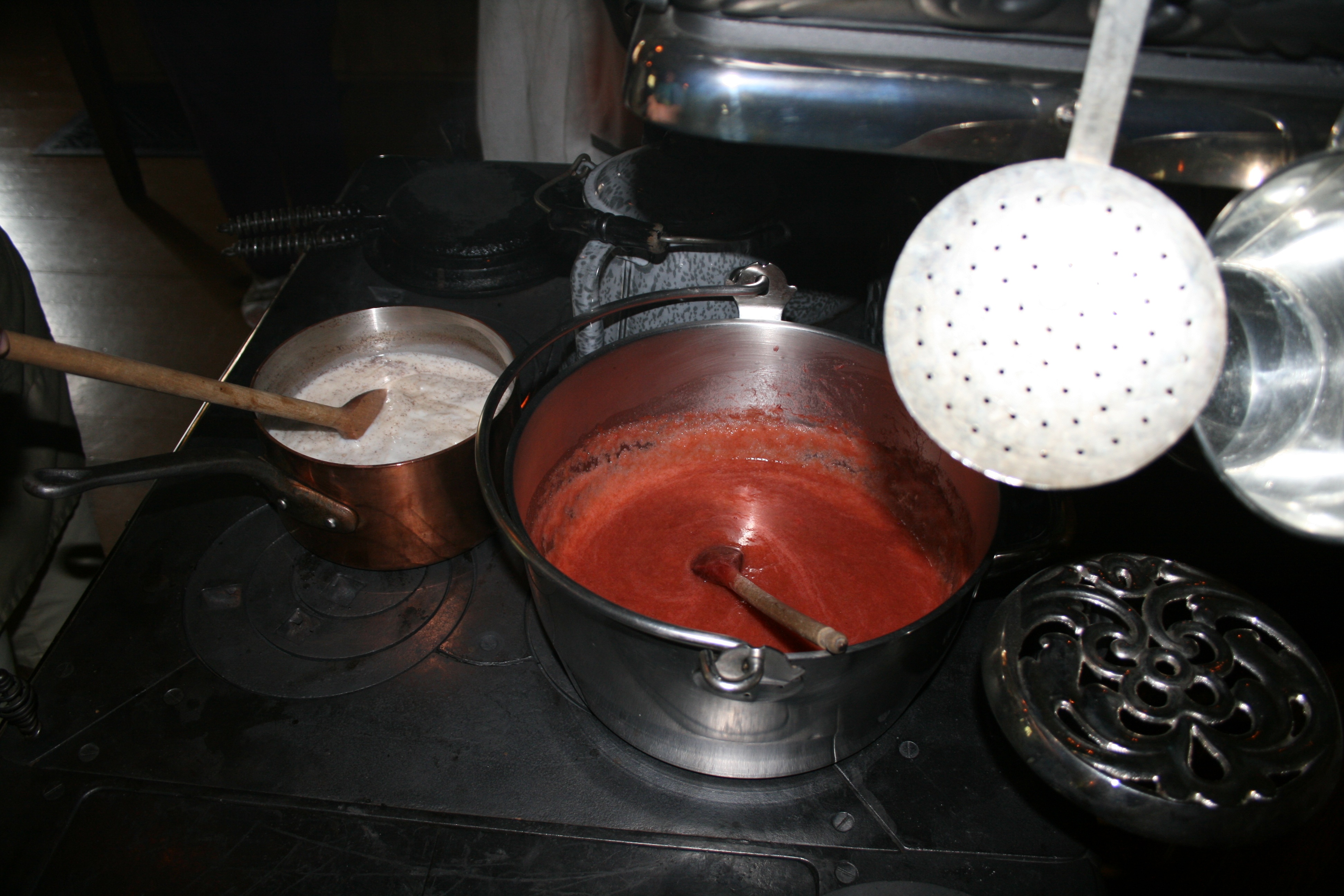
A few Junes ago, we participated in the Breakfast in a Victorian Kitchen program at the Villa Louis estate in Prairie du Chien, Wisconsin. The meal takes you inside the lives of the prosperous Dousman family – or rather the lives of the family’s servants. You don’t just eat the foods of the past – you roll up your sleeves to prepare them using the tools, recipes, and technology of the time. That means hand-crank eggbeaters, wood stoves, and recipes a bit less instructive and a lot more intuitive than today. The jelly omelet team had it far worse than us, though, beating two-dozen eggs, yolks and whites separated, for an hour.

Arriving around 8:30AM, we were quickly divided into teams to take on various tasks. The breakfast menu changes with the seasons, and that June day’s menu included fresh strawberries, bacon fried with sweet peppers, rice waffles served with strawberry-rhubarb sauce, fried Mississippi catfish, a thin bread called Wisconsin cake, and coffee. Some teams worked in the steamy outdoor preserve kitchen, while the rest cooked in the main kitchen with its dim gas lighting and imposing, ornate cast iron wood stove.

Laughter soon filled the kitchen as everyone struggled to complete their assignments. Anxious choruses of “I’m not sure we picked the right job” echoed around the room, followed by encouraging words from fellow participants. You’re never completely on your own, though. The Villa Louis kitchen staff are there to answer questions and to lend a hand to avert a cooking disaster.

About two hours later, breakfast was finally ready. My stomach grumbled fiercely after all this hard work. Everyone sat down to eat at two communal tables adorned with jars of flowers and herbs freshly picked from the grounds in the mansion’s kitchen. Our Wisconsin cakes, which seemed like a sure disaster during the egg beating and mixing process, turned out pretty well, as did everything else that made it to the table. Surveying the breakfast feast before us, all of that hard work definitely paid off: new experiences and a renewed appreciation for electric mixers.

Chinese Apples

Regionalisms, like regional foods, are everywhere. Even in our constantly connected and commercialized world, linguistic variations persist in communities around the country. There’s something heartening to me about the idea of the persistence of language idiosyncrasies in the face of so many leveling forces.

Last week, I learned a few new ones while visiting New York, Connecticut, Rhode Island, and Massachusetts. Speaking at the New York Public Library about my new book Apple: A Global History, a woman asked me why pomegranates are sometimes called “Chinese apples.” Beats me. I’d never heard that before! It turns out it’s a regionalism, fairly specific to the New York City/New Jersey area. It turns out the Chinese apple = pomegranate lobby even has a Facebook group devoted to it. Pomegranates are from Asia originally so that’s probably where the name originated, but that name didn’t seem to spread outside the northeast.

A few more, though, not necessarily food – or even apple – related:

  • What I call a roundabout or a traffic circle (perhaps I’m unsure myself) is a “rotary” in Massachusetts
  • Water fountains are supposedly “bubblers” in Massachusetts, just as they are in Wisconsin, though I never heard anyone reference this
  • Hero is a sandwich in New York City
  • A milkshake is a “cabinet” in Rhode Island and a frappe in Massachusetts (wish I’d had one but my desire to try things outmatches the number of meals in the day and room in my stomach)

What other food-related regionalisms do you know? Any other apple-related ones?


Dead People’s Houses

I love to haunt the homes of the dead, especially those of the famous and notable. Now before you think me profane, let me explain.

For as long as I can remember, I’ve loved visiting historic homes. Family vacations always involved at least one stop at a house museum and more likely, several. I can honestly say I’ve been in hundreds of historic homes, from General Ulysses S. Grant’s house in Galena, Illinois, and Rutherford B. Hayes’s home in Fremont, Ohio, to the homes of Susan B. Anthony, Harry Truman, Elizabeth Cady Stanton, and lesser figures who just happened to have beautiful old homes in states across the country. I thrilled at walking the same floors as President James Monroe, and tried to imagine the lives of the people who lived in these spaces decades and even centuries ago. It made history seem real and tangible (it’s the historic corollary to celebrity magazines that show celebrities doing normal things like grocery shopping. Thomas Jefferson sleeps in a bed, just like me!) and is probably largely responsible for my love of history today.

Cut to a few years ago when I met my now husband. “You want to visit a dead person’s house for what reason?” he asked. “You know they’re dead, right?”

The question left me speechless. “Of course I know that,” I snapped. “But aren’t you curious how they lived? Where they lived? Some of these homes are just so beautiful.”

He still hasn’t come around to my view. But he’s happy to come along and wait outside while I continue my tour of the homes of dead people in American history.

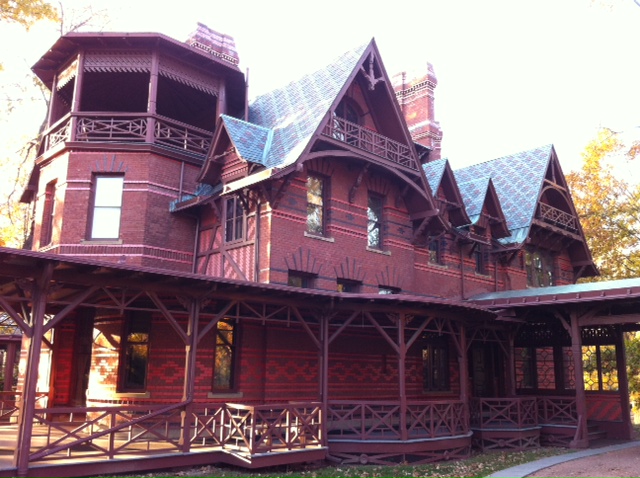
Mark Twain's house in Hartford, CT - the latest stop on my tour of dead people's homes


Apples on the Radio

Apples are on the minds of the folks at the public radio program “To the Best of Our Knowledge” where I recently spoke with Anne Strainchamps about the history of apples.

Check out the story of the Rambo apple on “Wisconsin Life,” too.

Ultimate Hitchhikers

Last week, I had the great honor of having my apple book excerpted on Salon.com. They took a portion of the first chapter, which explores how apples made it from Kazakhstan to your backyard (or somewhere near it at least). It’s a pretty neat trick.

Apples are perhaps the world’s greatest hitchhikers, seducing you to pull over with a flash of their sweet and delicious flesh. They stole a ride in your bag or rode along in the stomach of your horse, traveling dozens of miles by dint of their captivating taste and aroma.

They don’t just travel well.  Apples also tend to make themselves at home almost anywhere, insinuating themselves into the local culture and never leaving. It’s why we think of apples as very American fruit despite their origins in a place about as far away as you can imagine.

Apples produce offspring that can vary quite dramatically from their parents. Each seed contains the genetic material for a whole other kind of apple that can taste and look radically different than the parent fruit. Every apple has several seeds and every tree has hundreds of apples so one of these seeds is bound to have the street smarts to survive in their new home.

Thankfully for us and the fruit, apples taste pretty good so we don’t mind that they tend to stick around uninvited.

Throwing Stones

On Monday night, I went curling for the first time. Too concerned about falling and knocking myself out on the ice (a very real possibility), I didn’t manage to get any photos of the event. But that’s probably a good thing – it wouldn’t have been a pretty sight.

Curling has a long history in Wisconsin. In fact, the oldest continuously operating curling club in the country is in Milwaukee where they’ve been curling since 1846. Wisconsinites curled on rivers and lakes, anywhere they could find some solid ice to throw stones. While curling is solidly associated with Scotland, it may have actually originated in the Netherlands. Paintings from the mid-14th century show Dutch curlers. The game soon traveled to Scotland, though, where it became a national pastime. Scottish immigrants brought their love of the game with them to North America.

Americans often curled with wooden stones because wood was accessible and affordable. These stones varied in size, shape, and weight. A movement to standardize the game didn’t come until the 20th century.

Curling is a surprisingly challenging sport: something I hadn’t quite appreciated while watching it on TV during the Olympics. A slider fits on over your left shoe (if you’re right handed like me, that is) while your right foot slides back into a “hack” that’s kind of like the starting posts on a track. The basic movement is a long, low lunge with your left knee bent up and your right trailing behind as you push yourself forward on the ice, attempting to simultaneously aim your stone and not kill yourself. It’s a thigh burner and a real balancing act. Sweeping is a lot of fun, though, also requires serious coordination as you run down the ice alongside the stone sweeping, sweeping, sweeping fast and hard.

I left the curling open house with a new appreciation of this centuries old sport. I was also reminded of this charming booklet, the Annual of the Grand National Curling Club of America, 1880, detailing the matches of the 1878 – 1879 curling season that I’d run across years ago at the Wisconsin Historical Society. There’s much talk of “hardy men” braving the harsh winter weather to curl and the sumptuous meals served afterward to renew their strength.

Cider for Dinner

If you think all hard ciders are the same, it’s time to start drinking. Cider (assume I mean hard when I say it) exists in as infinite number of varieties as there are apples in the world. And that’s not even mentioning the countless ways the juice of apples can be distilled and fermented. Technique and ingredients, like in all foods, really matters.

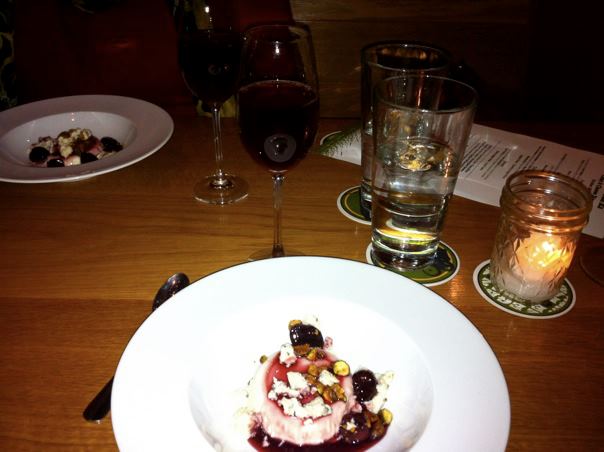
I recently went to a cider and cheese dinner at Graze.  Each course was paired with a cider from Wisconsin’s AeppelTreow. We had everything from a sparkling perry to start, to a draft cider and a berry – apple cider mix for dessert. Each was uniquely different and complimented our meal perfectly.

Dessert course with matched cider

Cider is often made from cider apples – apples specially suited to making cider just as some apples are best for baking. These aren’t the types of apples you find in the grocery store. And that’s probably a good thing since they can be high in tannins and acids that make them rather unpalatable to eat out of hand. But they are perfect for cider.

Most cider is made from a combination of apples expertly blended to yield a balanced mix of sugars, acids, and tannins. Tannins gives the cider its color; the more tannin, the deeper the golden brown. It also gives cider its dryness, the same dryness often found in red wines. The wrong blend of these elements can result an undrinkable cider. While most cider contains a blend of apple varieties, there’s one apple that is often sold as a single varietal: Kingston Black. It’s said to be the rare, perfectly balanced cider apple.

Cider tends to reflect the country of its origin. French ciders, for instance, tend to be light and bubbly like another French specialty, champagne. Local tastes become integral to the cider making process and the cider that is produced.

As much as I love cider, my favorite cider of the night was actually not an apple cider at all – it was the perry, or pear cider. In Europe, cidermakers traditionally made ciders from both apples and pears. This hasn’t been as true in the United States, where cider and perry tend to come from separate makers.  But as cider becomes more popular, I’m holding out hope that pears and apples will be united in alcoholic glory again.


Lutefisk Season

LutefiskFall is lutefisk time in the Midwest. Lutefisk is dried cod that has been rehydrated in a lye solution and then boiled or baked. The finished fish, served with butter, salt, and pepper, has the consistency and jiggly-ness of Jell-O. Needless to say, it’s an acquired taste.

Every fall, churches throughout the Upper Midwest hold special lutefisk dinners where Norwegian – Americans (though not exclusively – these dinners attract a wide fan base) get in touch with their heritage. In some families, lutefisk even takes the place of the holiday turkey. Fortunately, most of these dinners also include meatballs, mashed potatoes, lefse (the best part if you ask me), and salad for the lutefisk averse.

Norwegians probably didn’t invent lutefisk but they certainly have a long history of making and eating it. Various stories and legends tell of Vikings Salting and drying fish was an efficient way to preserve food, and many Scandinavians brought their lutefisk with them to America when they emigrated.

Today, nostalgia plays a big role in the annual lutefisk dinner. More lutefisk is probably eaten in Wisconsin and Minnesota than in Scandinavia where most people have moved on from the gelatinous fish. But it plays an important role in Midwestern culture, both as an emblem and connection to a past shared by many of this region’s first European immigrants and as a social and community event.

I know I’ll be there.

Apple Cures

Thomson's Home Healing Guide

American physician Samuel Thomson was a big fan of apples. The founder of his own 19th century medical system, a method of natural, botanic remedies known as Thomsonianism, Thomson prescribed apples for stomach aches and advised mixing emetics with cider for those who needed a little something sweet to help the medicine go down. His medical journal, the Thomsonian Recorder, included articles on planting and tending apple orchards. For cholera, though, apples should be avoided at all costs warned Thomson.

Apples have long played a role in medicine. Even when people wouldn’t eat the raw fruit, they were more than willing rub some apple pulp on their skin or to swallow a tincture containing apples. Apples were prescribed for disturbances of the bowels, lungs, and nervous systems in 12th century Italy. In the 14th century, apple cures often called for apples cooked with sugar and spice, a kind of medical apple pie. Seventeenth century English doctors advised cider for depression, though it may have been the alcohol rather than the healing power of apples that did the cheering.

Thomson likely championed apples because they were natural, not to mention easily accessible to most Americans. Nearly everyone had an orchard in the yard. They also had a long history in medicine. Thomson’s ideas of the healing power of plants and herbs weren’t necessarily new – but he managed to capitalize them so successfully as to present the first serious challenge to regular medicine in the 19th century.