A History of the Apple in 10 Objects: Seeds

apple seeds
Source: Aka

I know what you’re thinking – “seeds aren’t made by humans! This isn’t an object as defined by the rules of this game!” Yes, yes, I know. But we’re looking at seeds to talk about something humans do to (deliciously) interfere with the reproduction of apples: grafting.

Apples, like humans, produce offspring that can be radically different from the parent plants. They are heterozygous. This means that left alone, an apple tree will produce hundred of seedlings each a little (or a lot) different than the other. This genetic diversity allowed the apple to spread through the temperate regions of the world since at least one of those seeds had what it took to survive in new conditions. The only way to ensure that you get the same type of apple is by grafting.

Humans have been grafting plants for thousands of years, and apples may have been one of the first grafted fruits. To graft a plant, growers attach the root of one tree to the shoot of the desired fruit to clone it. It’s the only way to get reliable apple quality and consistent fruit.

The Persians, Greeks, and Romans each used grafting to produce favorite apple varieties. The Romans had at least twenty-four cultivated apple varieties, one of which, the Lady Apple, is still commonly grown and is one of the oldest known fruit varieties. It isn’t often you can get a real taste of the past, particularly one that dates back to ancient Rome.

History of the Apple in 10 Objects: Medicine Jar

Medical vase c. 1515 for storing herbs, roots, syrups, pills, ointments, and sweetmeats.
Source: Victoria and Albert Museum

Apples are good to eat and drink – but they could also heal. Long before we thought that “an apple a day kept the doctor away” (a relatively recent development), doctors and other healers used the fruit medicinally. A 14th century Italian medical book mentions that apples cure more effectively when served hot and sprinkled with sugar and other spices (medicinal apple pie, if you ask me). These roasted or baked apples were thought to ease digestion after a big meal. If you needed an excuse to eat pie, now you have an ancient medical justification for its benefits.

Cooked apples could also be found in the Arab pharmacopeia. Some of the first recipes for fruit pastes, sweets, and jams involving apples came from medical books not cookbooks. People in the Middle East pioneered the growing and refining of sugar on a large scale and more often used this sugar as medicine rather than as a tasty sweetener.

Raw apples also had their benefits. The fibrous apples kept English monks regular in the 14th and 15th centuries, and some believed that an apple at the start of the meal stimulated the stomach and heart. Eaten at the end of the meal, apples gave teeth a fairly good clean. While certainly not a substitute for a toothbrush, in the Middle Ages, this was pretty advanced preventative dentistry.

Apple pulp provided a vehicle for many medicines in the medieval pharmacy. Apple-based medicines were applied to the skin and some apples also appeared on ingredient lists for beauty products. The origin of the word pomade, the waxy substance used to style hair, traces its name to apple pulp.


History of the Apple in 10 Objects: Cider Press

Cider press in Madley, Herefordshire, UK
Source: mira66

Apples taste delicious. But they make an even better drink. Squish them up, enough to release the juice, and they quickly turn into a bubbly fermenting brew. Humans have made alcoholic apple cider for hundreds of years. It was thought to be a nutritious and healthful beverage as well as a good way to preserve what could otherwise be an overwhelming apple harvest. Cider was also one step on the path to cider vinegar, a fantastic preservative for foods for the winter months.

In Britain, nearly every farm had a few apple trees for eating and drinking. This tradition came to North America with the colonists where cider served as an important medium of exchange. Colonists paid for school and goods with barrels of cider. Everyone – children, too – drank cider.


History of the Apple in 10 Objects: Bronze Horse

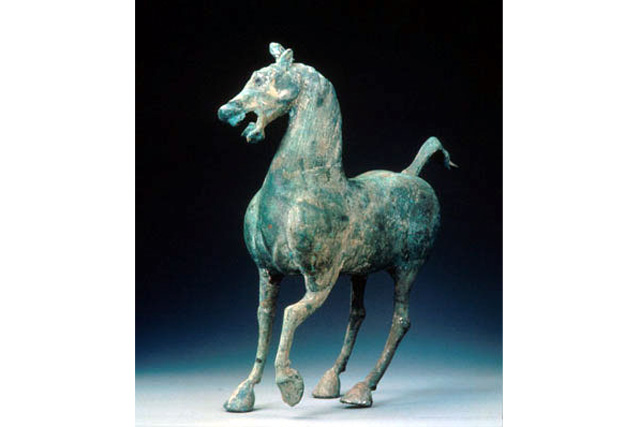
Bronze figure of a horse, Eastern Han dynasty, 2nd century C.E., Excavated from a tomb in Letai, Wuwei county, Gansu, H. 36.5 cm., Gansu Provincial Museum. Source: Asia Society

Born in the mountains of Kazakhstan, the apple hitched a ride to the rest of the world in the packs of humans and stomachs of animals traveling on the Silk Road. Humans picked up the delicious fruit to eat along the way, dropping the cores that house the seeds and all future apples.

But animals are an essential part of the story of the Silk Road. Horses, among other animals, played a key role, providing both milk for local use and transportation for the development of international relations and trade. The clever apple evolved to have smooth, tear-dropped shaped seeds perfectly proportioned to pass intact through the intestinal tract of a horse. In the belly of a horse, an apple could travel 40 or 50 miles a day, gaining tremendous ground in its takeover of the temperate world.

An Object History of Apples

In 2010, 100 curators from the British Museum unveiled a massive project to tell the history of the world through objects – 100 objects to be exact. The results were unveiled on BBC Radio 4 first before becoming a fantastic book, A History of the World in 100 Objects. 

It’s such a fascinating idea and such a perfect medium for telling historical stories since so much of what we think of as “history” is ephemeral – events we can’t see for ourselves, people we can’t really imagine as real people, dates that seem so long ago that we can’t even imagine them.

Because I love this idea so much – and because it is September (even though I really just can’t believe it – the changing leaves tell me it must be true) and apple season – I’m going to tell do my own, slightly pared down version: the history of apples in 10 objects, based on my book, Apple: A Global History.

The fun begins tomorrow.

Hitch-boating in Sweden

I’m sure my mom told me never to hitchhike. Or if she didn’t, I’m sure she meant to or hoped that I would understand that hitchhiking fell squarely under the “don’t talk to strangers” category. Don’t talk to them and certainly don’t ever get in their car.

All of these thoughts passed through my head as I stuck my thumb out for the first time, caution overcome by the reality that we were really freakin’ far from where we needed to be. In an hour. To catch a boat. To an island where our luggage sat waiting in our room for the night.

In The Innocents Abroad, Mark Twain wrote that “Travel is fatal to prejudice, bigotry, and narrow-mindedness, and many of our people need it sorely on these accounts. Broad, wholesome, charitable views of men and things cannot be acquired by vegetating in one little corner of the earth all one’s lifetime.” I sure hoped Twain was right about those “charitable” and “wholesome” men.

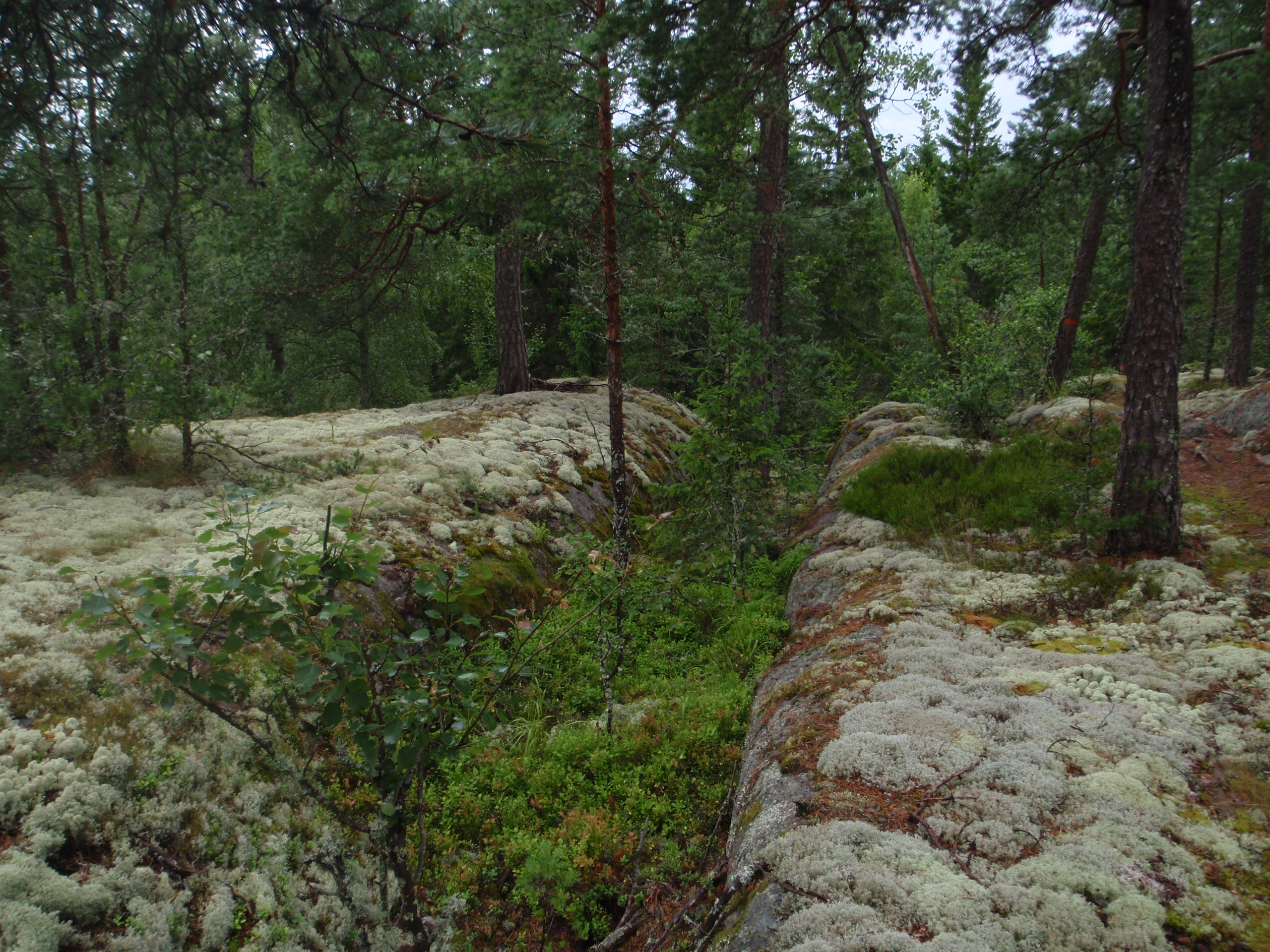
That morning, my husband and I had set out on a hike along a section of one of Sweden’s most popular and longest hiking trails, Sörmlandsleden. Marked by orange dots, arrows, and rings, the trail covers 1000 kilometers through woods, bogs, fields, and past lakes and streams. The plan was to do about 15km along the path, ending at the boat launch to Savo Island.

The day began rainy and gray but the lush green landscape and blueberry-lined path helped to make up for the extreme sogginess I felt from the waist down. We soon learned we weren’t alone on the path – swarms of mosquitoes trailed behind us, a mass of swirling insects whining in our ears and landing swiftly on any exposed skin if we paused for even a second. So we kept moving, enjoying as much as we could but also hoping to conserve our blood.
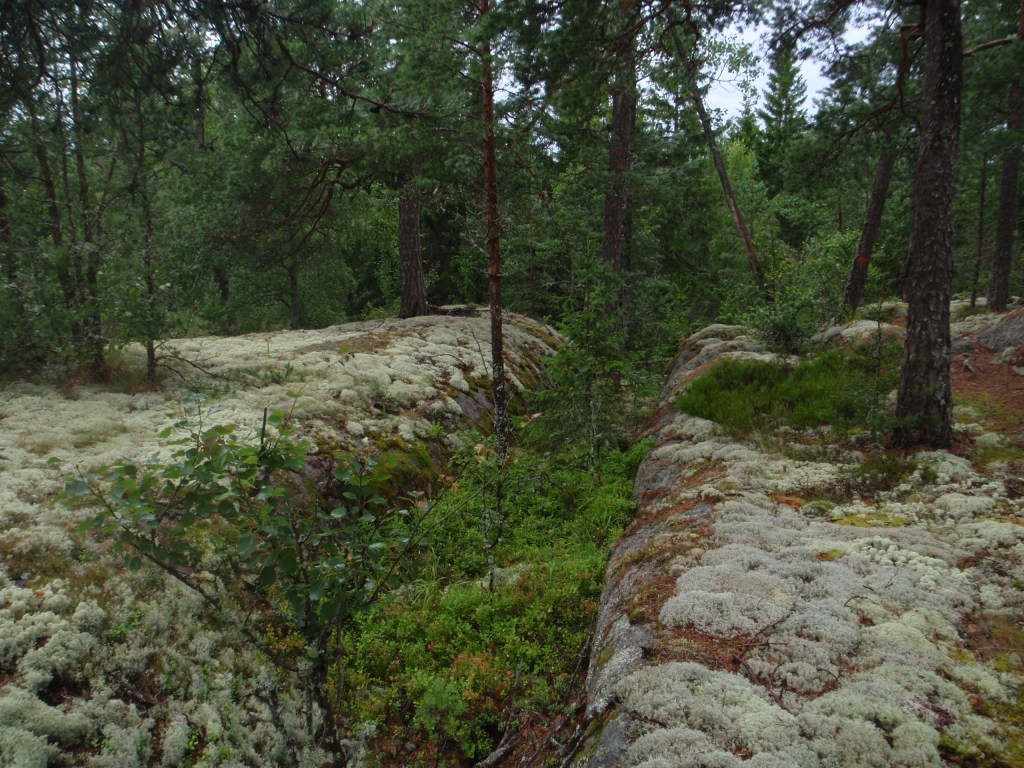
But somewhere along the line we got lost, though we didn’t know it for several hours. About halfway to the pier, we reached a beach and a signpost for the Sörmlandsleden pointing both straight toward what looked to be a shelter and to the left and a hill. We chose left.

We chose wrong.

Hours later, hungry and wet, we stumbled out of the woods and on to a driveway that led to a road.  That’s when we realized that we had made a mistake. Instead of a straight line toward the pier, we’d made a huge oval, ending up on the busy road a few kilometers north of where we started and about 20 kilometers from the pier. I called our hostel to explain the situation. The owner told me to call her when we got to the pier and she would send over their boat to get us.

Unsure what to do or how else to get there, our thumbs went out. My husband had thru-hiked the Appalachian Trail a few years back, where hitchhiking is as much a part of the experience as hiking. I was the novice. The guidebook had warned that Swedes won’t stop but I hoped they were wrong: that the warning came on the advice of the publishers’ lawyers rather than any statement of fact.

The first car to stop was a Prius driven by a man who spoke no English. After a confusing series of gestures and jabs at our topographical map (completely unhelpful for roads), he drove us a few kilometers to his driveway before pulling over and staring at us. We took that as our cue to get out.

Feeling confident by our initial success, I stuck out my thumb with a bit more conviction.  We walked along a bit further until a red station wagon driven by a man from Stockholm en route to his summer cabin pulled over. He spoke perfect English and lived only 3 kilometers from the pier. We chatted the whole way to his place, grateful for the kindness of strangers and the Swedish penchant for summer cabins.

Only a few kilometers from the pier now, we walked along the road, hoping for another ride but knowing it wasn’t too far now, that we would make it. We debated the finer points of hitchhiking as we walked. Nice cars won’t stop, my husband said, only crappy cars overloaded with clothes and bags and other junk. He also said that my presence made it more likely for someone to stop. Strangers will pick up women (a thought for another day) but rarely lone men.

A shiny red BMW rounded the corner and I barely put my thumb out, sure it would pass us by and probably so close that I’d have to jump onto the grass. But instead it stopped. Inside was an older man wearing hip waders and holding a basket of foraged mushrooms. We told him where we going and he nodded and waved us in with a “I’ll take you.”
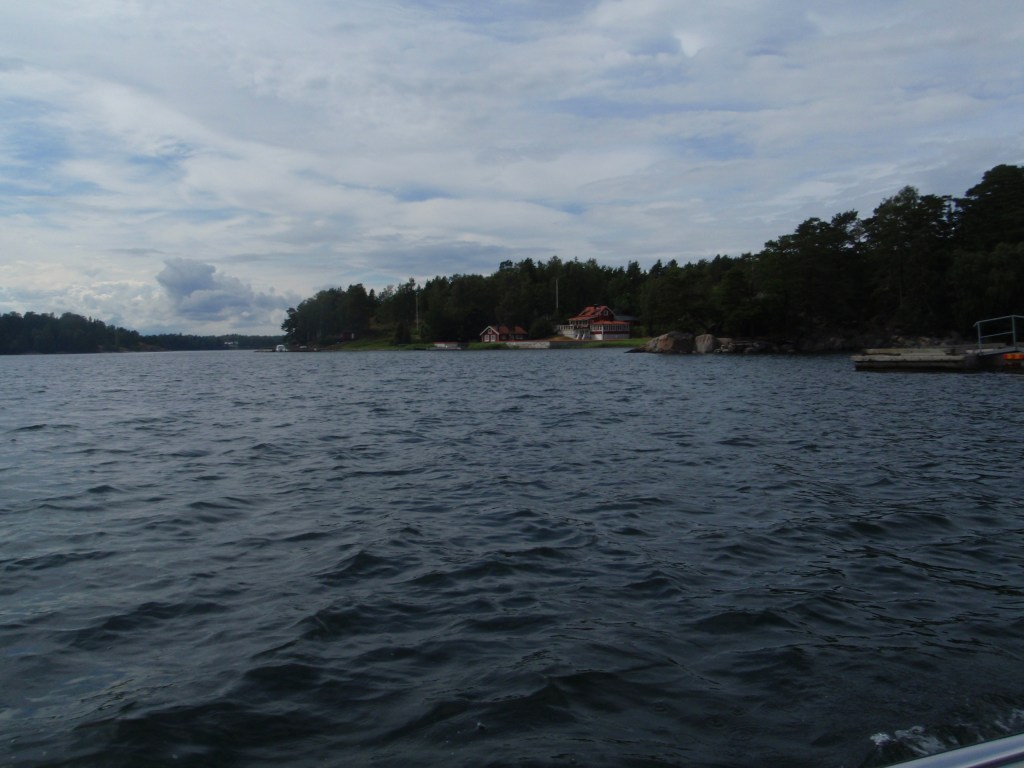
Arriving at the pier, we got out and thanked him for the ride. He shook his head and said, “no, I’ll take you.”

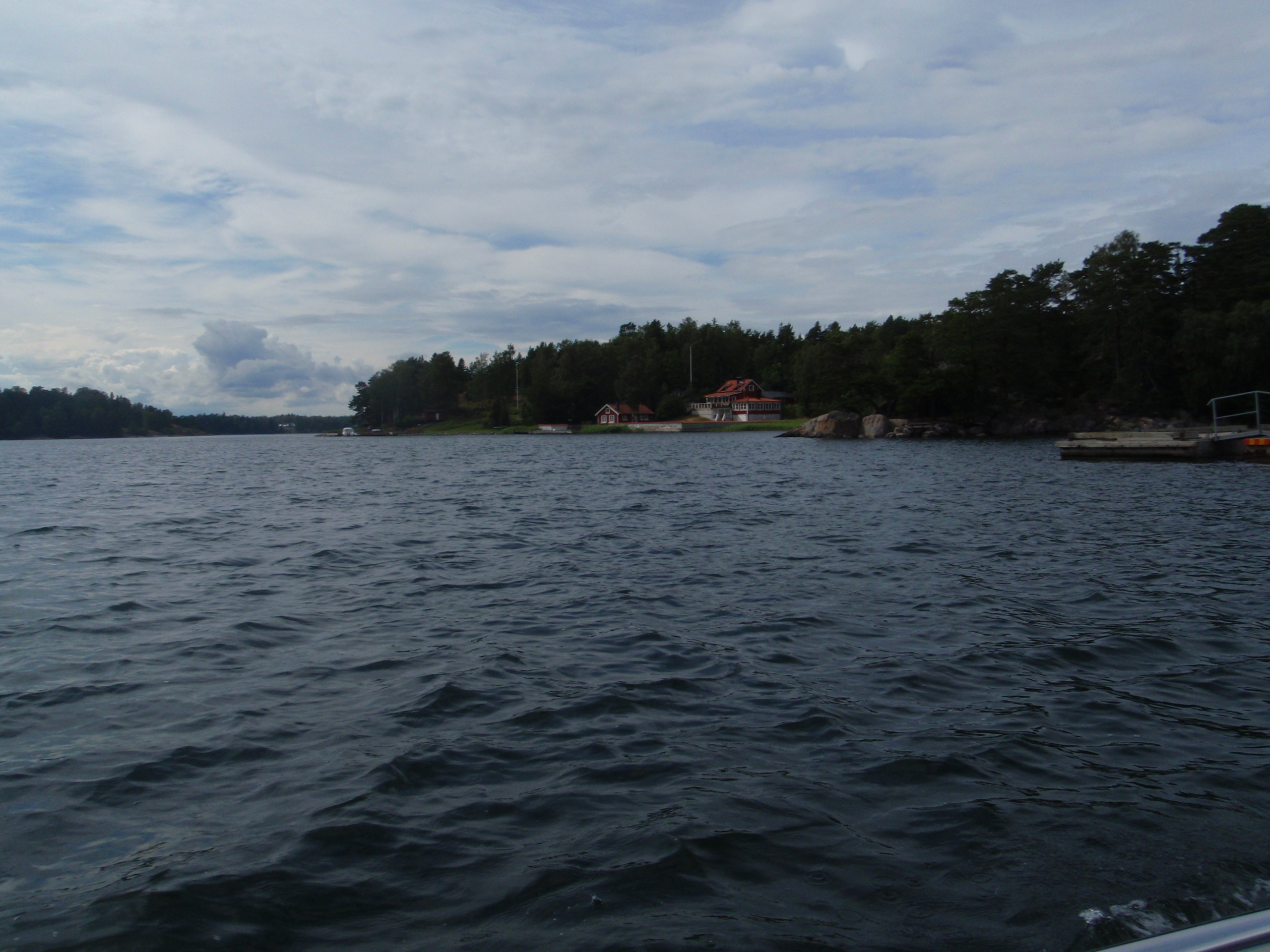
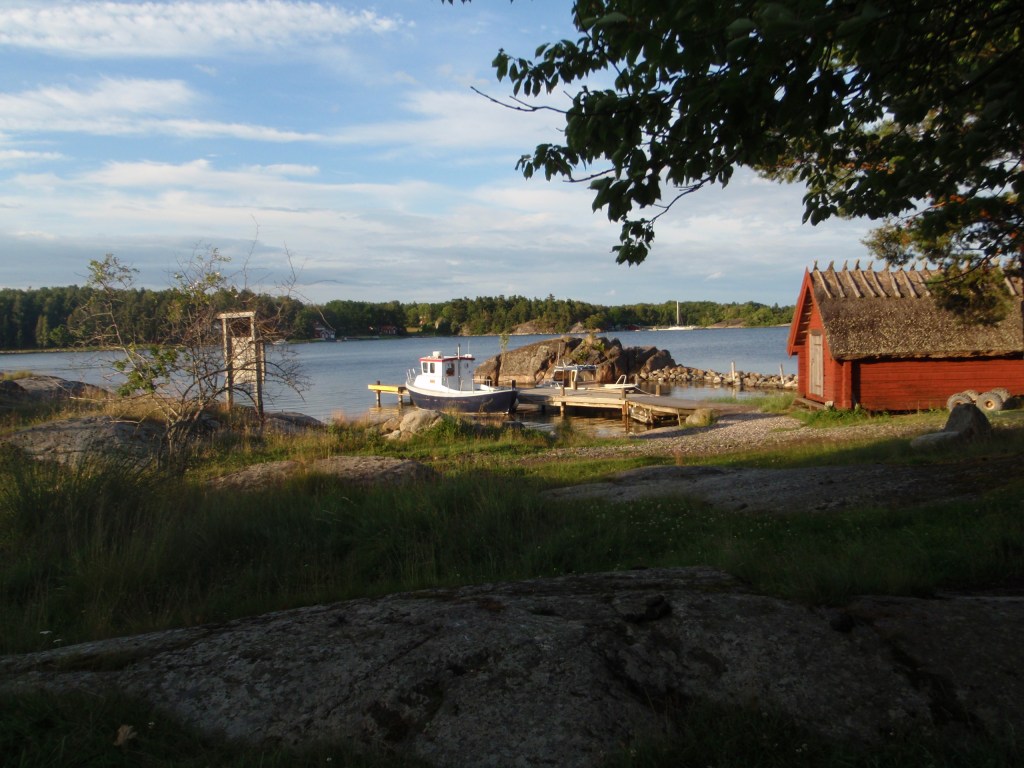
He pointed us to a motor boat tied up on the pier. We climbed in and he took to the controls. We soon learned that he lived on the island with his wife. When I asked him how many people lived there, he said that year ’round it was only two, he and his wife. Then he said, “I own the island.”

I caught my husband’s eye. “Oh my god, can this even be happening?” my face said. He only smiled and we sat and watched the island come closer in to view.

“I take you to my house. To meet my wife,” he said. Unsure what to say, we nodded and waited until he pulled up to the dock. We climbed out and followed him up the grass toward the house. “She will be surprised,” he said. A second later, “but maybe not so surprised.” He laughed and I laughed too, wondering if he does this often, picking up lost Americans by the side of the road.

He knocked on the window of the kitchen and his wife came to the door. He said something to her in Swedish and then “I found them by the road.” She smiled, looked slightly confused, and said “hello.” We thanked her and thanked him again. He turned and directed us down the path and through the woods to the hostel.

“Have a good time,” he said and turned to head back down the path to his house.
Ten Years On

Ten years ago yesterday, I packed up my car and moved 2,000 miles away from my home state. I was off to grad school in a new state, knowing no one, and not really quite sure what I was going to do in grad school but it seemed like the right thing to do. I liked to read and to write and to think about the past – what more did I need?

Wisconsin wasn’t a complete unknown. My parents grew up in Illinois, and like all good Illinois residents, they often spent their summers in Wisconsin. Even after they moved far away, to a town just outside Seattle, Wisconsin remained a summertime destination.

As a kid, my Wisconsin was rolling hills, fireflies, farm fields, blaring tornado sirens (though I had no idea what they were – being bookish, I liked to imagine it was an air raid and that we would soon need to darken the windows with our blackout curtains), and lightning that cut across the sky in an angry gash. My Wisconsin was Wisconsin Dells, Taliesin, House on the Rock, Lake Geneva, and the truly bizarre Don Q Inn. It was water towers with town names painted on the sides as though they were staking a claim to a piece of land and proclaiming it to all the surrounding fields and towns. And it was unlike anything I knew back home.

And while I came from a place rich in natural beauty – Mount Rainier, Puget Sound, towering evergreens – it was this more humble Wisconsin landscape that few would call magnificent that grabbed me and never let go.

Perhaps that’s why I now call Wisconsin home.

Home is a funny word, though. What does it mean and how do we know when we’ve found it? Is it the place where we grew up or the place we find ourselves as adults? Is it people or place or something else completely?

A Wisconsinite now for ten years, I still startle slightly to hear people refer to me as a “Wisconsinite” or a “Madisonian.” I’ll still tell people I’m not originally from here but at ten years and a third of my life spent here, what does that even mean and why does it matter?

I’ve heard people say that home is “wherever [insert loved one] is,” which sounds lovely and true. And while I don’t doubt their sincerity, I can’t help but want to shout “but place also matters!” Or at least it does to me, to my definition of home.

Everything I do and can do is a product of this place and its past. Everyone who lives here is a beneficiary of its people, traditions, and landscapes – all the elements that make a dot on a map a real place. Reading and writing Wisconsin’s history has taught me about Wisconsin but also about myself. And it’s helped me to feel at home here even if I’m not yet ready to call this place “home.”

That’s something I’m still working out.

Undiscovered Iceland

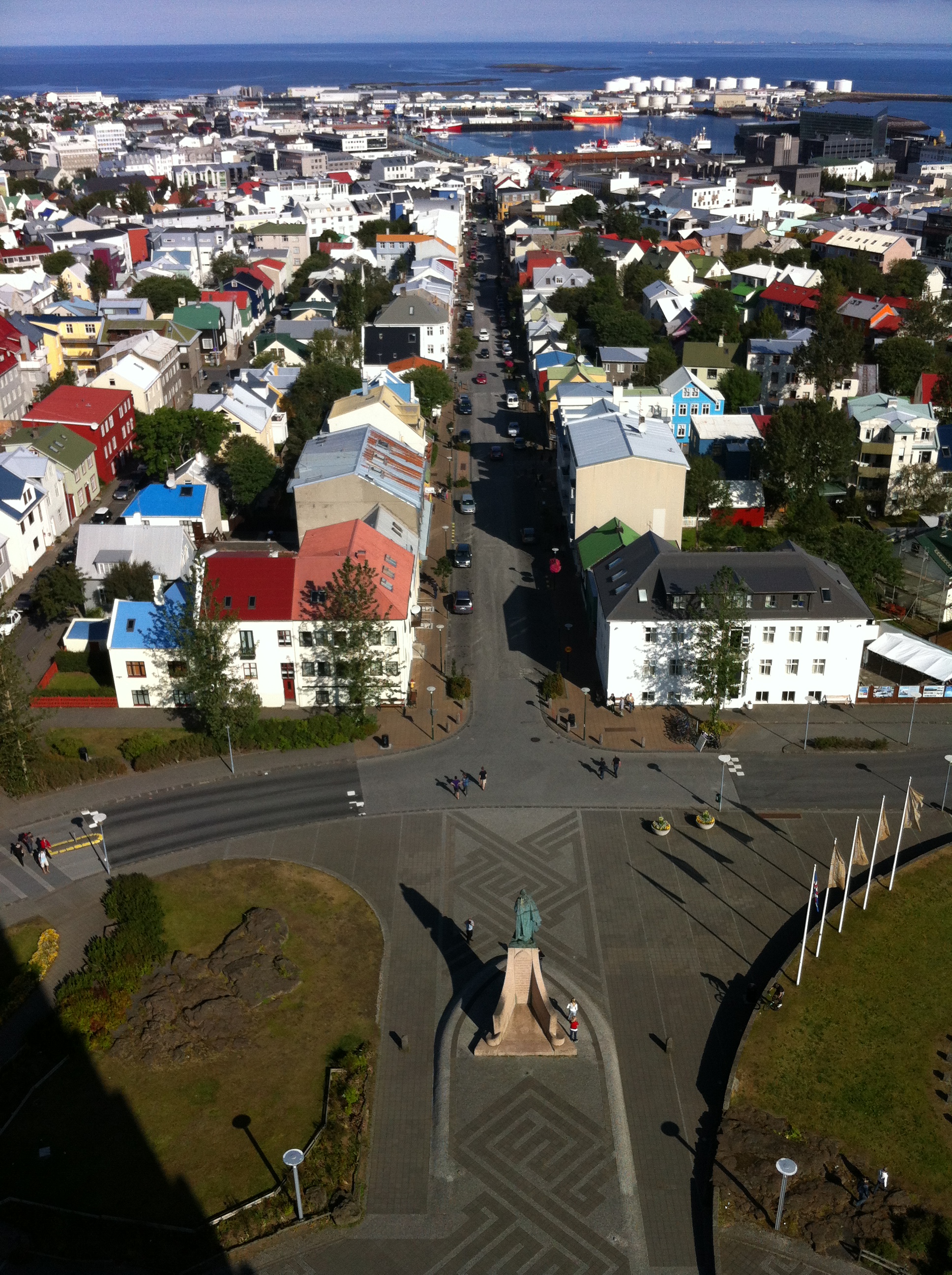
Looking down on the statue of Leif and Rekjavik

It seems that everyone wants to go to Iceland. Or maybe it only seems that way because I just returned from there. When I tell people we’ve just been to Sweden, Norway, and Iceland, the most common response has been, “I’ve always wanted to go to Iceland! What’s it like?” Forget those other two. The Iceland Tourism Board should be thrilled by this news.

What’s so intriguing about Iceland? The somewhat forbidding name (Norwegian Viking Floki Vigerdason named the island – some say it was to discourage enemies from settling there but more likely, he named it after traveling to the northern part of the island where he saw… ice)? It’s location? Having now spent a few days there, I feel hard-pressed to tell you what isn’t intriguing about Iceland. The light is spectacular. The landscape is both dramatic and stark with its volcanoes, glaciers, mountains, waterfalls, and thermal pools. The ground literally smokes. The capital city is modern, literary, friendly, and brightly colored.

And the history, oh the history. Nothing warms my little historical heart like seeing a statue of Leifur “the Lucky” Eiriksson outside the Rekjavik cathedral, the true European discoverer of North America, don’t you know. Not to mention a trip to the Þingvellir, where the Icelandic parliament formed in 930 (no, I didn’t forget a 1) and continued to meet until 1798. A pretty incredible history for a pretty incredible place.

Þingvellir, home to the Icelandic parliament. It’s also where the North American and Eur-Asian plates are splitting apart – visible plate tectonics.

Wait Five Minutes

Every place has its local sayings and phrases, the regionalisms known to those on the “inside” and potentially bewildering to those on the “outside.” Where I grew up near Seattle, it’s common to hear people comment that “the mountain is out,” or perhaps more often, that the mountain “is not out” since overcast is the sky’s perpetual shade. The mountain is Mt. Rainier and on a clear day, its looming visage is hard to miss all over the Seattle area. So when the mountain is “out,” you can see it and when you can’t see it, it’s “in.”  It never seemed strange until I moved away to say that a 14,000 foot mountain could be “in” or “out,” but there you have it. And once I’m back in town, the words fall easily from my lips once again even ten years on (gulp! I moved away a decade ago!?!).

Here in Madison, we have our own words – though nothing is “in” or “out” as far as I know. There’s “hippie Christmas” and “coastie,” as well as the general prefix “Mad,” which attached to any word means it is somehow tied to Madison: Madcity, Madrollin’, Madcat, Madtown, Mad, Mad, Mad.

Orkney mainland, Scotland

But then there’s this: “If you don’t like the weather, then wait five minutes and it will change.” Have you heard this? Have you heard it applied to your town or city? Does it seem like 90% of the world seems to believe this about where they live? Mark Twain supposedly wrote, “If you don’t like the weather in New England, wait a minute.” I’ve heard it said in Seattle, Portland, Madison (all over Wisconsin, really), Minneapolis, San Francisco, Cape Cod, Chicago, and Boston. On a recent trip to Scotland, I heard it again from a man in Glasgow bar. He said it was an old Scottish saying – maybe but it appears to be just as “old” all over the place so perhaps it’s only old in the sense that people have been saying it for a long time.

What is it about that phrase? And what does it tell us about our meteorological feelings? Maybe we say it as a way to excuse bad weather, as though we’re embarrassed about the current conditions but something better will be along shortly – really! Or maybe it’s a reflection on the impermanence of everything, even the weather – that this too will pass, that nothing stays the same, that change is unavoidable. Or maybe we all just live in really tempestuous places.

New piece on Jerry Apps finally out

Check out the latest issue of On Wisconsin (the University of Wisconsin alumni magazine) for my profile of prolific Wisconsin writer, Jerry Apps. Jerry is a force to be reckoned with – every book catalog I open from a Wisconsin publisher seems to include a new book from Jerry. His work ethic is both humbling and inspiring. I can only hope to be as engaged and active as he is in my 80s.