The Hysterical Woman

Reading 19th century literature, you might start to think that every woman was a swooning, mad hysteric.  Women seemed forever prone to fainting or madness–few were ever fully in their right minds. Most acted somewhat bizarre and with high theatricality, not unlike the clothes that fashion dictated women should wear.
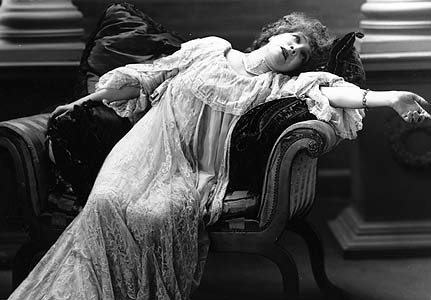


Hysteria was a purely female problem. Men suffered from their own version of nervous disease known as neurasthenia. The supposed problem? Women’s small size and supposed governance by their reproductive systems. That’s right. Women acted crazy because their womb overrode the power of their brains. The word even comes from the Greek word hystera  for womb.


So little was known about physical illnesses, such as epilepsy and neurological diseases, that the ”nervous” illnesses were generally lumped in together with them. The idea of neuroses as distinctly and purely in the mind was a minority view. More popular were a whole series of medical models for nervous illness and the psychological and physical options for treating them. Nerves were commonly ascribed a “force” that gave vitality to organs. Hysteria and neurasthenia were said to be caused by a weakness in this force, though the psychological evidence for this “force” and its loss were never evident. Anecdotes provided more powerful proof… at least for a time.  


Hysteria helped to reinforce existing gender and class attitudes. Women couldn’t hold positions of power or be trusted to vote if they were not rational beings! Hysteria worked very well at keeping women in the home and out of the public space, just what many men wanted. 


Hysteria could also work in a woman’s favor, though. Being classed as “sick” or “infirm” was one way to get out of performing your expected duties as a woman. In the book The Peabody Sisters by Megan Marshall, an amazing biography of three women in the 19th century, one of the sisters, Sophia, is often ill and seems to use her illness to forge an art career for herself. 


Female hysteria had mostly run its course by the 20th century. Doctors stopped recognizing it as a legitimate medical diagnosis and catch-all disease for any number of symptoms. 

When Toast Tastes Better

Why does food taste better when someone else makes it for you? Case in point (at least for me): toast.

At home, I rarely toast–at least to eat plain. I’ll toast bread for a sandwich, but rarely do I just eat it with butter or jam. But take me out to brunch or to a bed and breakfast in the UK and toast is all I want. This makes even less sense when you consider that the toast often served is made from the cheapest bread that I would never buy at home and usually arrives cold and rather limp on the table. But I will eat every piece with relish, as though it’s the most delicious thing you could possibly eat for breakfast. Or even dinner given the opportunity.

Toast has been around for centuries. No one liked eating stale bread so toasting became common in Rome as way to preserve bread. The word comes from the Latin tostum, which meant scorching or burning. Most early toast was held over the fire like a marshmallow or laid on hot stones. The toaster didn’t make its appearance until 1893 when Cromptin and Company introduced the first toaster in Great Britain. It didn’t reach America until 1909.

This early toaster only toasted on one side at a time. It took another decade for a two-sided toaster with a pop-up feature to appear. We still had to cut our own bread to make toast, though. Sliced bread didn’t appear until 1930 when Wonder introduced this modern marvel, which made toast even more popular. Today, nearly 90% of Americans have a toaster in the their home.

So why does toast taste better? Maybe it’s the familiarity–the comfort of something simple–that makes toast so powerful when I’m away from home. Or maybe I’m just hoping to see Jesus or the Virgin Mary appear in my bread.

Brussels Sprouts Appreciation Club

I have a, perhaps, unnatural love of brussels sprouts. A whole stalk can easily become my dinner when roasted in olive oil and lightly salted (my husband loves them too, though, so I try to share). And I seriously think many times while eating them, “these are way better than any candy.” Seriously. I do.

Many people hate brussels sprouts. And I used to be one of them.

As a kid, my parents would buy bags of frozen sprouts and steam them, topping the whole lot with butter. My mom, despite being incredibly picky about food, happened to love brussels sprouts. I would eat them, but always quickly and sometimes covered in parmesan cheese (the sawdust from the green can, that is). I could never imagine that there would be day when I would voluntarily eat them, much less look forward to their appearance at the market.

But then, about 7 years ago, for reasons still mysterious, I woke up CRAVING them. Having moved out of my parents’ house nearly five years earlier, I’m not sure I had eaten even one in that time. Nor had I ever thought about them. So I’m not sure why I needed those tiny cabbages so badly that day. Maybe its my Polish blood craving some cabbage-y goodness. I went to the store and purchased the same bag of frozen sprouts my mom had bought so many times. And I ate them all in one sitting. I loved them. I had to have more.

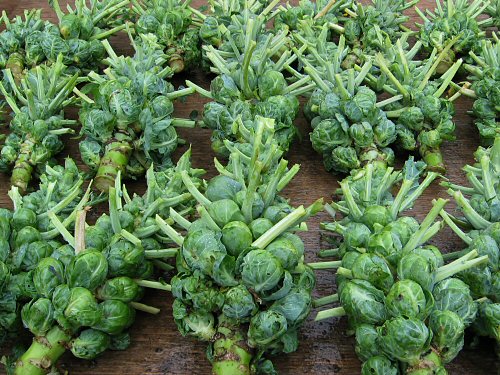
Forsaking frozen for fresh, I now eagerly await the appearance of the mutant stalk at the farmers market. One vendor had them labeled “Wisconsin Palm Trees” a few weeks back and they did look kind of tropical, with their nubby stalk and oversized leaves flopping over the top. I popped them off the stalk and roasted them for 35 minutes. I ate so many I nearly gave myself a stomach ache. I might be the first person to overdose on brussels sprouts.

To join my brussels sprouts appreciation club,  cook this from 101Cookbooks and see if you can resist.

The Flow of Electricity

Did you know that we used to think electricity was a fluid? That’s why we use words like “current” and “flow” to describe what is clearly not a liquid. But in the 19th century, electricity was a force that many believed had the power to heal and recharge humans.

In the early years of scientific medicine, many doctors came to believe that nervous diseases had physical causes and could only be cured by physical means. Some compared humans to batteries, saying that we sometimes suffered from a low charge that needed a jolt of energy to recharge. This idea seemed to offer a legitimate explanation for the worn out businessman, the languishing youth, and the excitable, swooning woman of the 19th century. This “disease” came to be called “neurasthenia,” a name popularized by physician George M. Beard who combined all of the so-called symptoms of the disease under one named cause.

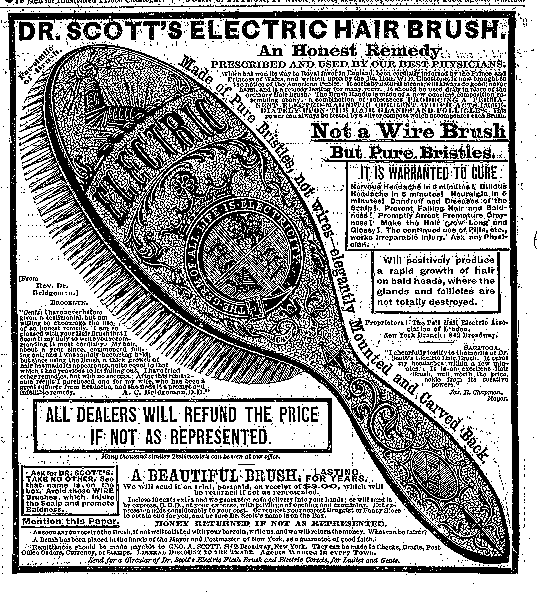
The solution? Electricity (it also probably didn’t hurt that Beard happened to be friends with Thomas Edison, the electric wizard of Menlo Park).  Many doctors came to believe that we could recharge our “neural batteries” with electricity. And so various devices purporting to soothe weary brains began to appear with increasing frequency. My favorite is Dr. Scott’s Electric Hair-Brush, which claimed to both make hair more glossy and calm worn-out brains.

The era of electric medicine began to come to an end by the turn-of-the-20th century. Because neither neurasthenia nor electricity actually exhibited physical changes–only proclamations of change (suggestion is powerful)–skepticism about its power began to emerge in the medical community. We also had new theories about mental illness and the mind as scientific research advanced. Electricity remained a magical force, though, its enigmatic nature and invisible power provoking the imagination to ever more fantastical heights.

Rediscovering Apples

Even though I grew up in a state known for its apples, I’d never really loved an apple until I moved 2,000 miles away—to a place known more for its cheese, beer, and brats, than its delectable fruit. And yet, even though images of apples were plastered all over any mention of Washington state, the apples of my childhood were tasteless, boring, almost cottony in my mouth. 

Oh my god, look at that interior!

Red Delicious, the virtual symbol of the state, was never delicious. It was the apple you got in the school lunch line while desperately wishing you had brought something from home. Or sometimes, even the apple your own mother put in your lunchbox, clearly a sign of aggression. So I never ate them unless forced to by mother who was too busy to notice that they were really terrible. These Washington apples weren’t the fruit of kings as apples once were, but rather the fruit of mediocrity.

The apples I discovered in Wisconsin, however, were altogether different. They weren’t uniformly dark red or bright green or buttery yellow but were mixes of all of those shades and more. They snapped when you bit into them, releasing a shower of juice that the skin could barely contain, rather than sagging and finally giving way under the pressure of your teeth like those so-called Delicious.

My first transcendent apple experience occurred in the fall of 2002. I remember it like other people remember their first kiss. It was called Pink Pearl, though there was nothing pink or pearly about its skin which was a homely yellow-brown. Its flesh was like nothing I had ever experienced before, marbled pink and white like those Pilsbury birthday cake mixes I’d always begged for as a kid. And the taste? The taste literally brought tears to my eyes it was so incredible and unknown to me.

It was also slightly embarrassing, as I was standing in front of the farmers’ booth, surrounded by other shoppers at the farmers market. I had no idea apples could taste like this—that really any
fruit could be that perfumed, sweet-tart, and delicious. And that that fruit could grow in Wisconsin rather than the Apple State.


I’ve since learned that thousands of apple varieties exist around the world. Someday I hope to try them all.

Loving Susan B.

I love Susan B. Anthony. And Elizabeth Cady Stanton…even though I’m probably not supposed to. As a women’s historian, the heroes of women’s suffrage are no longer the heroes of the professional study of women’s history. Studying suffrage is old, something the field has supposedly moved past–or at least that’s how it certainly felt when I was a graduate student. And while it certainly makes some sense as we try not to focus on “great white woman history” as we had for so long with men…it still makes loving Susan B. feel a little illicit.

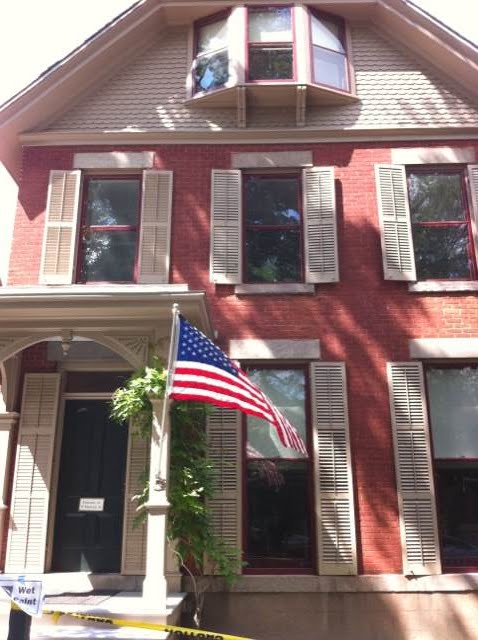
Last week, I visited Susan B. Anthony’s house in Rochester, New York, (fittingly, on the 90th anniversary of the Susan B. Anthony amendment, the 19th) and the week before, Seneca Falls. Both were wonderful, though, I was disappointed that we couldn’t go inside the restored church where the first Women’s Rights Convention was held. Even so, both were magical places. The Seneca Falls convention often gets relegated to a historical footnote when it was, in fact, a truly revolutionary event–for the first time in history, women publicly gathered to proclaim their rights. As a woman–as a person–, I don’t think you can help but be moved by that idea, though, I also think the true enormity of that call to arms at that time is hard to grasp. Women were basically invisible before the law, unable to own property of any kind, vote, to call for a divorce, or even have a say over the fate of their children in case of divorce; only the wealthy were educated. So to say that women had rights was truly shocking and revolutionary for 1848. By the way, historian Gerda Lerner has an excellent essay on the importance of Seneca Falls to women in her book Living With History, Making Social Change.


I’m not sure you can visit Susan B. Anthony’s house and fail to be impressed by her determination. She lived and breathed women’s rights–and I’m so thankful to her.