Food & Think

I had the great pleasure of having one of my pieces featured on the Smithsonian’s fantastic food blog Food & Think on Monday. It’s funny how a prompt– in this case “the most memorable meal of your life”– can bring back memories in a flush of sights, sounds, and smells. And just thinking about my meal made the whole month I spent in England come back in more vivid detail that it might have had someone just asked me to tell them about the time I spent in London 11 years ago.

Something I didn’t include in this piece was my memory of one weekend dinner in the Zebra Club. The thuggish Eastern European chef must have had the night off so dinner that night was both made and served by the regular waiter, whose name I wish I could remember. I do remember that he was from Serbia and that he bore a slight resemblance to Mr. Bean. He took our order–pasta or meat, as usual–and then headed back into the kitchen.

From my place at the table, I could see through the round window to the stove.  Through that portal I saw the Mr. Bean-waiter ignite something that resulted in tremendous flames–they were literally 18 inches high and looked like they could easily singe his eyebrows off. Did I mention I ordered pasta?

Twenty minutes later, he emerged from the kitchen with our bowls of rubbery pasta. Everything looked normal: or as bad as what had become “usual” by this point in the trip.

I never discovered what the flames were about. We tried asking but he seemed confused by the question. Perhaps he had hoped no one had seen. He wanted to keep those flames to himself.

Bloomers and the Water Cure

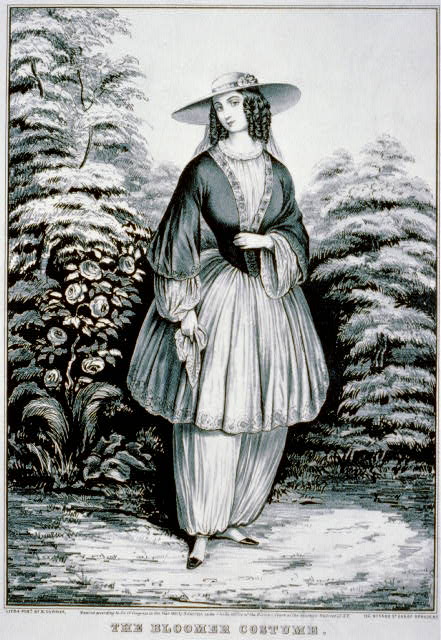
Amelia Bloomer is a name that many people who study women’s history even a little bit tend to know. She’s the namesake of “bloomers,” a style of dress that became popular among women’s rights advocates and dress reformers in the 19th century. Bloomer, the woman, didn’t invent the costume, but she was an early and ardent advocate of them and as a result, gave her name to the style. Bloomers consisted of a loosely fitting coat or dress that reached below the knees and a pair of billowing pants similar to Turkish trousers (picture MC Hammer or the Disney-fied Aladdin) gathered at the ankles.

Although widely associated with women’s rights, bloomers were actually one of the treatment outfits for those taking a water cure. Hydropathy, as the water-cure system, was known was a popular form of medical therapy in the United States from the 1820s to the 1860s. The basic idea was that cold water was pure and clean and could therefore cure just about any disease. People “took” water in any number of ways but the most common was a wet sheet that would be wrapped around a patient for several hours until he or she sweated. An alternative to the sheet was a wet dress, which was introduced at a hydropathic institute and later became the model of the bloomer costume. Women who took the water cure often sometimes cut their hair short for easy drying and felt themselves free from the prevailing and restrictive women’s fashion.

The wet dress was introduced to the fashion world by Elizabeth Smith who displayed her fashion to women’s rights leader Elizabeth Cady Stanton. Amelia Bloomer discovered it when Stanton came for a visit and she soon began writing about it enthusiastically in her magazine, The Lily. Articles on the bloomer trend were soon picked up by other publications and it came to be dubbed “bloomers” for Bloomer’s advocacy of it for women. Bloomer herself along with other wearers of bloomers suffered merciless ridicule for their fashion choice.

The bloomers adoption by the women’s rights movement also damaged its reputation among hydropaths. Bloomers came to be associated with female radicalism and its followers were suspected of free love and of a desire to be free of all feminine graces.

Amelia Bloomer mostly abandoned the bloomer in 1859 but she continued to fight for women’s rights and for more sensible, less restrictive clothing for women for the rest of her life.

Hair of the Dog

Having a morning drink after a night of too much drinking is one cure for a hangover. Although it’s unlikely that “hair of the dog” works, the idea of treating yourself with what caused the problem in the first place is a homeopathic idea.

One of the primary tenets of homeopathy is that like cures like. The right treatment for an illness is the treatment that produces the same symptoms in a healthy person. So if you have a headache, whatever herb or drug causes a similar headache in a normal person is the right treatment. This idea forms the foundation of homeopathy.

Homeopathy was an extremely popular medical movement in the 19th century, rivaling orthodox medicine for supremacy. A big part of its appeal was its simplicity–you could buy a homeopathy kit that would help you match symptoms to treatment–and the minimal pain inflicted by its therapies.

At the time, many doctors and patients believed that a drug needed to cause a lot of pain to be effective. How else were you to know that it was working if you weren’t bleeding or passing out? Homeopathists proposed an alternative: that drugs don’t have to hurt to work. Homeopathists treated patients with very small doses of medicine diluted at least 30 (and often many more) times. While many critics derided the use of small doses, claiming that they could never treat anyone, homeopathists at least knew that they were causing no more harm. The same could certainly not be said of regular doctors and their regimen of bleeding, puking, blistering, and sweating.

Homeopathy also claimed some successes in treating people during cholera epidemics in 1832 and 1849, leading many regular doctors to defect to homeopathy. Cholera sufferers got small doses of camphor and were urged to seek out clean air and water. While homeopathy may have done little to cure these people, they also didn’t cause more pain to people already suffering as bleeding, blistering, and sweating likely did.

Homeopathy fell out of mainstream favor in the 20th century, but some of its ideas live on in things like “hair of the dog.” Homeopathists didn’t invent or even endorse the idea of treating a hangover with alcohol, but the idea of like curing like is imbedded in that urban myth. Homeopathy also changed our view of what medicine is supposed to feel like. Today, we look for drugs with few side effects, not the painful, visible signs of treatment from the past.

Wisconsin’s Hardy Early Settlers

I just recorded an audio piece for WPR’s Wisconsin Life series on the state’s settlers and why they stayed in such a cold place. Take a listen.

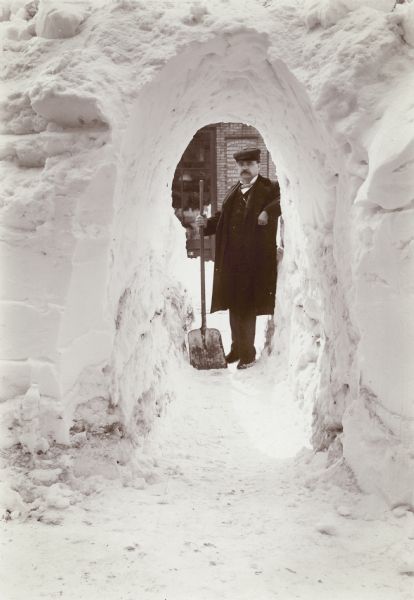
That’s some deep snow. Hurley, Wisconsin, 1899.

Get your head examined

Today, when you tell someone to “get his or her head examined,” you are usually implying that they are crazy. But the phrase had real currency in the 19th century. People really did get their heads examined–but not to find out they were crazy.

The phrase actually comes from the antebellum phrenology fad when people–all kinds of people, from president James Garfield to Walt Whitman–got their heads “read.”Phrenologists could read your character, including what you are good at and what weren’t, by looking at the bumps on your head. Supposedly, Clara Barton, founder of the Red Cross, and Ulysses S. Grant even picked their careers based on a head reading. Forget What Color is Your Parachute? In the 19th century, it was What Bumps are on My Brain?

Phrenology offered physical “proof” of your internal self. That was part of its appeal in an age when everyone was driven to “know thyself.”Your whole self could be understood by the landscape of your scalp, a powerful idea with incredible potential for making the world work better.

Not everyone thought phrenology was a great idea, though. Lots of people thought it was a crazy idea, which is likely where the phrase “getting your head examined” got it’s uncomplimentary overtones.

Cold Climates

When it’s 0 degrees outside, do you ever wonder why your ancestors decided to stick this out rather than move somewhere warmer? Why stay in the upper Midwest or New England when California, the Carolinas, or New Orleans beckoned?

In Wisconsin, the reasons people came and stayed had a lot to do with the kinds of people they were. Many of the state’s first immigrants came from cold places originally (Norway, Germany, Finland, Canada) so a cold winter was nothing they didn’t already know.

Warmer climates were also more susceptible to devastating outbreaks of disease, particularly yellow fever and malaria. Mosquitoes, the main carriers of these diseases, couldn’t survive our cold winters so the outbreaks were never as severe or as long-lasting here as there.

Wisconsin also looked like home to many immigrants. Something about the lay of the hills and fields reminded many of them of Norway, Germany, or Switzerland. Sure, they’d been on a boat for a while and maybe the time away and the deliriousness of travel had twisted their memories, making anything seem inviting after time spent crammed on the lower decks of a ship, but countless letters home described a new place that recalled a beloved homeland. Norwegians wrote glowing letters about the area just west of Madison near Blue Mounds, Mt. Horeb, and the town of Vermont. The Swiss loved the green hills of today’s Green County.

It also helped that many of the warmer places were not yet part of the United States in the 19th century or at least not yet as secure from potential Spanish takeover or other threats. Arizona didn’t become a state until 1912. Texas wasn’t sure it didn’t want to be an independent republic until the mid-19th century. Things were more settled in the north for the most part.

So thank your ancestors for settling somewhere cold. They may have kept your bloodline safe from yellow fever and found an easier new start in a place that seemed a lot like home.

A Nuptial Head Reading

In 1844, Lydia Folger married Lorenzo Niles Fowler in Nantucket. Fowler was, with his brother Orson Squire, the foremost proponents of phrenology in the United States, so it should probably come as no surprise that some head reading occurred at the ceremony. Lorenzo read the bumps on the head of Lydia’s uncle Walter, declaring, so the story goes, that his ego was nearly as large as his genius.

I ran across this story on the website of the Nantucket Historical Society while looking up more about Lydia Folger Fowler. Lydia was a remarkable woman. The second woman to graduate from medical school in the United States (and the first American-born–Elizabeth Blackwell was English), she lectured extensively on health, anatomy, physiology, and hygiene in addition to practicing medicine. She wrote books and taught courses to women.

In her lectures to women, Lydia praised their roles as mothers but also urged them to think about the other years of their lives, those not tied to child bearing and raising. She told them that an educated mother made the best mother. She constantly emphasized how important it was for individuals to study, practice, and perfect themselves. This was especially important for mothers, Lydia said, who had a responsibility to more than merely caretakers of their children and husbands.

Lydia’s story is little known, in part, because of her gender but also because of her marriage to one of the famous Fowler brothers. She was also the cousin of a much more famous woman: Lucretia Mott, the famed Quaker woman’s rights advocate.  But she made important contributions to the history of women and medicine. And who could forget a wedding that involved head bump reading?

New Domesticity

When you dive into the past, especially the history of women, you won’t go far before you run smack into the idea of domesticity. Domesticity belonged to women–the word encapsulated both what duties women had and the ideal of womanhood in the 19th century. Women were to be pious, pure, domestic, and submissive. A woman’s place was in the home, taking part in tasks and chores that maintained and fulfilled her piety and purity. Housework was one such “uplifting” task.

The idea of domesticity arose in the early 19th century when the growth of new industries, businesses and professions created a new class of Americans: the middle class. This new middle class did not have to make what it needed to survive. Men produced goods and performed services outside the home while women and children stayed home. A man going off to work out in the rough public world served to create the view that a man alone could support his family. Women were far too delicate to be out in the world. They needed to stay home and make the home a refuge for men from the unstable, immoral business world.
Even as more women moved out of the home and into the workplace in the 20th century, many of the ideas of domesticity and the equation of women with domestic work remained.

All of this was on my mind recently when I read a piece by Steph Larsen on Grist about the links between the DIY lifestyle (sewing and preserving food for instance) of today and domesticity of the past. Larsen recounts chaffing at her mom’s declaration of how domestic she’d become after she serves them a meal made up of foods she’d grown, harvested, preserved, and cooked. Many of my female friends preserve and cook for their families.  And I occasionally feel the same sense of unease that Larsen recounts as I happily make dinner for my husband many evenings and pack his lunch in the morning. Am I betraying my feminist forebearers? Or is somehow the fact that this is a choice rather than something women must do make it okay?

My desire to cook comes from a place of real enjoyment. As a kid, my mom hated to cook and so we ate many meals out in restaurants or from a box in the freezer. To my mom, cooking was drudgery. I feel the opposite but not because I feel any pressure to put food on the table. Cooking for me is a reprieve. One of the few things I do in my life that yields immediate results. Writing means waiting months if not years to see your efforts in its final form. Cooking and food are also, for me, a way of supporting local farmers and combatting an agricultural system I think is broken.

So while domesticity continues to include a body of home tasks associated with women and women alone, maybe the doors on the cage are more open now.

Healing the Spiritual and Physical

In colonial America, your minister often provided succor to those afflicted in faith and fever. Ministers were usually the most educated people in a community so it made sense that they would be entrusted with medical care as well. Not to mention that so little was known about disease and its causes that fusing religion and medicine made as much sense as any other theory (and probably more so to the deeply religious American colonists). As historian Richard D. Brown put it, “even the most rational and learned individual..saw no clear boundary between physical and spiritual phenomena.” The joining of these two roles, however, was not without its complications.


Cotton Mather, one of the most prominent Puritan ministers in New England, introduced smallpox inoculation in 1721, a move that ignited a fierce debate in the Puritan community. Puritans believed that every affliction was proof of God’s special interest in their affairs. Some suggested that smallpox (a serious and deadly threat in colonial America) was perhaps God’s punishment for sin and that to interfere with that through inoculation or anything else would only anger God and provoke more punishment. Mather did not waver, though. He wrote that “whether a Christian may not employ this Medicine (let the matter of it be what it will) and humbly give Thanks to God’s good Providence in discovering of it to a miserable World; and humbly look up to His Good Providence (as we do in the use of any other Medicine) It may seem strange, that any wise Christian cannot answer it. And how strangely do Men that call themselves Physicians betray their Anatomy, and their Philosophy, as well as their Divinity in their invectives against this Practice?”Eventually, inoculation did gain widespread acceptance. 


The spread of print and increased literacy helped bring elite medicine to the masses through home medical manuals. Many ministers as well as their followers had copies of some of the most popular manuals, including William Buchan’s Domestic Medicine (1769) and John Wesley’s Primitive Physick (1747). 


Wesley, better known as the founder of Methodism, was extremely interested in the democratization of medicine. Believing that medicine and doctors were often only accessible to the wealthy, he wrote his own medical manual to allow anyone to easily treat themselves. Wesley considered making medical knowledge and treatments available and comprehensible to the public was part and parcel of his pastoral duties. 


The minister-doctor predominated until at least 1750 and continued on to the early 19th century in some areas of the country. It was only with the rise of medical education, apprenticeships, and licensing laws that  the two forms of healing separated. But ministers continued to play an integral role in healing, particularly in many of the alternative health movements (homeopathy, hydropathy, osteopathy, etc) that flourished in the 19th century.

Poland Rising

How did the Irish get so popular? In the 19th century and even into the early 20th, the Irish were decidedly not a favorite immigrant group. They were often poor and, more damning, Catholic, a major strike against them in a very Protestant United States. The Irish were stereotyped as hot-headed drunkards, uncivilized and unskilled. Political cartoons were widely used to express negative opinions about Irish immigrants. And yet something changed…

Today, everyone wants to be Irish. There are stores selling Celtic this and that all over the country, Irish bars, and Irish music festivals. Maybe it was sheer numbers. Millions of Irish came to the United States so their influence became impossible to ignore. And they didn’t remain poor and unskilled. Many became politically, economically, and religiously powerful in their new country. John F. Kennedy–Irish and Catholic–probably had something to do with it, too.

All of this leads me to the Poles (and myself as I’m a quarter Polish). Why haven’t the Polish experienced this renaissance of opinion? Poles were often poor and Catholic, too. They didn’t come in quite the same numbers as the Irish but most settled in urban areas like the Irish, especially heavily in the Midwest. Chicago today bills itself as the largest Polish city outside of Poland. And yet Poles are often still the butt of jokes rather than a beloved culture. Everyone I know who has been to Poland raves about its beauty and culture, but rarely do you see a special issue of Conde Nast Traveler or Budget Travel telling you where to go now in Poland.

Southwest Poland, near Jelenia Gora

It all makes me want to start a Polish rehabilitation project.  Someday, maybe we’ll all start wearing purple on Polish Independence Day (November 11th, for those who haven’t already marked their calendars).