My book A Short History of Wisconsin recently (in the last few months anyway) became available as an ebook. And it’s digital self just won a silver prize in the history category from eLit Awards, which, according to their website, recognizes the “very best of English language digital publishing entertainment.” That’s right – my history book has ceased to be just a book and is now “digital publishing entertainment.” Awesome. Thanks eLit!
Writing
Making Radio
Most of my work days look like this:
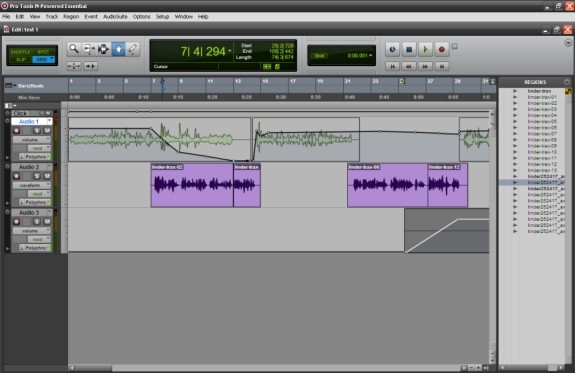
I sit for hours cutting a word from here and a phrase from there; deleting the sound of swallows and licked lips (you’d be amazed how loud they are in a microphone – and perhaps once you do know, how self-conscious you become about them); searching for the perfect music and then fitting it in to complement but not overpower the voice, to emphasize a point and then fade away; and trying to make sentences I’ve cut from 10 different places sound like they flow naturally from one into the next. It’s the glamorous world of radio.
But if maybe not glamorous – there’s nothing stylish about the enormous black headphones strapped to my head – it’s certainly magical. Even after hours listening to the same paragraph over and over and over… and over… to the point that I have memorized the entire essay or interview answer (or more recently, a song), it never fails to excite me when it finally falls together. It’s just like writing the perfect sentence or finding just the right word to describe a moment, a scene, a person. It just feels… right.
Creating radio is an intimate experience, too. Radio is itself the most intimate of mediums – a voice talking to you, the listener, over the airwaves. Voices you know in a second but couldn’t identify the face of its owner. And yet you somehow feel connected. You feel that you know her.
The same thing happens in my headphones as the subject tells me a story, over and over, that I just have to get right. I owe it to her, I think, as I make the painful decisions of what is essential and what can be left behind. The soundwaves may not look so personal on my screen but most special things are hard, if not impossible, to see.
I can’t imagine the day when this will ever get old – when I’ll stop getting excited about someone’s story and determining how to share it. Sure, my ears throb after hours encased in headphones and my pointer finger aches from endless mouse clicking, but even so, the end result always sounds like magic to me.
Here a few recent radio pieces I’ve produced* for Wisconsin Life on Wisconsin Public Radio:
Count This Penny – songs based on letters of Wisconsin Civil War soldiers (love them, love this)
Stand-Up Paddleboarding (I can’t wait to try it!)
Distill America (I did the recording for this one, too)
* Many people ask me what a producer actually does. Good question. In radio, producers do a variety of things but generally book guests for talk shows, find music and sound clips, sometimes write questions for interviews, conduct interviews, and edit audio. Essentially everything but take to the microphone themselves.
Cross-Country Skiing on the Radio
My essay on cross-country skiing was featured this morning on Wisconsin Public Radio’s “Wisconsin Life.”
And last week, I had a great conversation with CSA farmer Kristen Kordet about planning for the farming season. We looked at seed catalogs and talked about her favorite varieties. She’s a delight to talk to and I think the edited piece turned out really well.
Lessons of Adulthood
Have you ever looked at your life – really stopped everything and took a good look around – and thought, “how did I get here?” It can be disorienting in some ways, if you think back on where you thought you’d be when you were 8 years old or 15 or even two weeks ago when I was only 31 and do a real evaluation.
This thought passes through my mind nearly every time I give a talk. A talk. Me. Where I stand up in front of people and speak about history (usually) for 45 minutes. Into a microphone. The lights down low. With people staring at me. And I actually like it.
Growing up, I did everything I could to avoid public speaking. And when I did have to give talks, I gripped the podium (if there was one) until my knuckles turned white and my fingers ached from the strain, my knees shaking, my face buried in my notes, and my words tumbling out on par with that guy from the Micromachine commercials. I hated it. I hated being on display even if really, no one was really listening or frankly, cared all that much in school. I just needed to get out of school, get through this class, and then I would never have to give a speech again. Never!
But then I became a professional writer.
And I learned the cold, hard truth about the writing life: there’s speaking involved. You can’t just sit in your garret all day, turning out pages of prose for the world to lap up in eager anticipation. Readers want to see you. Or more accurately, readers learn they want to be your readersby seeing you and hearing you speak. And so you speak. And hopefully with time, you get better at it and maybe even start to enjoy it.
Five years on of fairly steady speaking engagements, I’ve discovered something earth-shattering: I like to speak publicly. The realization came slowly, so slowly that at first I didn’t recognize it. One day, in the middle of a talk, I found myself walking up and down the aisle with a microphone in hand. Who was I, Phil Donahue?! I felt suddenly disembodied, like I was watching someone who looked a lot like me but couldn’t possibly be me because I hate public speaking, talking, laughing, smiling, having a great time. But it was me and it is me.
I never thought I’d be up there, much less by choice. Wasn’t the great promise of adulthood as a child the freedom to do what you wanted?
I’m still surprised every time I stand up to give a talk. Surprised at who I’ve become but pleased to know that I could do it all along.

