Defining Home and Region

Where’s home? Is it where you live now or where you’re from? And if you’ve moved, when does your new place transition to “home?”

I’m staring down nearly nine years in Madison, Wisconsin, this summer. I came for school but stayed for… work and friends and then love. And even though I’ve never felt more connected to a place than I do Madison, I still feel surprise when people refer to me as a “Wisconsinite” or a “Madisonian.” Obviously, I’ve made the cut in their minds but for some reason I’m not sure I’ve made it in mine. What I think of as my “formative years” happened somewhere else even if I’m not all that different from the people in my new home.

My husband and I have been talking about the Midwest as a region a lot lately. Where is it? What is it? Who considers themselves part of it, Midwesterners, and who doesn’t? Midwest Living magazine includes Oklahoma in the Midwest but I’d venture to say that many people in Wisconsin wouldn’t consider Oklahoma Midwestern (no offense to those Oklahomans who do). And what about Ohio? It kind of is and isn’t, straddling the line between the Midwest and the East but firmly in the eastern time zone.

I was born in the Midwest and live there again now so does that make me a Midwesterner? Even though I spent two-thirds of my life in the Northwest?

All of these things–home and region–are really choices we each make about where we choose to identify some part of ourselves. For some, not choosing can be a regional identity, too: rootlessness. And maybe that’s my choice right now.

Every Dairy State Needs a Queen

June in Wisconsin means June Dairy Month. That’s right, “America’s Dairyland” has a special month devoted to dairy. It’s perfectly reasonable to think this unnecessary since isn’t every month about dairy in a state that has chosen to label itself as such? Well, no, apparently it’s not enough. We need to have dairy farm breakfasts all over the state, to put cows up by the state capitol, and to have the opportunity to meet Alice in Dairyland, Wisconsin’s dairy royalty.

Alice in Dairyland peddles cheese

I recently recorded an essay for “Wisconsin Life” about Alice, linking these agricultural queens to fertility goddesses of yore (thankfully, I didn’t actually use the word “yore” in my story). Sure, she began as a kind of beauty queen but the role has evolved into more of a marketing job. You can’t just represent dairy anymore–you actually have to work for it.

Talking about Alice at work, a coworker wondered why there’s no male dairy royalty. Perhaps Albert in Dairyland? I wouldn’t want to unseat Alice from her absolute reign so perhaps he could be a consort ala Prince Philip, Duke of Edinburgh?

Wisconsin’s Hardy Early Settlers

I just recorded an audio piece for WPR’s Wisconsin Life series on the state’s settlers and why they stayed in such a cold place. Take a listen.

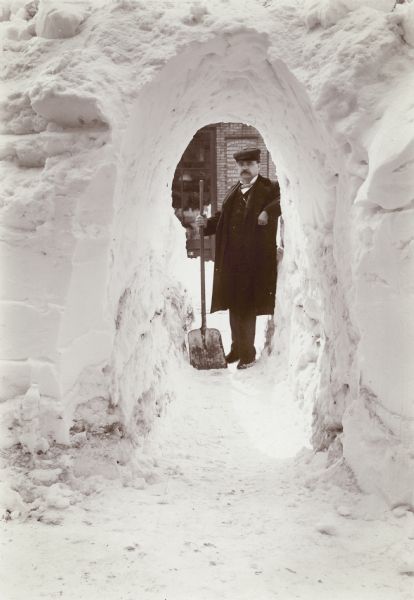
That’s some deep snow. Hurley, Wisconsin, 1899.

Cold Climates

When it’s 0 degrees outside, do you ever wonder why your ancestors decided to stick this out rather than move somewhere warmer? Why stay in the upper Midwest or New England when California, the Carolinas, or New Orleans beckoned?

In Wisconsin, the reasons people came and stayed had a lot to do with the kinds of people they were. Many of the state’s first immigrants came from cold places originally (Norway, Germany, Finland, Canada) so a cold winter was nothing they didn’t already know.

Warmer climates were also more susceptible to devastating outbreaks of disease, particularly yellow fever and malaria. Mosquitoes, the main carriers of these diseases, couldn’t survive our cold winters so the outbreaks were never as severe or as long-lasting here as there.

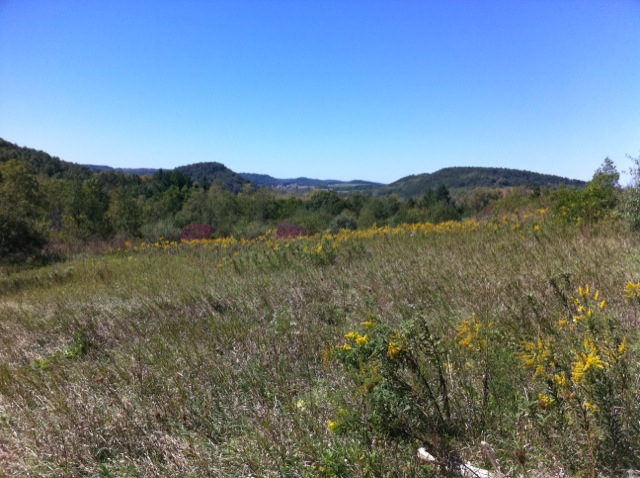
Wisconsin also looked like home to many immigrants. Something about the lay of the hills and fields reminded many of them of Norway, Germany, or Switzerland. Sure, they’d been on a boat for a while and maybe the time away and the deliriousness of travel had twisted their memories, making anything seem inviting after time spent crammed on the lower decks of a ship, but countless letters home described a new place that recalled a beloved homeland. Norwegians wrote glowing letters about the area just west of Madison near Blue Mounds, Mt. Horeb, and the town of Vermont. The Swiss loved the green hills of today’s Green County.

It also helped that many of the warmer places were not yet part of the United States in the 19th century or at least not yet as secure from potential Spanish takeover or other threats. Arizona didn’t become a state until 1912. Texas wasn’t sure it didn’t want to be an independent republic until the mid-19th century. Things were more settled in the north for the most part.

So thank your ancestors for settling somewhere cold. They may have kept your bloodline safe from yellow fever and found an easier new start in a place that seemed a lot like home.

Hiking the Ice Age Trail


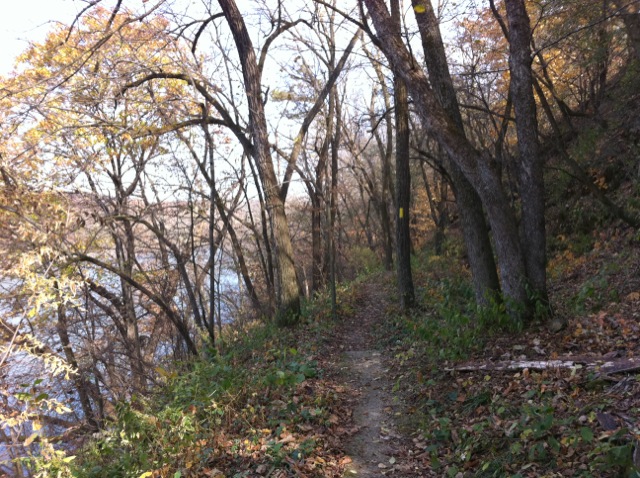
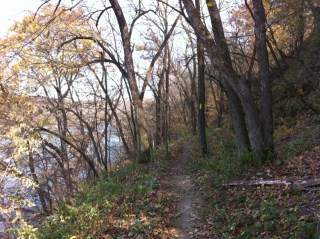
The death throes of the last Ice Age are clearly visible along a path not far from a busy stretch of highway near Madison, Wisconsin. Standing in the parking lot of the Ice Age National Scenic Trail, stands of oaks covering rock-strewn moraines and areas of crater-like kettle ponds are clearly visible. The trail preserves and celebrates the state’s geologic past as it courses like a u-shaped river through Wisconsin.
Around ten thousand years ago, the mile-high wall of ice known as the late Wisconsin Glacier, responsible for shaping much of the physical landscape of Canada, the Upper Midwest, New England and parts of Montana and Washington, began to melt. In its wake, the retreating ice deposited a line of sediment along its southern edge, a serpentine strip of gravelly hills called a terminal moraine that defined the glacier’s final reach. And fittingly–considering the glacier’s name–one of the best places to see the effects of the continent’s Wisconsin glaciation is in Wisconsin, along the Ice Age Trail.
Ice Age Trail segment in the Lodi Marsh
Extending like a ribbon from St. Croix Falls in Polk County to Potawatomi State Park in Door County, this scenic belt provides a walking tour of geologic beauty both close to home and in some of Wisconsin’s remotest places. Carved from land both privately and publicly owned in 30 counties, the trail is currently more than half-finished, about 600 of the proposed 1,200 miles, and is one of only two national trails in the U.S. contained within one state.
Preservation of this geologic fingerprint was the idea of Milwaukee attorney and avid outdoorsman Raymond Zillmer, who believed the trail would tell the story of Wisconsin’s past while serving as a wide-scale conservation effort in a state he believed destined for more and more development. And since 1958, thousands of Wisconsin residents have volunteered countless hours to protect, preserve and share this past through the creation of a continuous park along the glacier’s edge.
Last fall, we started section hiking the trail, beginning with the part closest to Madison and working our way north and south. Our progress is slow. It’s hard to get very far when you have to park at one end and hike back to the car, and when you only have a day or two every two weeks to go out. But we’re getting there. 
The Devil’s Staircase in Janesville
Last weekend we completed about half of the Janesville section, about six miles, but 12 for us since we had to walk back the way we came. The trail is a fantastic mix of city, park, suburbia, prairie, and woods. We’ve hiked–if I can even use that word–around the Farm and Fleet in Verona, past several libraries, and through the downtown streets of Lodi, Cross Plains, and Janesville. We walked through a dark tunnel under a roadway, hoping to find a safer way to cross, only to find ourselves at what appeared to be the underground entrance to a mental hospital. And a few weeks ago, a golf ball from a wildly off course golfer nearly knocked me out as we hiked the strip of woods between a neighborhood and golf course. But we’ve also hiked through gorgeous restored prairies and along limestone bluffs. 
The Ice Age Trail is truly a wonderful adventure. And one I think I’ll be on for the rest of my life at the rate we are going. 

Songcatchers

Did you know that the government once paid people to record our nation’s musical heritage? In the years before World War II, fieldworkers, evocatively known as “songcatchers,” traveled around the country  recording, collecting, and transcribing folk music from everyone from lumberjacks to American Indians and recent immigrants. Many of the recordings ended up in the Library of Congress in its folk music collection, along with photographs and other ephemera from our nation’s singers and musicians.

A great picture of some Wisconsin women playing the Swiss bells.  WHI-25191

The urge to collect this music came from many sources. One was technology. As electricity spread and more people bought radios, many folklorists and other songcatchers worried that people would sing along with the radio rather than their traditional music, spelling the end to the rich and vital music of our nation’s ethnic heritage.

Another was employment. During the Depression, several New Deal programs, including the Federal Music Project, the California Folk Music Project, the Wisconsin Folk Music Project, and the Resettlement Administration, gave unemployed men and women jobs collecting music. One goal of the Federal Music Project was to record and define the American musical scene in all its variety.

Interestingly, many of the people given the task of collecting folk music were women. Frances Densmore, for instance, devoted her life to the study of American Indian music, visiting Indian communities across the Upper Midwest to study and transcribe their music. Another woman, Helen Heffron Roberts traveled to Jamaica, Hawaii, California, and the American Southwest collecting music and other ethnographic materials.

At the time, music, like many other professional fields, was largely closed to women. Many did not believe women possessed the bodily strength or presence of mind to play music in professional orchestras, conduct, or compose complete pieces. Yet these women became the first to go out in the field and live among their informants, studying and recording music. They truly were pioneers in American ethnomusicology and in pushing women forward into new careers.

This music truly is great stuff. It’s nice to think that we once thought it was so important to invest in our culture.

Here’s a verse from a song collected in Wisconsin called “Fond du Lac Jail:”
“In the morning you receive a dry loaf of bread
That’s hard as stone and heavy as lead
It’s thrown from the ceiling down into your cell,
Like coming from Heaven popped down into Hell.”

My story on Wisconsin songcatcher Helene Stratman-Thomas will appear in the winter issue of the Wisconsin Magazine of History.