Homeless Book Club

On Tuesday morning, I had the honor of speaking at Madison’s Homeless Book Club.  I give a lot of talks, mostly on Wisconsin history but also on writing, being a writer, apples, and whatever else someone somewhere thinks I know anything about. And while I’ve learned to enjoy giving talks, this one was particularly fun.

The group meets once a week to discuss a book in a local church. It’s a respite, an escape from the hardships of daily life. Everyone in the group had read my book, A Short History of Wisconsin. It’s always a different experience going in to a group already familiar with your work rather than trying to “sell” them on it through the caliber (really, how entertaining you are ) of your talk. They asked great questions about the choices I made as a writer in selecting what to include and exclude, and for more detail about certain topics. One person even suggested that the conclusion should have been the introduction, which was fascinating to me since the introduction and conclusion are the most handwringing parts of any writing project in my mind – it was also the first time in what must be more than 100 talks about this book that anyone has suggested that structural change.

The group has had an impressive roster of guest authors, including Michael Perry (Population 485, Coop, Truck: A Love Story), Luis Alberto Urrea (The Devil’s Highway, Queen of America) and Garth Stein (The Art of Racing in the Rain), so it was a pleasure to be asked and included among this group. I had a great time and I hope they did, too!

Read about my visit on the “Streets of Madison” blog.

Silver Award for eHistory

My book A Short History of Wisconsin recently (in the last few months anyway) became available as an ebook. And it’s digital self just won a silver prize in the history category from eLit Awards, which, according to their website, recognizes the “very best of English language digital publishing entertainment.” That’s right – my history book has ceased to be just a book and is now “digital publishing entertainment.” Awesome. Thanks eLit!

Mushroom Hunter

I’ve only found one. “Found” might be too generous of a term for what happened. Tripped is probably more accurate even if it makes me sound like the klutz that I probably am.

Miraculously, the morel mushroom survived the impact with my foot, its top cut clean off the stem but still whole and undamaged. I carefully picked it up and stuck it in the netting pocket of my backpack. Please don’t get crushed now, I thought, imagining what I would do with this single mushroom when we got home from our hike.

Warm spring weather sends morels popping up through the dried leaves of a Wisconsin woods. They are a wily bunch – resisting easy detection with their brown spongy heads. Accomplished morel hunters zealously guard their mushrooming grounds. I know a few of them. “Maybe I’ll take you sometime,” says a friend. “But you’ll have to be blindfolded.” I laugh but then realize she’s not joking. Morels are the truffles of Wisconsin. Now if only I could get a morel sniffing pig…

Advice on how to find morels is plentiful. Look by dead or dying elms, they say. Old apple orchards, pine trees, old ash, or old poplar. The advice all assumes I can easily identify these trees, particularly when dead or dying. I look at pictures and study tree guides.

Ferns but no morels yet...

But out in the woods, I just walk and scan, walk and scan, hoping to spot that elusive brown cap. No luck yet. I’m not yet worthy of the shirt I spotted in the window of a Czech Village store in Cedar Rapids: Morel Mushroom Master. The store boasted a full line of mushroom lovers gear and even had two 18 inch carved wooden morels in the window.

My one morel made it home safely from the hike. I carefully washed it and then sauteed it in butter. Divided into two servings, the small slices equalled about a teaspoon of food each for me and my husband. But it was an intoxicating taste of a hunt that I’ve only just begun.

Check out this great morel mushroom poem from poet Jane Whitledge.

Making Radio

Most of my work days look like this:

I sit for hours cutting a word from here and a phrase from there; deleting the sound of swallows and licked lips (you’d be amazed how loud they are in a microphone – and perhaps once you do know, how self-conscious you become about them); searching for the perfect music and then fitting it in to complement but not overpower the voice, to emphasize a point and then fade away; and trying to make sentences I’ve cut from 10 different places sound like they flow naturally from one into the next. It’s the glamorous world of radio.

But if maybe not glamorous – there’s nothing stylish about the enormous black headphones strapped to my head – it’s certainly magical. Even after hours listening to the same paragraph over and over and over… and over… to the point that I have memorized the entire essay or interview answer (or more recently, a song), it never fails to excite me when it finally falls together. It’s just like writing the perfect sentence or finding just the right word to describe a moment, a scene, a person. It just feels… right.

Creating radio is an intimate experience, too. Radio is itself the most intimate of mediums – a voice talking to you, the listener, over the airwaves. Voices you know in a second but couldn’t identify the face of its owner. And yet you somehow feel connected. You feel that you know her.

The same thing happens in my headphones as the subject tells me a story, over and over, that I just have to get right. I owe it to her, I think, as I make the painful decisions of what is essential and what can be left behind. The soundwaves may not look so personal on my screen but most special things are hard, if not impossible, to see.

I can’t imagine the day when this will ever get old – when I’ll stop getting excited about someone’s story and determining how to share it. Sure, my ears throb after hours encased in headphones and my pointer finger aches from endless mouse clicking, but even so, the end result always sounds like magic to me.

Here a few recent radio pieces I’ve produced* for Wisconsin Life on Wisconsin Public Radio:

Count This Penny – songs based on letters of Wisconsin Civil War soldiers (love them, love this)

Stand-Up Paddleboarding (I can’t wait to try it!)

Distill America (I did the recording for this one, too)

Sugaring Season

* Many people ask me what a producer actually does. Good question. In radio, producers do a variety of things but generally book guests for talk shows, find music and sound clips, sometimes write questions for interviews, conduct interviews, and edit audio. Essentially everything but take to the microphone themselves.

An Ode To Bloomers for Women’s History Month

March is women’s history month, and in honor of the month (though really, every day is about women’s history for me), I recorded an essay about Amelia Bloomer and her bloomers for Wisconsin Life. 

Eating Out of Season

Some people feel guilty about eating too much. Others about eating “bad” foods – you know, the ones that taste delicious usually because they are too fatty, too salty, too sugary, or some combination of all three. “Bad” is, of course, relative.

For me, my letter A of shame comes from eating out of season. Or perhaps worse still – eating foods that will never have a season here in Wisconsin. Foods from thousands of miles away. Bananas. Avocados. I hide them away when company comes, outwardly virtuous to my local seasonal eating plan but hiding a terrible damning secret.

It’s a foolish worry. Food shouldn’t inspire guilt. That’s part of what makes eating so pleasurable. Not to mention the dozens – literally dozens – of bunches of kale and pounds and pounds of winter squash, potatoes, carrots, parsnips, and rutabagas I’ve virtuously eaten (and loved) this winter. My mettle is proven – a real medal, perhaps one made from a massive slice of carrot, should hang ’round my neck.

Even so, it’s one I think about every time I go to the grocery store or order from a menu. What’s in season? What’s possibly local? How will that asparagus really taste in February as opposed to the tender bundle I can barely keep out of mouth in June? Is it worth it? Sometimes the answer to that last question is “yes.”

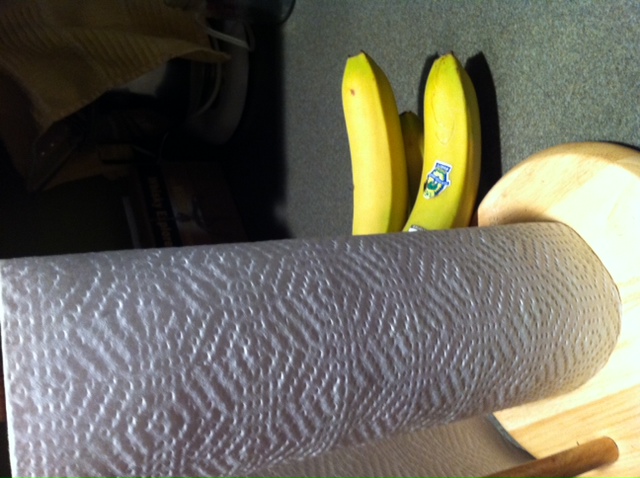
Bananas cower in fear of being discovered behind the paper towels

In some ways, I feel less remorse eating those never seasonal foods than the ones that are just out of season. I know what a really ripe, really delicious tomato tastes like so it’s wan, well-traveled winter cousin is a poor substitute. Even the apple I ate today tasted off – my fall apples finally ran out a month ago so this store-bought apple from South America tasted of a season that didn’t match the view out my window. An avocado, on the other hand, is always foreign – at least until I move somewhere with an avocado season – so I have no comparisons, no trade-offs for a potential pleasure now over the benefits of waiting until spring or summer.

I’m trying to let the guilt pass. You’ll know how well I’ve succeeded if you see a bunch of bananas on my counter.

Cross-Country Skiing on the Radio

My essay on cross-country skiing was featured this morning on Wisconsin Public Radio’s “Wisconsin Life.”

And last week, I had a great conversation with CSA farmer Kristen Kordet about planning for the farming season. We looked at seed catalogs and talked about her favorite varieties. She’s a delight to talk to and I think the edited piece turned out really well.


Embracing Winter

Before I moved to Wisconsin, I’m not sure I’d ever even seen a cross-country ski. As a kid growing up near Seattle, winter was a destination, not a season.  On Monday mornings, my classmates returned to school with creased lift tags dangling from the zippers of their coats, and their red, sunburned faces raccoonishly imprinted with goggles. But my parents, Chicagoans by birth, didn’t ski, had never skied, and certainly weren’t about to start downhill skiing in their late 30s. So winter remained more of an abstraction to me, a snowy realm I could see on the flanks of the Cascades – far off in the distance.

Things were different in Wisconsin. Winter was unavoidable, an elemental part of life. Even so, I often overheard people talking about how they “got through it” as if it were a messy divorce or a one-hundred-year flood rather than an annual occurrence. I learned to “get through” winter on cross-country skis.

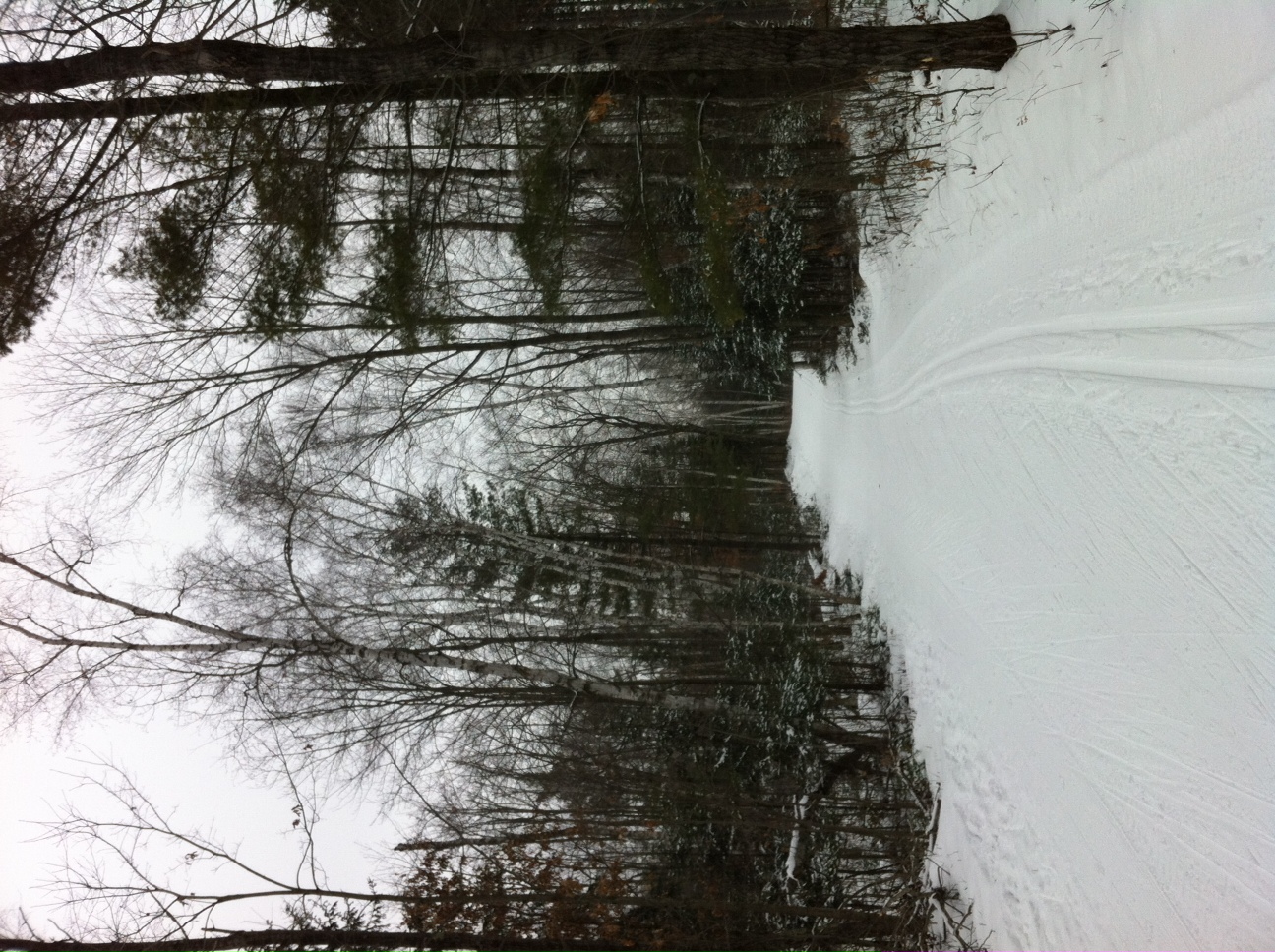
Once you get the motion right – the kicking and gliding, riding the driving ski with your body floating above – you discover the grace of skimming through still air and snow. Sliding and poling your way along, cross-country skis make no more noise than a kayak slipping through flat water.

Even the first awkward tries can have grace. My first cross-country skis were rentals. Stepping onto the strips of what seemed to me unimaginably thin plastic, my feet slid forward and I fell backward. Three falls later, I was off, shuffling and jerking my arms and puffing the arctic air. Despite myself, I soon fell into a rhythm, sloppily syncopated but forward marching, punctuated by my growing elation.

With snow and skis, I can go anywhere, over a frozen pond and through the interior of the woods. In the spring and summer, I’d worry about my path, anxious to find a trail map to keep from getting lost. But in the winter, my ski tracks are reassurance, guiding me back to my start.

When Lake Mendota freezes, I glide out onto its surface, a wide expanse of flat, snow-covered ice that feels eerily empty yet magical before the packed shoreline of the city. Part of the spell is skiing past the ghosts of summer – boathouses, sections of dock, lawn chairs, a life preserver. The Memorial Union Terrace, the center of summer in Madison, sits unobtrusively under a blanket of snow.  The bright paint of upturned boats now splotched with snow seem a bit more solemn in the stark winter light. Yet at the same time, the sky rarely feels so large or so vivid.

There’s peace on two skis. The muffled quiet of the snow seems to magnify every other sound. The rustle of dried branches, bird calls, the swirl of my thoughts. Now I’m the one with the weekend winter stories, of quiet wonders found skiing in snowy woods and fields. It’s not showy but more exhilarating than anything I could imagine.

A Christmas Orange

Did you get an orange in the toe of your stocking for Christmas? Despite the piles of glistening oranges tempting us year ’round at the grocery store, winter really is citrus season. And oranges, like all citrus fruits, used to be a rare and precious treat – hence the fruit’s appearance in Christmas stockings. Even after oranges became more widely and regularly available in the mid-20th century, my parents still threw a few in my stocking each year (though it may have been an effort to counterbalance my all  – Christmas cookie diet of the preceding week).

Oranges are believed to be natives of China. In some languages, the word for ‘orange’ actually means Chinese apple – apfelsein in German and sinaasappel in Dutch, for example. The ‘apple’ name got tossed around a lot in fruit history as many round, brightly colored edibles got tagged with the name before finally getting their own unique identifier.

Despite being linked to apples by name, oranges didn’t travel overland to colonize Asia and Europe like the apple. As Waverley Root notes in Food, “there were no oranges in the hanging gardens of Babylon, they are not mentioned in the Bible, and it is questionable whether the ancient Greeks knew them.” Oranges, instead, came by sea, carried to Europe by Arab traders and explorers. The Romans grew them but they were rare and expensive so they didn’t gain the cult following of the apple, which the Romans cultivated at least 24 varieties. Oranges mostly disappeared with the fall of Rome.

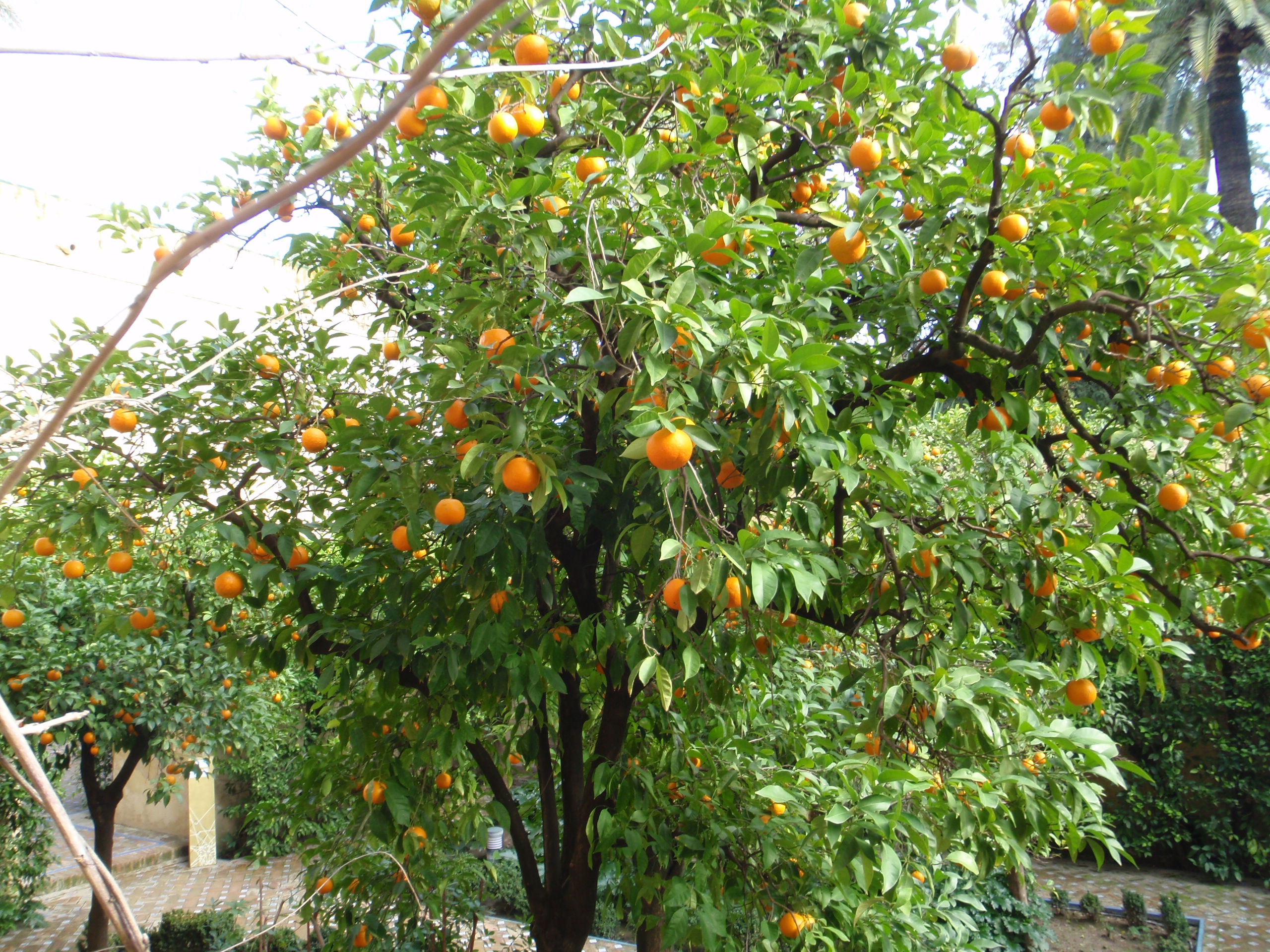
The Moors revived the orange in Europe, conquering Spain and covering the region from Granada to Seville in citrus orchards that remain prevalent to this day. The streets of both cities, but especially Seville, are lined with orange trees that sag under the weight of the fruit in the winter. I made the mistake of eating one of the oranges on a tree in Seville, not realizing they were the bitter, Seville orange that is the principle component of what I only half-jokingly refer to as my mortal food enemy: marmalade. It now made sense why the Spaniards just walked by the free food hanging above their heads.

The bitter oranges of Seville

Christopher Columbus brought oranges to the New World, one of the rare instances of a European explorer bringing something good along with them. Columbus planted them on Hispaniola in 1493, and the climate of the West Indies proved so conducive to the fruit that the islands were soon covered with orange groves.

Hernando de Soto is on record as bringing the first oranges to what is now the United States, though he may not have been the first.  Either way, oranges were growing in abundance in Florida by the late 16th century, and the state remains the country’s leading producer of oranges. And the leading producer of Christmas oranges.

The Coffee Cure

T.S. Eliot measured out his life in coffee spoons. Scottish historian and philosopher Sir James Mackintosh claimed that “the powers of a man’s mind are directly proportioned to the quantity of coffee he drinks.” Many other coffee drinkers would probably agree.

In 1803, German physician Samuel Hahnemann claimed that coffee was purely medicinal and nothing more. The founder of homeopathy, Hahnemann drew a careful distinction between ‘food’ and ‘medicine.’ “Medicinal things are substances that do not nourish, but alter the healthy condition of the body,” Hahnemann wrote in On the Effects of Coffee. Medicines taken by a healthy person “deranges the harmonious concordance of our organs, undermines health and shortens life.” For Hahnemann, coffee fell into this category of harmful substances, potentially responsible for all of man’s suffering and ill health. Coffee was the cause of impotence, sterility, rickets, insomnia (pretty true actually), stammering, melancholy, and malicious envy among other conditions.

Hahnemann - No black coffee for him

Hahnemann’s feelings about coffee seem to stem from his personal dislike of its flavor rather than anything scientific, though. “No one ever smoked tobacco for the first time in his life without disgust,” he wrote, and “no healthy person ever drank unsugared black coffee for the first time in his life with gusto – a hint given by nature to shun the first occasion for transgressing the laws of health.” Hahnemann clearly needed to ask for “room” with his order.

Hahnemann certainly wasn’t blind to the benefits of coffee, though, especially in the morning. His description seems to describe several people I know and to explain the Starbucks empire: “In the first moments or quarters of an hour after awaking…everyone who is not living completely in a state of rude nature, has a disagreeable feeling of not thoroughly awakened consciousness, of confusion, of laziness, and want of pliancy in the limbs.” He goes on to explain how coffee “removes this disagreeable situation” as “we suddenly become completely alive” with each sip.

Two decades later, Hahnemann realized that perhaps he’d been too hasty in his condemnation of coffee. He wasn’t ready to fully embrace coffee but maybe it wasn’t the sole cause of man’s fall from health.

Millions of coffee drinkers agree.