“Mothers to the Motherless:” Policewomen in Chicago

Policewomen Agnes Walsh (from left), Anna Loucks, Theresa Johnson, Anna Sheridan, Lulu Burt, Mabel Rockwell, and Miss Clara B. Olsen.  Source: Chicago History Museum

Policewomen Agnes Walsh (from left), Anna Loucks, Theresa Johnson, Anna Sheridan, Lulu Burt, Mabel Rockwell, and Miss Clara B. Olsen.
Source: Chicago History Museum

On August 5, 1913, ten women were sworn in as officers – or “copettes” as one reporter called them – for the Chicago Police Department. The women, all trained as social workers, did not wear uniforms or carry revolvers but they did have a badge.

The fight for female officers had been raging for decades. Women’s groups had long argued that female detainees and juveniles needed protection from male officers and other male prisoners. Searched, interrogated, and detained in cells often beside or within sight of men, women detainees often suffered rape and sexual assault. Even outside of jails and courtrooms, advocates argued that women with police authority could keep better order and protect the morals of women and children at beaches, public parks, and other places of amusement than male officers. They could become, in effect, “mothers to the motherless.”

Few police departments and politicians supported the effort. Many labeled the crusade unnecessary and a waste of money. Others argued that women were physically incapable of being officers. Even after many cities passed ordinances authorizing the hiring of women officers in the late 19th and early 20th centuries, few appropriations were made to actually make the hires.

Chicago Mayor Carter Harrison pushed the city council to hire female officers for the department in 1913. An order was passed, and Harrison appointed ten women. Police training consisted of a two hour lecture delivered by the terrifically named Chief McWeeny (especially fitting considering the pervasive belief that women were not strong enough to be officers) who told the new recruits to have compassion, not be “too strenuous,” “don’t be too nosy,” and to “present all cases fairly and squarely.” The women then received a police whistle, a book of rules, and badge.

Two days later, on August 7th, two of the female officers made their first arrest. It was of another woman, Nellie Cameron, for disorderly conduct. The novelty of women arresting women attracted a fair bit of media attention. Everyone was eager to see how women would handle a potentially physical interaction in making arrests. One officer claimed that female criminals would put up a bigger fight than normal for policewomen because they would not be afraid of another woman. Those opposed to policewomen jumped on every opportunity to show that women could not handle the work, though given the limited role and power (not to mention gear and a proper uniform) afforded these early women officers, the comparison of male and female officers could hardly be fair.

Concern about women’s physical strength led the police chief to assign a new batch of women officers to jujitsu instruction in 1914, a development that led to the New York Times to report, “Policewomen to Wrestle.”

Women’s path into police work and law enforcement was long and hard. In 1913, there were 38 in the U.S. By 1915, this number had risen to 70 in 26 cities. Most served in limited roles, mostly keeping order among women and children, in public places. It would be decades more before they earned a more equal place on the force. Even so, these early women forged a pioneering course.

There are few things in history that I love more than what I like to refer to as “women in unexpected places.” It’s usually a job or activity deemed “unwomanly” or dangerous to feminine virtue for one lame (and generally unconvincing, at least to me) reason or another. This is what draws me to policewomen and people like 19th century phrenologist, educator, and doctor Lydia Folger, who had her own medical practice (at a time when women struggled to even be educated and get adequate medical care) and wrote books and gave lectures on such taboo topics as the workings of the female body. Folger and other women like her were leaning in long before Sheryl Sandberg, and their stories have long energized and encouraged me. Really, they are the reason I do history.

Agitation for female police officers

What History Is

The conclusion of Peter Ackroyd’s The History of England Volume I: Foundation* includes a sentence I can’t stop thinking about: “The writing of history is often another way of defining chaos.” He goes on to say how convenience, circumstance, misjudgments, and errors play a large part “in what we are pleased to call the ‘development’ of institutions.”

None of this should come as any surprise. History is the story of people and who among us has not had a life of turmoil and coincidence (and if you have, I don’t want to hear from you)? Opinions change, even the most hardened beliefs transform or are discredited, everything is in a constant state of transition even if it sometimes seems just the opposite. It really is chaos with the historian struggling to piece together and interprete a whole mess of personalities into some kind of narrative that makes sense and gives us a sense of continuity and identity and belonging.

Ackroyd’s use of the word ‘pleased’ particularly pleases me because history can all seem so fated, so predetermined in hindsight as though people in the past were any different than people today. It’s easy to forget that, though. I think it’s why many people don’t (or think they don’t) like history (You do! Trust me!). Life was just as confusing and frustrating and overwhelming and wonderful 1000 years ago as today. History is the stories of people just like you and me.

I’m in the midst of deciding what “chaos” I want to take on as my next book project. It all feels so big and daunting right now with so many voices shouting for attention and roads of unknown possibilities. But it’s also exciting, like the throws of a new relationship. I’ll let you know what I find.


* This was a last minute “I have pounds to spare” purchase at the Heathrow airport before a flight home that turned out to be a remarkable page turner. I’ve had great luck with my hasty book buying (another great airport purchase was Robin Lane Fox’s The Classical World that kept me from fully enjoying all of the entertainment options on offer in our business class “pods” because I couldn’t stop reading it), which I’d like to attribute to my good taste but is really the acumen of the store’s book buyer.

A [Museum] Walk Through Medicine’s Past

Let me tell you about a wonderful place.

I spent the month of May abroad, touring – much of it on foot – in Ireland, Wales, and England. One of my best mornings was spent in London at the free museum and library of the Wellcome Trust (my history dorky-ness reigns unimpeded through work AND vacation times). I first discovered it online while doing research for my next book on the history of 19th century alternative health. The center is an amazing resource for understanding the history of medicine and science, and the connections between medicine, life, and art. Intriguing, right?

Even better for my little Wisconsin history heart, the foundation for the library came from the collections of Wisconsin-born pharmaceutical salesman Henry Solomon Wellcome (1853-1936). Wellcome ran a successful pharmaceutical business in London but devoted much of his time and resources to collecting books and objects related to medicine, health, alchemy, and even witchcraft from around the world.

Here’s three cool things I saw:

2013-05-29 11.11.09

1. Prosthetic limbs through time.

Prosthetic body parts have been used since at least the time of the Greeks and probably earlier (the Greeks left what is likely the first recorded use). None of these are quite that old but can you imagine wearing one of these? Near these limbs was a box of glass eyes.

2013-05-29 11.10.40

2. Phrenological Skull

In the late 18th and 19th centuries, phrenologists argued that the shape and size of various parts of the brain – these parts were known as organs – determined your personality. Your skull was supposedly a “faithful” cast of the brain encased within so rather than perform some risky operation to take a look at your brain, phrenologists could simply feel and measure the bumps on your head. Phrenology was very controversial in the medical community – and even among phrenologists themselves as this skull demonstrates. One half shows the organs as described by phrenology’s founder, Franz Joseph Gall, while the other half shows those of Gall’s disciple Johann Spurzheim.

2013-05-29 11.07.57


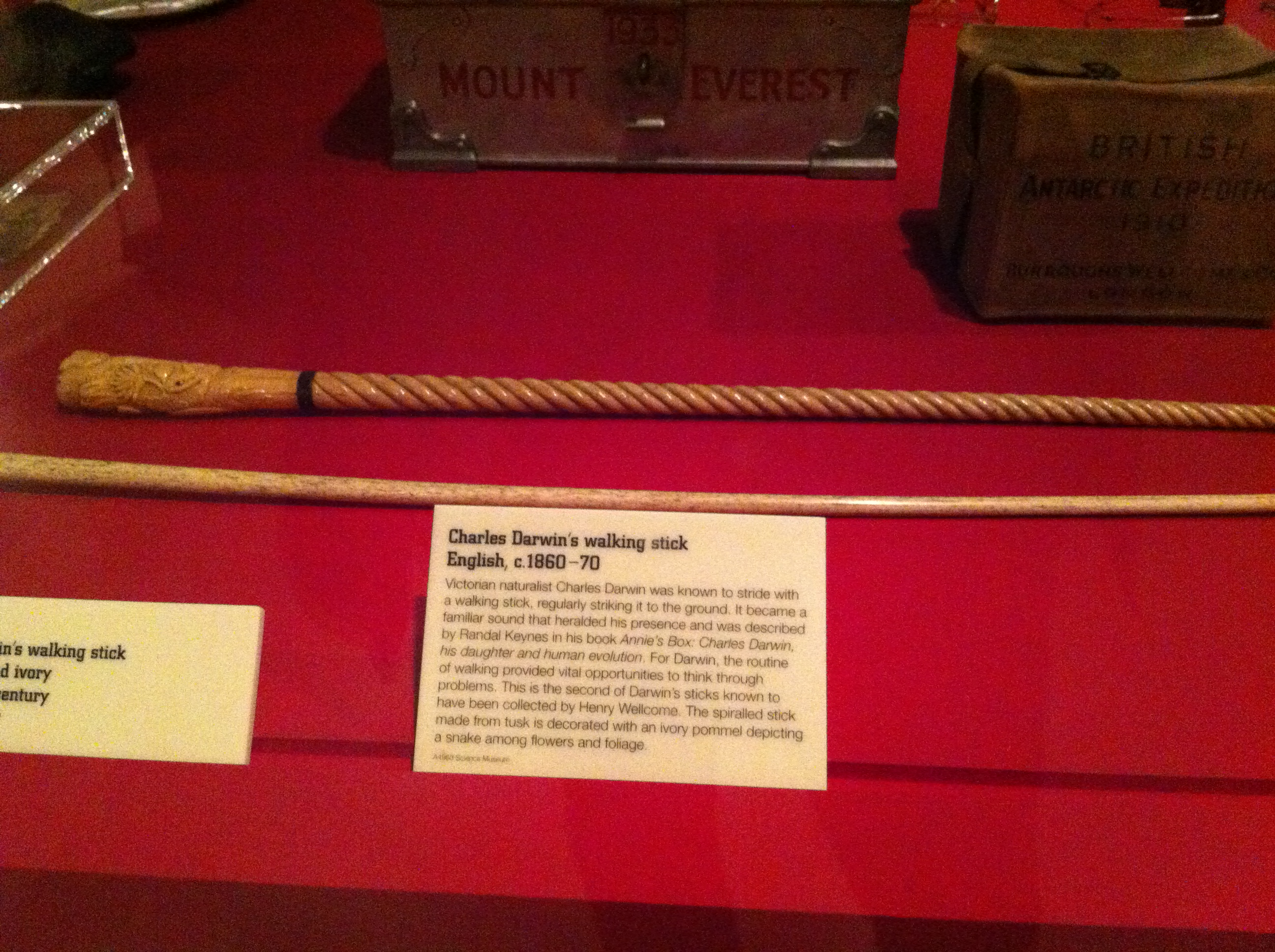
3. Charles Darwin’s Walking Stick

These are two of Darwin’s walking sticks, both intricately carved, one from ivory and one from whalebone. Darwin was a walker – he claimed to get many of his best ideas while walking. As a fervent walker myself, I loved to know that the clicking sound of Darwin’s walking stick hitting the ground became something of his calling card and signature sound.


New Book!

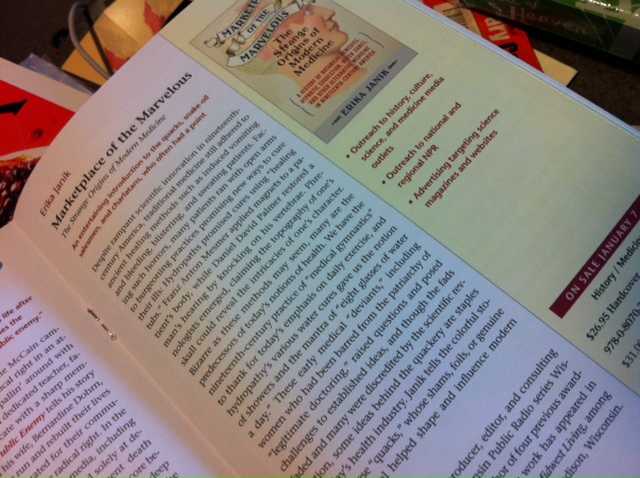
It’s still a ways off – pub date is January 7 – but seeing it in the Beacon catalog makes it more real!Erika Janik Marketplace of the Marvelous

Everything you wanted to know about what we now call alternative but what was known in the 19th century as “irregular” medicine. It’s not quite as irregular as you might think!

Butter and Dairy Queens

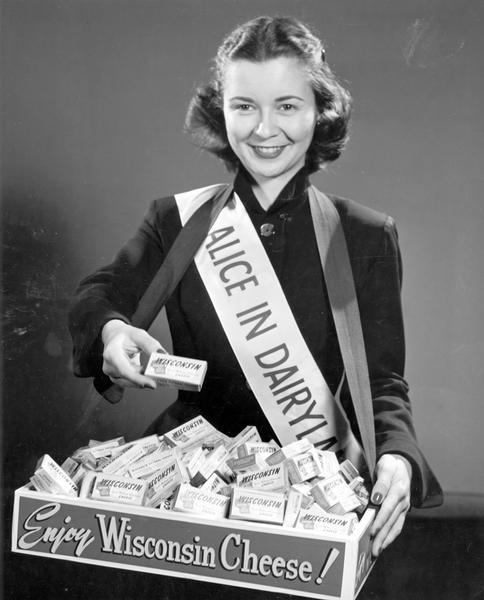
Some girls dream of being a movie star. Me? I’ve got a thing for agricultural queens like Alice in Dairyland. Alice is Wisconsin’s agricultural royalty. Crowned in May, she travels the state during her yearlong reign talking up the importance of farming.

Wisconsin's first Alice Source: Wisconsin Historical Society

Wisconsin’s first Alice
Source: Wisconsin Historical Society

Alice in Dairyland got her start in 1948 at the Wisconsin Centennial Exposition (she was preceded by the “Dairy Queen”).  Margaret McGuire-Blott had the honor of being the first Alice. Alice’s early years were a bit strange. At the State Fair, a huge paper-mache Alice would answer questions from children, while the real Alice sat backstage and threw her voice. But she also got to travel the country.

Early Alices logged more than 150,000 miles a year. They went to Hollywood, rode in the Rose Parade, and danced with Lawrence Welk on TV. Today’s Alice spends most of her time in Wisconsin but she continues to make appearances worldwide.

I met my first Alice at the Wisconsin State Fair in 2003 where I got to shake her hand. Our bond was cemented when she gave me a cow-shaped air freshener.

This was only my first encounter with Wisconsin royalty, though. I once took a class with Wisconsin’s Honey Queen. She wore a different honey t-shirt every day. I thought at first that she just really liked honey.

Wisconsin’s royalty isn’t just confined to dairy and honey, though. We’ve also got a cranberry queen, a Brown Swiss Queen, and a Cherry Blossom Queen, among others. While they may seem a little silly and outdated today, these agricultural queens have an ancient history.

For thousands of years, women have been associated with agriculture and the harvest. Women have been depicted as symbols of the earth, fertility, and abundance, the very things that people hoped for their crops. The mystery of life, especially birth, was one area that women held deep firsthand knowledge, and fertility goddesses, particularly Mother Earth, were important figures in the ancient world. The correlation of fertility and the goddess found its roots in agriculture. All over the world, from Asia and Africa to Europe and South America, female goddesses represented the fruitful plains as well as the work of tending to them.

The Greeks had Demeter who was said to have invented agriculture and all of the rituals associated with it. The Romans had their own Demeter named Ceres, as well as Pomona who kept an eye on the fruit trees. Hindu goddesses watched over food, the harvest, and nourishment. In North and South America, a Corn Mother gave life to the continents’ staple crop. Corn along with beans and squash were known as the Three Sisters because the plants were said to embody female spirits.

This ancient connection between women and the land extends to real women, too, not just divinities. Women have long been responsible for growing, harvesting, and preparing food for themselves and their families.

So Alice in Dairyland and Wisconsin’s other queens aren’t just some prefeminist holdover from the 1940s and 1950s. They are the modern incarnation of a tradition that stretches back thousands of years to people and cultures around the world.

Butter Rules (at least in Wisconsin)

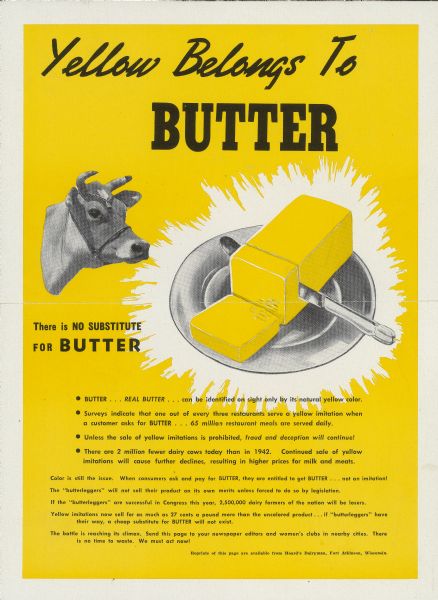
If you eat a meal in a Wisconsin restaurant and want margarine instead of butter, you have to ask for it. Wisconsin law forbids the substitution of margarine for butter in a public eating place. A few lawmakers tried to overturn the law in 2011 but failed in their effort. Under the law, students, patients, and inmates in state institutions will be served butter with meals unless a doctor says that margarine is necessary for their health.  And when you shop for margarine in a Wisconsin grocery store, you must buy a whole pound colored a certain shade of yellow and labeled in letters of a specific size. And don’t even think about making that margarine with imported oil—only domestic vegetable oil can be used in Wisconsin margarine.

Think everything in the Midwest is canned soup, processed and fake? Think again. And Wisconsin’s oleo-war is the ultimate example.

The “Oleomargarine Regulations,” otherwise known as Wisconsin Statute 97.18, are the last fragments of a once mighty law that shielded Wisconsin citizens from the dangers of butter fakes like margarine. Wisconsin was the last state in the country to permit the sale of margarine colored yellow to look like butter. And that was in 1967—nearly a century after margarine was first produced in the United States.

From the start, the artificiality and industrial origin of margarine, or oleo, as it was then known, inspired fear and suspicion. Its main selling point was its low cost. Farmers, not just in Wisconsin, but across the country saw margarine as a phony, a factory-made good contrary to the superior moral values and virtues of farm-produced products. Not that butter being produced on many of these farms was so wonderful.

So bad was the overall quality of Wisconsin butter at the time, that it was known in the Chicago markets as “western grease” and was sold as a lubricant, not for human consumption.  All that began to change after the formation of the Wisconsin Dairyman’s Association in 1872, an organization that quickly recognized that unless butter improved in quality, margarine would drive Wisconsin butter off the market.  Wisconsin passed its first anti-margarine law in 1881, the first of many laws that imposed taxes, licenses, and labeling restrictions on manufacturers.  The most potent weapon against the demon spread, though, was an 1895 law that prohibited the manufacture and sale of margarine colored yellow in imitation of butter.   Grocers and restaurateurs caught trying to palm off margarine for the genuine article faced fines of $50 to $500. Get caught twice and you were sent to jail.

By 1910, margarine manufacturers began to fight back by including packets of coloring  for purchasers to tint the naturally pale margarine according to taste.  Pro-butter interests continue to argue against colored margarine, claiming that yellow was the natural and unique color of butter and that any shade of yellow margarine was an attempt to deceive the consumer.  Colored margarine was banned outright in Wisconsin in 1931—to both buy and to use – though the inclusion of packets of coloring was never outlawed.

Post-World War II conditions favored the repeal of anti-margarine laws, particularly as more and more Wisconsinites began smuggling in yellow margarine from our lax neighbor to the south Illinois because it cost less.  The decades long tussle officially came to an end on July 1, 1967, when Governor Warren Knowles signed legislation legalizing colored margarine using a yellow pen and wearing a yellow tie. While eliminating the color restrictions, the remaining restrictions remind us that in Wisconsin, butter once stood for the good, the true, and the pure.


Historic Green Travel

At a time when everyone and everything is engaged in going green, it’s worth noting that Wisconsin’s first environmentally-sound tour occurred long before going green was hip.

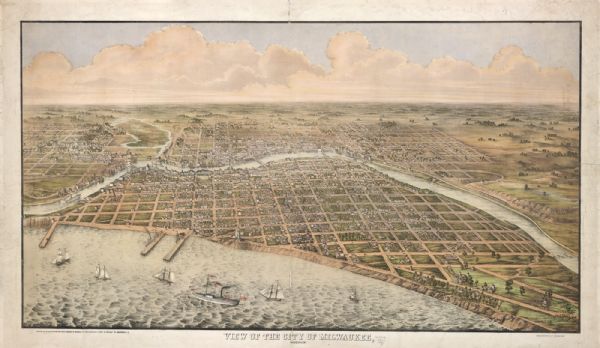
In July 1858, an anonymous Milwaukee resident and his companion set out to cross the entire state, from Lake Michigan to the Mississippi, on foot, just for the heck of it. Signing his articles only as “Alpha C.,” he described their “walk of some little romance” in the Milwaukee Weekly Sentinel.

1856 View of MilwaukeeSource: Wisconsin Historical Images

1856 View of Milwaukee
Source: Wisconsin Historical Images

Walking only three miles outside Milwaukee on the first day, the pair walked 23 miles to Delafield the next day, stopping in Oconomowoc, “a very pleasant village, full of pleasant people, on a very pleasant lake, full of very pleasant sail boats,” he wrote.  Every trip seems pleasant at the start, doesn’t it?

At Watertown, floods had damaged the Watertown Plank Road, which made it “risky for the unsuspecting traveler to attempt to cross Rock River after dark.  There was enough of the bridge left to carry a man into deep water, and nothing laid across to stop him;… and my walk to the Mississippi came near ending at the Rock.”

From Watertown, the pair turned north into Dodge County, where they found a well-kept resort on Lake Emily and the “largest field of Fife wheat I have ever seen…I am incompetent to describe it with justice.”

Fort Winnebago, which they examined at Portage, “is not the interesting pile of ruins that some folks expect to find it. Heading for Baraboo the pair needed to cross the Wisconsin River as dusk came on. The owner of the only boat offered to take them across for the exorbitant fee of $3.00, thinking that with the coming dark, the travelers’ only option would be to pay.  “But we showed him there was one thing more we could do; we reduced ourselves to the state of nature, fastened our little effects up our backs over our shoulders… and swam the river.”

1858 map of WisconsinSource: Wisconsin Historical Images

1858 map of Wisconsin
Source: Wisconsin Historical Images

Exhausted and wet, they camped somewhere around Devils Lake and “then, for the only time during the whole journey, some doubt came into my mind as to there being so much romance about it after all; for that evening only, it assumed the aspect of a stern matter of fact; Fancy was overpowered by Experience.” They made a large fire “to keep the wolves and mosquitoes away, and ate voraciously of smoked beef and crackers.

They reached the Wisconsin Dells the following day, “where one might think the whole world was made of rock.” They visited Pilot Nob, admired the gorges, and speculated correctly on the potential of the area as a magnificent tourist destination.

Following the railroad northwest for the next few days they passed through Lemonwier Valley, and the new towns of Mauston, New Lisbon, and Greenfield.  They pushed through to Sparta and then on to La Crosse where they climbed Grandad Bluff and the writer realized “the earliest ambitious wish of my boyhood was at last gratified — I saw the Mississippi!”

Arriving in La Crosse thirty days after they began, the author concluded ” by the roads I travelled, the distance is 302 miles, all of which I walked,” a mighty distance to walk then as it is almost unimaginable today.  And clearly the walking bug and spirit of adventure were still in him, as he planned to continue on to Itasca Lake, Minnesota, the source of the Mississippi, excited by the prospects of all that he would see along the way.

Old Photos of New Family

As a kid, I would sometimes purchase new aunts, grandparents, and cousins. No, it wasn’t some kind of mail-order bride-type scheme or human trafficking. It was old photographs to fill a family album.

My dad collects old cameras, and every year, we’d go to a big camera show just south of Seattle. Honestly, I dreaded going. Camera bodies, lenses, straps, red bellows, black bellows, tripods, and other metallic odds and ends filled table after table in what seemed to be a room without end. My dad looked at everything at least five times. Maybe five hundred. Or at least that’s what it seemed to my child-sized patience.

Then one year, my mom and I discovered a side room filled with shoe boxes and milk crates of black and white photographs. Babies in Christening gowns on tufted chairs; head shots of women with braids wrapped several times around their heads; mothers and children standing buttoned up around a seated father in a suit and bowler. I couldn’t stop flipping through the photographs, wondering who these people were and how they ended up anonymously stashed in a box. Most had nothing written on the back.

“Lost relatives,” I declared to my mom.

She was fingering a worn velvet photo album with “Family Album” stamped in gold on the front. Inside, its thick board pages had cut-out windows surrounded by printed flowers, polka dots, and curlicues. It was the most beautiful photo album I’d ever seen. A paper tag inside said it dated from the 1890s.

Soon, we were grabbing photos from the boxes and trying them out in the album. Maybe this beautiful woman in the bustle was my great-great-great aunt? And this toddler leaning over the back of the chair a distant cousin? Maybe, why not? We soon filled the album with our new relatives.

To this day, I can’t stop looking at old photographs, trying to imagine who these people are and what their lives must have been like. Photographs of old sports teams and panoramic view of factories with all the employees lined up out front are some of my favorites. And of course, this photo:

This is one of my favorite photos. A bikini and hip waders?! Pretty much perfect.

This is one of my favorite photos. A bikini and hip waders?! Pretty much perfect. Source: WHI 1994

The velvet album filled with my fictional family still sits in my parents’ living room, the people in the photos separated from their own families but more than welcome in mine.


Train Person

I’m a train person. The pace, the unexpected views, the reading, the lack of need for me to pay attention to where we’re going, the very old-fashionedness of it… it’s really just perfect.   Some of my best ideas and clearest thinking have happened while confined to my seat with little to do for hours but stare out the window. The constant rush in my head finally settles down and a perspective I can’t seem to see or grasp in my daily life comes into focus. Everything seems possible again. The path forward seems less a tangle of thorny blackberries than a meandering jaunt through a forest filled with singing cartoon rabbits and deer.

And I can say this after many not-so-perfect long-distance trips.

An overnight trip from Spain to Italy had us clutching our bags in the night as thieves boarded the train at small town stops to grab what they could before jumping off as the train pulled out of the station.

OLYMPUS DIGITAL CAMERA

My first Amtrak trip from Wisconsin to Seattle started with a bus ride to the Twin Cities after flooding took out a portion of the tracks in Central Wisconsin. Once on the train, we discovered that the train had not received all of its usual supplies for the 40+ hour trip across the country. The snack bar had hot dogs but no blankets, pillows, or much of anything else. I shivered in my coach seat, sleeping little, and eating nothing but a 1 pound bag of carrots that I happened to bring along. By the time we reached Idaho, the bathrooms in our car had become indoor outhouses. The lock on one stuck on me and I had to be rescued by the porter who kicked the door open while I pressed my back against the sidewall to avoid a broken nose.

A more recent trip from Chicago to New Orleans took a tragic turn when our train crashed into a man attempting to race the train in his truck in Mississippi. Needless to say, he lost.

But these bad times have been far outweighed by the good. I’ve seen all the people Nathaniel Rich describes in “How to spend 47 hours on a train and not go crazy.” The people who refuse to fly; people starting over; and people obsessed with trains. Once, we stayed in a hotel filled with train spotters in Montana. They sat by the windows and outside on the deck, counting the trains, taking photos of the trains, and talking about trains. All were white-haired men. A few wore the blue-and-white striped engineer hats that I thought only children and characters in children’s books wore. They were deadly serious about trains. Their wives, on the other hand, sat away from the windows chatting about everything but. They paid no attention to the passenger and freight cars clattering by every 10 minutes.

OLYMPUS DIGITAL CAMERA

OLYMPUS DIGITAL CAMERA

We met a man another trip who criss-crossed the country from his home in Santa Barbara on the train. He planned to take one long-distance train after another for two weeks, his destination the journey itself.

Trains often pass through areas you can’t experience any other way, both astonishingly beautiful as on the train from Inverness to Kyle of Lochalsh in Scotland and across the mountains of Norway, and others less so like the trash-strewn industrial landscapes ringing many American cities. But there’s still something magical about all of these places and the rare glimpse afforded from a seat behind a broad pane of glass.

Onboard, I scribble notes and ideas to myself on receipts, hotel notepads, and ticket stubs in an attempt to capture all the good feelings and thoughts that the train has inspired. Stepping off and onto the platform, life consumes me once again. But I’m calmed by the thought that I can capture it all once again on my next train trip.