Apples are on the minds of the folks at the public radio program “To the Best of Our Knowledge” where I recently spoke with Anne Strainchamps about the history of apples.
Check out the story of the Rambo apple on “Wisconsin Life,” too.
Apples are on the minds of the folks at the public radio program “To the Best of Our Knowledge” where I recently spoke with Anne Strainchamps about the history of apples.
Check out the story of the Rambo apple on “Wisconsin Life,” too.
If you think all hard ciders are the same, it’s time to start drinking. Cider (assume I mean hard when I say it) exists in as infinite number of varieties as there are apples in the world. And that’s not even mentioning the countless ways the juice of apples can be distilled and fermented. Technique and ingredients, like in all foods, really matters.
I recently went to a cider and cheese dinner at Graze. Each course was paired with a cider from Wisconsin’s AeppelTreow. We had everything from a sparkling perry to start, to a draft cider and a berry – apple cider mix for dessert. Each was uniquely different and complimented our meal perfectly.
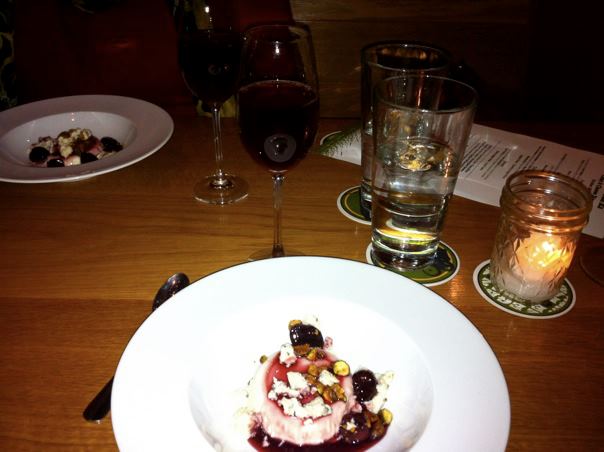
Dessert course with matched cider
Cider is often made from cider apples – apples specially suited to making cider just as some apples are best for baking. These aren’t the types of apples you find in the grocery store. And that’s probably a good thing since they can be high in tannins and acids that make them rather unpalatable to eat out of hand. But they are perfect for cider.
Most cider is made from a combination of apples expertly blended to yield a balanced mix of sugars, acids, and tannins. Tannins gives the cider its color; the more tannin, the deeper the golden brown. It also gives cider its dryness, the same dryness often found in red wines. The wrong blend of these elements can result an undrinkable cider. While most cider contains a blend of apple varieties, there’s one apple that is often sold as a single varietal: Kingston Black. It’s said to be the rare, perfectly balanced cider apple.
Cider tends to reflect the country of its origin. French ciders, for instance, tend to be light and bubbly like another French specialty, champagne. Local tastes become integral to the cider making process and the cider that is produced.
As much as I love cider, my favorite cider of the night was actually not an apple cider at all – it was the perry, or pear cider. In Europe, cidermakers traditionally made ciders from both apples and pears. This hasn’t been as true in the United States, where cider and perry tend to come from separate makers. But as cider becomes more popular, I’m holding out hope that pears and apples will be united in alcoholic glory again.
 Fall is lutefisk time in the Midwest. Lutefisk is dried cod that has been rehydrated in a lye solution and then boiled or baked. The finished fish, served with butter, salt, and pepper, has the consistency and jiggly-ness of Jell-O. Needless to say, it’s an acquired taste.
Every fall, churches throughout the Upper Midwest hold special lutefisk dinners where Norwegian – Americans (though not exclusively – these dinners attract a wide fan base) get in touch with their heritage. In some families, lutefisk even takes the place of the holiday turkey. Fortunately, most of these dinners also include meatballs, mashed potatoes, lefse (the best part if you ask me), and salad for the lutefisk averse.
Norwegians probably didn’t invent lutefisk but they certainly have a long history of making and eating it. Various stories and legends tell of Vikings Salting and drying fish was an efficient way to preserve food, and many Scandinavians brought their lutefisk with them to America when they emigrated.
Today, nostalgia plays a big role in the annual lutefisk dinner. More lutefisk is probably eaten in Wisconsin and Minnesota than in Scandinavia where most people have moved on from the gelatinous fish. But it plays an important role in Midwestern culture, both as an emblem and connection to a past shared by many of this region’s first European immigrants and as a social and community event.
I know I’ll be there.
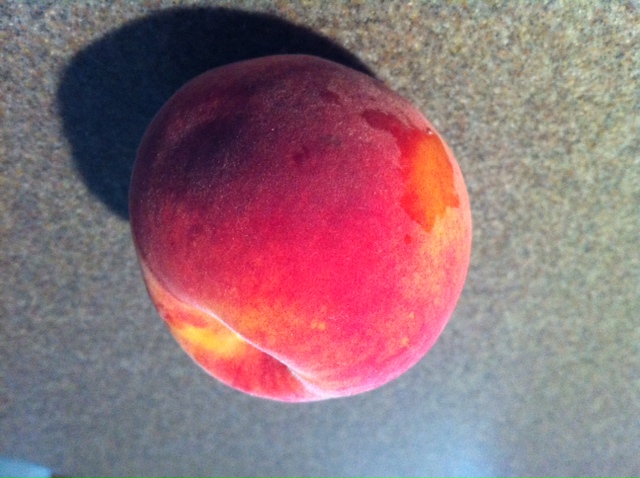
Living in Wisconsin, you resign yourself to eating from the small stream of local fruit. Apples, sure. Pears? Check. We have berries – strawberries, blueberries, blackberries, and raspberries – but the season is short and they are often expensive and available in limited supply at the farmers market. There’s a few others (and many wild fruits for foraging if you know where and when to look) but let’s face it: we aren’t Michigan.
So it was a pleasant surprise to run across bags overflowing with Wisconsin peaches at the farmers market this last weekend. Not only peaches but peaches in October, a month that I tend to associate with the emergence of hardy greens, cabbages, potatoes, beets, and squash. I eagerly bought a sack – and may have elbowed a few people aside in my hurry and delight (sorry, folks) – and rushed back home to dig in.
While I often think of peaches reaching their apogee in southern climates, peaches and apples actually have similar life stories. Peaches are believed to have originated in north China, not all that far from the mountains of Kazakhstan that birthed apple trees. They traveled east, west, north, and south with people and animals. The Romans learned about peaches from the Greeks who had learned about them from the Persians who had first introduced them to the West. In conquering Persia, Alexander the Great took many things from the Persians but one of the most valuable was their love and knowledge of fruit, including apples and peaches.
The Romans even called them “Persian Apples” for the Persians who loved them and likely “apples” for their round shape (many round fruits and vegetables have been called “apples” at some point, from cherries and avocados to eggplant). The Spanish fell particularly hard for the peach and brought it to the Americas, where Native Americans are widely credited with spreading peaches across the continents… and even to Wisconsin, I suppose.
I’ve certainly never hid my devotion to brussels sprouts. But I hadn’t realized how widely word had spread until I crossed paths with the friendly owner of a local restaurant I happen to love. He smiled, said “nice to see you,” and then: “the brussels sprouts salad will be back on the menu very soon.”
Caught.

Lunch today. I may have a problem.
Before refrigeration, all apple cider was hard cider. Apples crushed to the point of releasing their juices quickly become a fizzing, cloudy fermented brew. What we think of as apple juice had a limited lifespan – drink it now or face it’s alcoholic dark side.
But that was okay because most people wanted cider. Cider was the drink of choice for men, women, and children for centuries. It was easy to make at home and provided a way for families to store the apple harvest without spoilage. Cider was also safer than water in many places, and could be made into vinegar for preserving vegetables and fruits for the winter. It really was a useful liquid.

Apple juice only became common with refrigeration in the late 19th and early 20th centuries. The sweet juice was helped along by temperance advocates who decried the dangers of drinking fiendish cider, demon rum’s evil, fruity cousin.
Americans only began calling alcoholic cider “hard” in the 20th century when the sweet juice ascended to the apple drink of choice. Today, cider and apple juice are used almost interchangeably in the United States (some people do have specific beverages in mind with each word but there’s no consensus on what each mean), while alcoholic apples get the moniker “hard.” In most other countries, cider – without qualifiers – still refers to fermented apple juice.
What does Rambo have to do with fruit?
Long before Rambo was a muscular pop culture hero, Rambo was an apple – but not just any apple. Big, juicy with a blush of red when ripe, the Rambo apple was said to be the favorite of Johnny Appleseed, a man who certainly knew his apples. Originating in Sweden, the Rambo apple came to North America with colonist Peter Gunnarson. Gunnarson arrived as a laborer for the New Sweden Colony on the Delaware River in 1640. Among the things he brought with him was a cask of his favorite Swedish apple seeds.

Along with a new home, Peter Gunnarson soon took a new name: Peter Rambo, named for a mountain near his hometown in Sweden. Obviously, he had no idea how big his name would later become.
The apple thrived in North America. Apples are particularly skilled at making themselves at home anywhere. So much so that we often think of apples as native American fruits. But they aren’t from here at all. Apples originated in the mountains of Kazakhstan and traveled the world in the bags and stomachs of humans and animals. They are a canny and prodigious fruit.
The Rambo apple entered American folklore through Johnny “Appleseed” Chapman. Chapman is rumored to have called the Rambo his favorite apple. He planted them (and thousands of other apple seeds) throughout the mid-Atlantic and Ohio Valley, including the Rambo tree that still grows in Ashland County, Ohio, planted by Chapman around 1830. The Rambo was beloved in the 19th century and thousands of these juicy apples were planted around the country.
But while the Rambo apple flourished in its new home, back in Sweden, the Rambo apple had gone extinct. The harsh winter of 1709 led to the death of the Rambo apple and several other old Swedish apple varieties.
It wasn’t until 2008 that the Rambo apple returned to Sweden as a living memorial to the millions of Swedish Americans who crossed the Atlantic for a new life in North America. Some of those Swedish immigrants came to Wisconsin where Rambo apples have also been planted at Old World Wisconsin.
The Rambo apple became part of popular culture in the 1970s when writer David Morrell named his action hero for the apple. His wife had brought home a bag of them from the store. Seeking a “strong sounding name” for his hero, Morrell pounced on the name Rambo after taking a bite of these delicious apples.
The poor apple’s name was never the same again.
On a hike this weekend, I picked a wild apple from a tree sagging under the weight of its slightly misshapen fruit. It was a beautiful fall afternoon and the fruit fairly glowed in the golden fall sunlight. Having just written a book on apples, how could I resist grabbing one for a taste?

In my enthusiasm, I forgot to take a picture of the apple. But look at the lovely fall prairie
It goes without saying that wild apples aren’t like grocery store apples. But they also aren’t like the apples you tend to find at u-pick orchards either. They’re gnarled and lumpy, like an apple skin stretched taught over a box of rocks. They often have black spots and hard knobs from hungry insects. These imperfect wild apples reflect the apples of the past, before pesticides and other pest management strategies made it possible to have perfect, unblemished fruit. So picking one with a good spot for a bite can be a challenge – a hunt high and low through the branches for the right one.
Finding one, I took a bite, my husband watching expectantly for my reaction. I winced briefly at the surprising tartness and then relished the sweet aftertaste. The flesh was bright white with a slight green twinge toward the core, and the texture crumbly, more like a cake than a fruit.
Wild apples aren’t always so good. An apple’s agenda is different than our own. For an apple, a big core with seeds is crucial to reproduction and survival. They aren’t concerned about a good tasting or even a big amount of flesh for eating like we want in an apple. Wild apples are often bitter and tannic, too.
The apple I ate may have been the only one of its kind. An apple tree produces offspring completely unlike its parent tree. Each generation looks and tastes different. Only grafting allows us to produce apples of the same variety. The seed of this wild apple in the Baraboo hills may have traveled over many miles in the stomach of an animal. Or maybe it was the offspring of a tree near by.
All I know is that an unexpected apple found on a hiking trail on a beautiful afternoon is one of the purest pleasures of the season.

My new book, Apple: A Global History, is out this month!
Apple: A Global History explores the cultural and culinary importance of a fruit born in the mountains of Kazakhstan that has since traversed the globe to become a favorite almost everywhere. From the Garden of Eden and Homer’s Odyssey to Johnny Appleseed, William Tell, and even Apple Computer, Erika Janik shows how apples have become a universal source of sustenance, health, and symbolism from ancient times to the present day.
Featuring many mouthwatering illustrations, this exploration of the planet’s most popular fruit includes a guide to selecting the best apples, in addition to apple recipes from around the world, including what is believed to be the first recorded apple recipe from Roman gourmand Marcus Apicius. And Janik doesn’t let us forget that apples are not just good eating; their juice also makes for good drinking—as the history of cider in North America and Europe attests.
I just got back from my first water cure.
 |
| The Greenbrier Resort is a period film brought to life |
Okay, so maybe it wasn’t really a water cure of yore, but the Greenbrier Resort in White Sulphur Springs, West Virginia, began as a resort for people seeking the healing power of the sulphur water that bubbled up from its mountainous ground. People first began coming in 1778, and the visitors only increased in the 19th century as people drank and bathed in hopes of curing everything from headaches to arthritis. All of this water bubbles up from a green-domed, white-columned spring house to the side of the main resort. On top is a statue of Hygeia, the Greek goddess of health and medicine. The spa still uses water from the spring house, though, most people probably think of it as spa rather than a medical facility these days.
Presidents came to the Greenbrier. Lawyers, bankers, and others hoping to escape the summer heat came, too. The construction of the large main hotel in 1858 made the White Sulphur Springs not only a place of healing but also the place to be seen for social elites. That seemed about right. Hydropathic institutes attracted many people who were just looking for a break from the city. They tended to be built in beautiful places (West Virginia is gorgeous) and to offer outdoor activities to relax and rejuvenate.
I was there to attend the Symposium for Professional Food Writers, a multiday extravaganza of great food and great food talk. I met some fantastic and talented people many of who (and many of them are already) are sure to be famous. I’ll be sure to remember that I knew them when.
Today, a visit is like a step back in time–and for me, a step into another social class. Famed decorator Dorothy Draper redid the place in outsize florals, massive colored stripes, and bright colors after World War II (I should have taken more pictures. Heidi Swanson of 101Cookbooks took some nice ones). Everything you could ever need is taken care of as employees swirl around you in the lobby and at every meal. Afternoon tea brought live piano music and a well-dressed couple dancing in the lobby before tea sandwiches and cookies were brought out on silver trays carried high above the heads of the servers. It was a little like stepping into the “Be Our Guest” number from Disney’s Beauty and the Beast.
 |
| Wow, look at the wallpaper. Our curtains were the same pattern and even the ceiling was wallpapered. |
It’s also probably the closest you can get to the hydropathic experience of the past. A well-appointed resort attracting people from all over the country to take in the fresh air, exercise, and of course, as much of that healing water as you could handle.
 Erika Janik