Eating Out of Season

Some people feel guilty about eating too much. Others about eating “bad” foods – you know, the ones that taste delicious usually because they are too fatty, too salty, too sugary, or some combination of all three. “Bad” is, of course, relative.

For me, my letter A of shame comes from eating out of season. Or perhaps worse still – eating foods that will never have a season here in Wisconsin. Foods from thousands of miles away. Bananas. Avocados. I hide them away when company comes, outwardly virtuous to my local seasonal eating plan but hiding a terrible damning secret.

It’s a foolish worry. Food shouldn’t inspire guilt. That’s part of what makes eating so pleasurable. Not to mention the dozens – literally dozens – of bunches of kale and pounds and pounds of winter squash, potatoes, carrots, parsnips, and rutabagas I’ve virtuously eaten (and loved) this winter. My mettle is proven – a real medal, perhaps one made from a massive slice of carrot, should hang ’round my neck.

Even so, it’s one I think about every time I go to the grocery store or order from a menu. What’s in season? What’s possibly local? How will that asparagus really taste in February as opposed to the tender bundle I can barely keep out of mouth in June? Is it worth it? Sometimes the answer to that last question is “yes.”
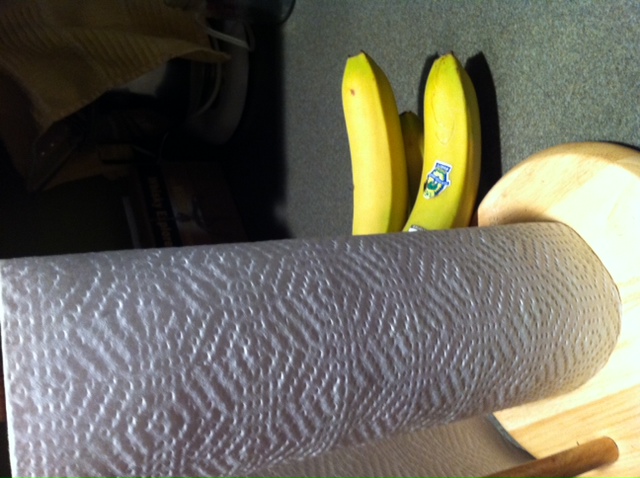
Bananas cower in fear of being discovered behind the paper towels

In some ways, I feel less remorse eating those never seasonal foods than the ones that are just out of season. I know what a really ripe, really delicious tomato tastes like so it’s wan, well-traveled winter cousin is a poor substitute. Even the apple I ate today tasted off – my fall apples finally ran out a month ago so this store-bought apple from South America tasted of a season that didn’t match the view out my window. An avocado, on the other hand, is always foreign – at least until I move somewhere with an avocado season – so I have no comparisons, no trade-offs for a potential pleasure now over the benefits of waiting until spring or summer.

I’m trying to let the guilt pass. You’ll know how well I’ve succeeded if you see a bunch of bananas on my counter.

Solace of Tortillas

Growing up, I never ate Mexican food. Never did a tortilla, refried bean, or dab of guacamole cross my lips – at least until I was in college. But now, it’s all I want in uncertain, tired, stressful, and even many joyous occasions. It’s a comfort food I found only as an adult.

On a recent trip, my husband and I drove for hours – days really – looking for something we just couldn’t find. We hit every small town, walked the main streets, searching for a bit of local culture and charm – the kind we run into a lot in Wisconsin. But it was not to be. After another day of side roads and diversions, pulling into a town that promised a historic waterfront with a charming downtown that actually yielded a few mostly closed businesses (and the open ones all empty, rather charmless bars), boarded up buildings, and a large cement wall between the town and the water, we dejectedly realized our search was likely in vain. Tired and disappointed, we headed to the nearest Mexican place, for there’s solace in tortillas.

It wasn’t the first time. Many trips, even ones a little more rewarding, often find us in a Mexican restaurant at some point. A long day of driving or the excitement and stress of being in a big crowded city for several days straight often leave me craving fajitas. Tired and a little dehydrated, we ate Mexican after my first triathlon. A visit to the emergency room after a bee sting was followed by tacos. Our engagement dinner a few years back found us in a Mexican restaurant after a long afternoon and early evening driving around the Olympic Peninsula. My now-husband was a little embarrassed – it wasn’t what he’d hoped our first meal as an engaged couple would be – but to me it was perfect. Perfectly us to end up eating Mexican.

Engagement Mexican - tired and dirty from hiking and driving

Comfort can come in nearly any food, found at any time. It isn’t always something you grew up with or remember having at certain times as a child or teenager. Sometimes your comfort food is something that appears at just the right time and place.


Wassailing the New Year

Here we come a-wassailing 
Among the leaves so green; 
Here we come a-wand’ring 
So fair to be seen. 
Love and joy come to you, 
And to you your wassail too; 
And God bless you and send you 
a happy New Year.

We all know the song, as familiar as nearly any other holiday song. And while I often happily sing along to songs that I have no idea what they mean (or perhaps I’m just singing all the wrong words – a post for another time), this one made me pause. I’m coming a-what? And we’re wishing it love and joy?

Wassailing is the practice of thanking the deity of the apple orchards to encourage fertility and ensure next year’s crop. The term wassail probably comes from the Old Norse ves heil and the Old English was hal meaning to “be in good health.” It was originally used as a greeting but became so integrated into drinking rituals in England that the invading Normans who arrived in 1066 thought it was a toast distinctive to the island. Wassail also came to mean the drink used for the toast, which was usually a spiced wine known as Renwein. Because the wine and the spices had to be imported, it was a precious commodity among early English families. Recipes varied among families based on who could afford which ingredients.  Later, beer became an acceptable and widely used wassail.

Dancing in the Cider Orchard

Wassailing became an important practice (and the seeming social event of the season) in cider growing areas of England at least as far back as the 18th century. Held on the eve of Twelfth Night in early January, revelers placed a jug of cider or a piece of cider-soaked bread or cake on the biggest apple tree to honor the gods. In other places, trees are sprinkled with cider. A chant or song nearly always accompanied the offering, and the ceremony generally concluded with the banging of pots and kettles, the firing of guns, and the blowing of horns. These noises were either intended to awake the tree gods or to scare away evil spirits – or maybe a little bit of both. Some people still celebrate today.

So next time you hear the song, bless the apple trees for the coming of spring and maybe make yourself some wassail to ward off evil spirits.

Wassail

Recipes for wassail vary widely, and can have a base of beer, wine, or cider. This recipe is based on a Tudor concoction.

10 small apples

10 teaspoons brown sugar

2 bottles dry sherry or dry Madeira

1/2 teaspoon grated nutmeg

1 teaspoon ground ginger

3 cloves

3 allspice berries

1 stick cinnamon

2 cups superfine sugar

1/2 cup water

6 eggs, separated

1 cup brandy

Heat oven to 350°F. Core the apples and fill each with a teaspoon of brown sugar. Place in a baking pan and fill the bottom with 1/8-inch of water. Bake for 30 minutes or until tender. Set aside.

Combine the sherry or Madeira, nutmeg, ginger, cloves, allspice berries, cinnamon, sugar, and water in a large, heavy saucepan and heat without letting the mixture come to a boil. Leave on very low heat.

Meanwhile, beat the egg yolks until light and lemon-colored. Beat the whites until stiff and fold them into the yolks. Strain the wine mixture and add gradually to the eggs, stirring constantly. Add the brandy. Pour into a metal punch bowl and float the apples on top. Makes about 10 servings.


A Christmas Orange

Did you get an orange in the toe of your stocking for Christmas? Despite the piles of glistening oranges tempting us year ’round at the grocery store, winter really is citrus season. And oranges, like all citrus fruits, used to be a rare and precious treat – hence the fruit’s appearance in Christmas stockings. Even after oranges became more widely and regularly available in the mid-20th century, my parents still threw a few in my stocking each year (though it may have been an effort to counterbalance my all  – Christmas cookie diet of the preceding week).

Oranges are believed to be natives of China. In some languages, the word for ‘orange’ actually means Chinese apple – apfelsein in German and sinaasappel in Dutch, for example. The ‘apple’ name got tossed around a lot in fruit history as many round, brightly colored edibles got tagged with the name before finally getting their own unique identifier.

Despite being linked to apples by name, oranges didn’t travel overland to colonize Asia and Europe like the apple. As Waverley Root notes in Food, “there were no oranges in the hanging gardens of Babylon, they are not mentioned in the Bible, and it is questionable whether the ancient Greeks knew them.” Oranges, instead, came by sea, carried to Europe by Arab traders and explorers. The Romans grew them but they were rare and expensive so they didn’t gain the cult following of the apple, which the Romans cultivated at least 24 varieties. Oranges mostly disappeared with the fall of Rome.

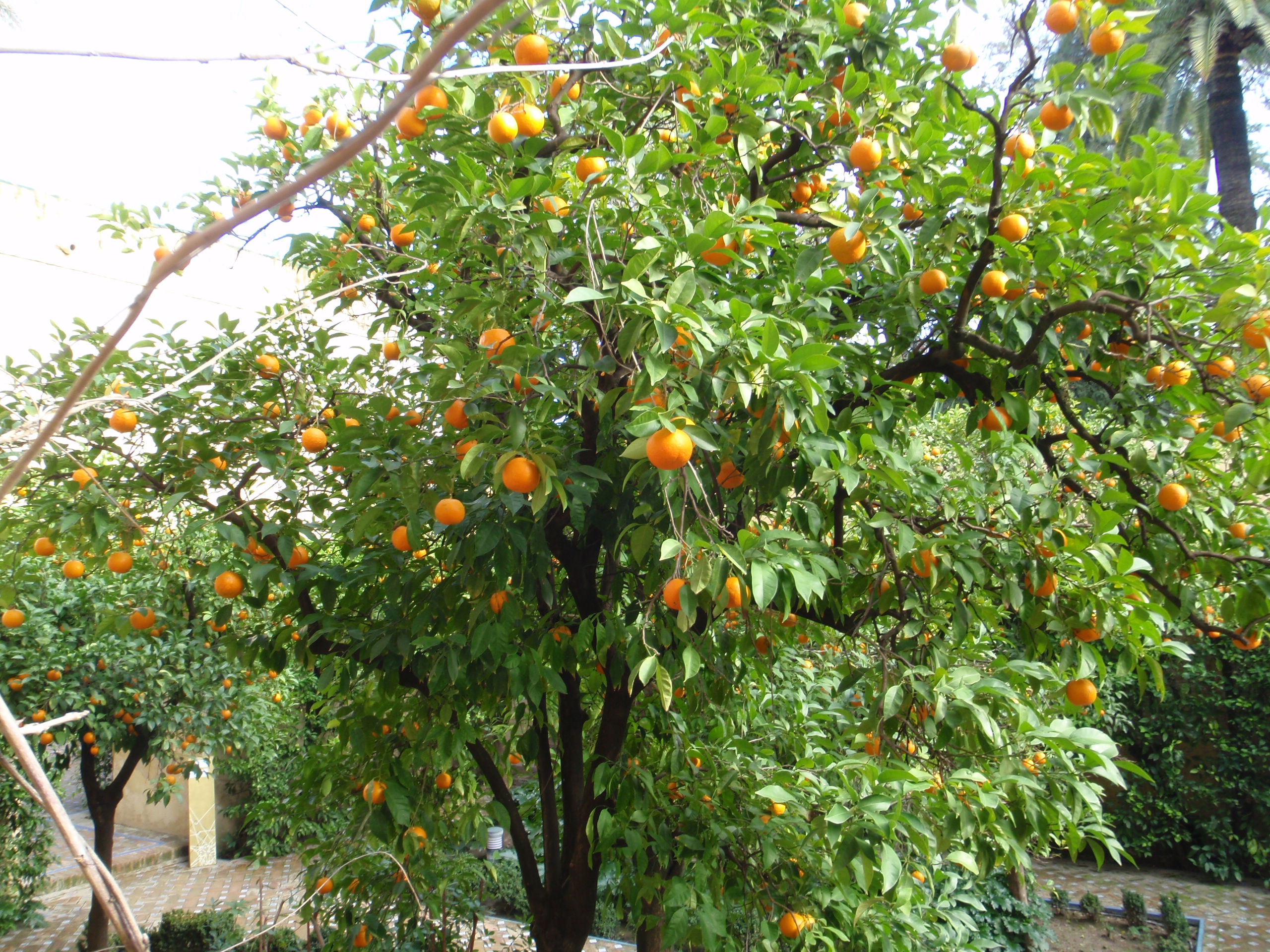
The Moors revived the orange in Europe, conquering Spain and covering the region from Granada to Seville in citrus orchards that remain prevalent to this day. The streets of both cities, but especially Seville, are lined with orange trees that sag under the weight of the fruit in the winter. I made the mistake of eating one of the oranges on a tree in Seville, not realizing they were the bitter, Seville orange that is the principle component of what I only half-jokingly refer to as my mortal food enemy: marmalade. It now made sense why the Spaniards just walked by the free food hanging above their heads.

The bitter oranges of Seville

Christopher Columbus brought oranges to the New World, one of the rare instances of a European explorer bringing something good along with them. Columbus planted them on Hispaniola in 1493, and the climate of the West Indies proved so conducive to the fruit that the islands were soon covered with orange groves.

Hernando de Soto is on record as bringing the first oranges to what is now the United States, though he may not have been the first.  Either way, oranges were growing in abundance in Florida by the late 16th century, and the state remains the country’s leading producer of oranges. And the leading producer of Christmas oranges.

The Coffee Cure

T.S. Eliot measured out his life in coffee spoons. Scottish historian and philosopher Sir James Mackintosh claimed that “the powers of a man’s mind are directly proportioned to the quantity of coffee he drinks.” Many other coffee drinkers would probably agree.

In 1803, German physician Samuel Hahnemann claimed that coffee was purely medicinal and nothing more. The founder of homeopathy, Hahnemann drew a careful distinction between ‘food’ and ‘medicine.’ “Medicinal things are substances that do not nourish, but alter the healthy condition of the body,” Hahnemann wrote in On the Effects of Coffee. Medicines taken by a healthy person “deranges the harmonious concordance of our organs, undermines health and shortens life.” For Hahnemann, coffee fell into this category of harmful substances, potentially responsible for all of man’s suffering and ill health. Coffee was the cause of impotence, sterility, rickets, insomnia (pretty true actually), stammering, melancholy, and malicious envy among other conditions.

Hahnemann - No black coffee for him

Hahnemann’s feelings about coffee seem to stem from his personal dislike of its flavor rather than anything scientific, though. “No one ever smoked tobacco for the first time in his life without disgust,” he wrote, and “no healthy person ever drank unsugared black coffee for the first time in his life with gusto – a hint given by nature to shun the first occasion for transgressing the laws of health.” Hahnemann clearly needed to ask for “room” with his order.

Hahnemann certainly wasn’t blind to the benefits of coffee, though, especially in the morning. His description seems to describe several people I know and to explain the Starbucks empire: “In the first moments or quarters of an hour after awaking…everyone who is not living completely in a state of rude nature, has a disagreeable feeling of not thoroughly awakened consciousness, of confusion, of laziness, and want of pliancy in the limbs.” He goes on to explain how coffee “removes this disagreeable situation” as “we suddenly become completely alive” with each sip.

Two decades later, Hahnemann realized that perhaps he’d been too hasty in his condemnation of coffee. He wasn’t ready to fully embrace coffee but maybe it wasn’t the sole cause of man’s fall from health.

Millions of coffee drinkers agree.

Lefse in the Family

“It just isn’t Christmas without lefse.” It’s a phrase I’ve been known to say many times over the years as I eagerly tear into the foil wrapped package of lefse sent express from my grandma’s kitchen in Illinois to my childhood home near Seattle.

Growing up, the tortilla-like Norwegian flatbread (often made with potatoes, especially in Scandinavian-American communities, but not necessarily in Scandinavia itself) was a special treat – even if my uncle often compared it to a cloth napkin in flavor and texture. He just didn’t get it.

Like her Norwegian ancestors, my grandmother usually makes lefse once, maybe twice, a year, freezing small packets of lefse to last throughout the year. Truth be told, lefse making is chaos incarnate, which perhaps explains why a year’s supply is made in one fell swoop. The sticky, gummy dough sticks like library paste to the grooved rolling pin and counter tops, while a thin layer of flour covers every horizontal surface in addition to your face, hair, clothes, and the inside of your eyelids.

The dough is no match for my grandmother, though, whose slight frame masks a fierce rolling skill. The dough quickly becomes thin enough to “read the newspaper through,” her constant refrain as she rolls and watches my feeble attempts to match her dexterity. Good lefse requires careful discernment of the right amount of flour, the proper temperature of the griddle or pan, and the perfect temperature of the dough, neither too warm nor too cold.

I helped her some years, though I may have messed it up more than I helped. The grilling is one area that I’ve managed to master with aplomb, lifting the dough in one swift swoop of my sword-like stick, laying down the edge, and rolling it out quickly so it lies flat on the round lefse griddle. Thirty seconds or so later, the lefse needs to be flipped. Timing is everything in achieving the perfect balance of knobby brown flecks and bubbles on the pale rounds. A whole batch can take all day.

Moving to Wisconsin, I was shocked to learn you can buy lefse in the grocery store – nearly all of them in Madison have at least one brand. As with all things, though, homemade – grandma-made -is best.

It turns out lefse skill runs in my family. While scanning some newspaper articles my grandma had saved, I found an article in a Minnesota paper featuring my great-grandmother and her lefse recipe. It turns out, according to the article, that she, too, didn’t think it was “Christmas without lefse.”

My great-grandmother, Anne Anderson, lefse superstar


Cooking up the Past

Lifting weights had not prepared me for the strain of beating eggs to stiff peaks with a hand crank beater. Turning and turning and turning, switching arms every few minutes, until the translucent whites began to froth and then, finally, turn to a foamy mass, a moment my husband and I feared might never come. Making breakfast 19th century-style is hard work.

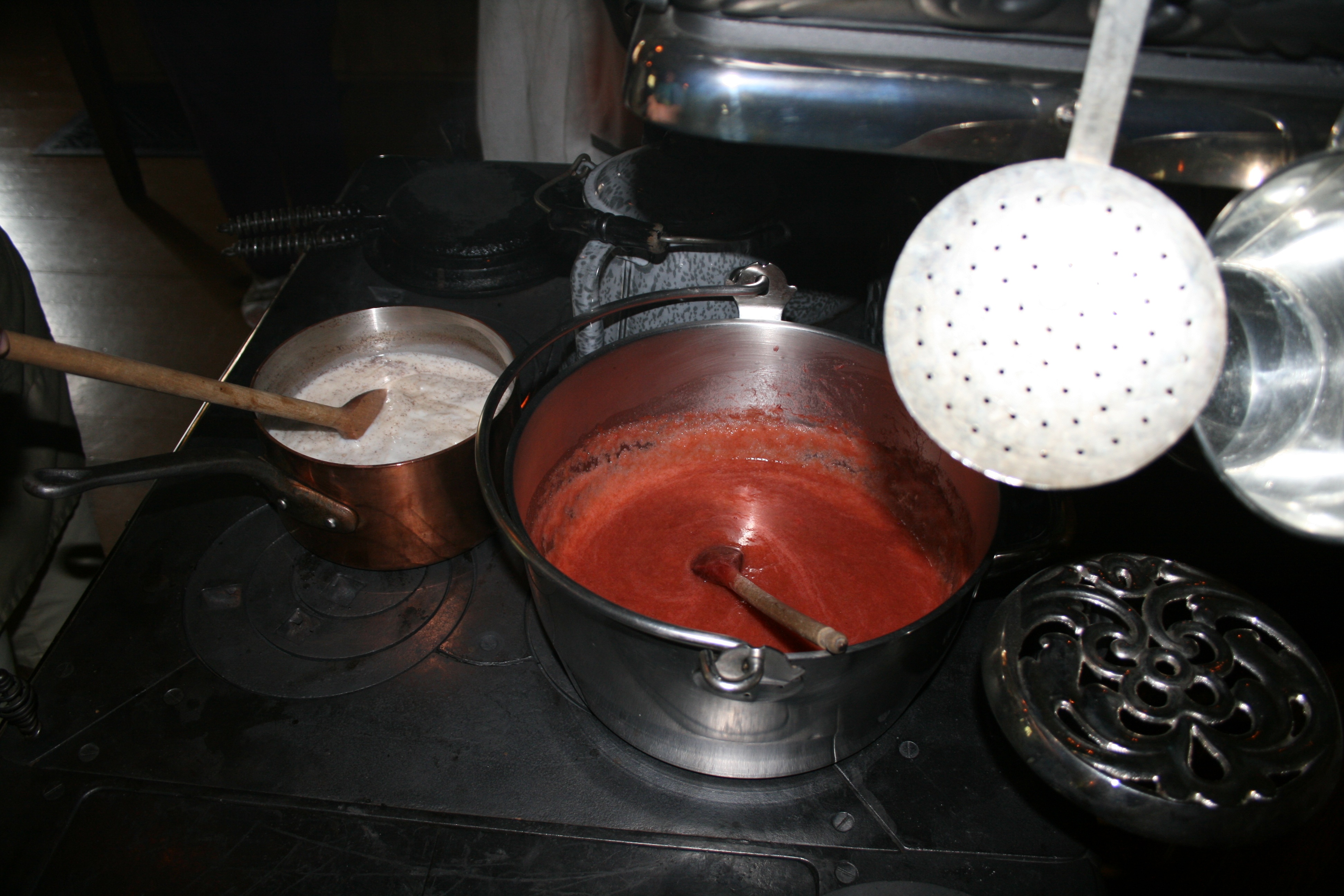
A few Junes ago, we participated in the Breakfast in a Victorian Kitchen program at the Villa Louis estate in Prairie du Chien, Wisconsin. The meal takes you inside the lives of the prosperous Dousman family – or rather the lives of the family’s servants. You don’t just eat the foods of the past – you roll up your sleeves to prepare them using the tools, recipes, and technology of the time. That means hand-crank eggbeaters, wood stoves, and recipes a bit less instructive and a lot more intuitive than today. The jelly omelet team had it far worse than us, though, beating two-dozen eggs, yolks and whites separated, for an hour.

Arriving around 8:30AM, we were quickly divided into teams to take on various tasks. The breakfast menu changes with the seasons, and that June day’s menu included fresh strawberries, bacon fried with sweet peppers, rice waffles served with strawberry-rhubarb sauce, fried Mississippi catfish, a thin bread called Wisconsin cake, and coffee. Some teams worked in the steamy outdoor preserve kitchen, while the rest cooked in the main kitchen with its dim gas lighting and imposing, ornate cast iron wood stove.

Laughter soon filled the kitchen as everyone struggled to complete their assignments. Anxious choruses of “I’m not sure we picked the right job” echoed around the room, followed by encouraging words from fellow participants. You’re never completely on your own, though. The Villa Louis kitchen staff are there to answer questions and to lend a hand to avert a cooking disaster.

About two hours later, breakfast was finally ready. My stomach grumbled fiercely after all this hard work. Everyone sat down to eat at two communal tables adorned with jars of flowers and herbs freshly picked from the grounds in the mansion’s kitchen. Our Wisconsin cakes, which seemed like a sure disaster during the egg beating and mixing process, turned out pretty well, as did everything else that made it to the table. Surveying the breakfast feast before us, all of that hard work definitely paid off: new experiences and a renewed appreciation for electric mixers.

Of Greenhouse Windows

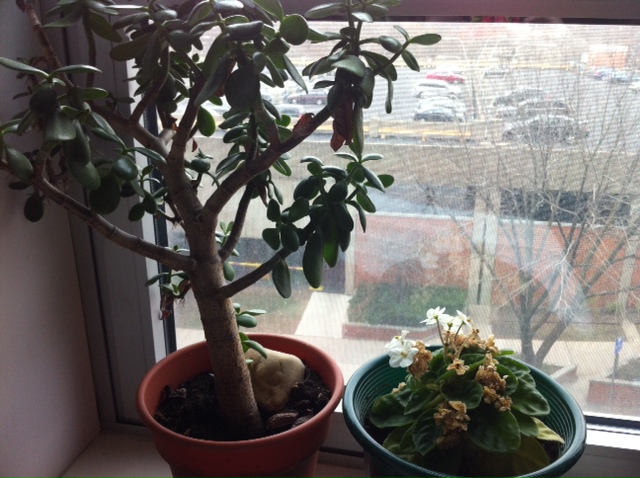
My mom’s greenhouse was always packed with plants, a miniature rainforest on two metal shelves jutting out above our kitchen sink. Spiny plants with thick rubbery leaves; African violets with tauntingly soft but oversensitive velvety leaves; something feathery inside a foggy plastic bubble that required watering through the hole at the top; and a stubby brown root topped with a high ponytail of cascading green leaves.

Some had been with my parents since they were first married in the early 1970s, traveling to Washington State from Illinois from the impossible to imagine time before I was born – a time as distant to me as the old growth forests. “A plant can live that long? Longer than me?” I thought. “No way.”

The greenhouse window was a staple of my childhood. Everyone had one in my 1980s subdivision, though not everyone used theirs for gardening. My babysitter kept hers stacked with mail and the Playdoh masterworks of her charges (mine included – I was a virtuoso with garlic press “hair” on my snowman-like people).

But for us and others who filled it with plants, the window offered a green growing barrier to the outside; something alive in a world that was otherwise dramatically altered and built up by humans. And maybe it was also a bit of longing for another place, a way to nurture something that otherwise had no business growing in the temperate Northwest.

The image of that window popped into my head this morning on my way to work. Unbidden but there and strangely vivid. I could see nearly every plant, and remember the hours my mom spent carefully taking each down from the shelf and varying her watering to meet their specific needs (no water on the leaves of the violets!). Do houses even have greenhouse windows anymore? I couldn’t recall the last time I saw one.

My own plants sit on a windowsill and the floor, enjoying the view, maybe, but missing the camaraderie of the packed greenhouse window.


Learning to Eat

“Food is to be feared” is the mantra I absorbed as a child. Though my mom never said those exact words aloud, nearly every meal we consumed screamed “Caution!” or “Are you really sure about that?”

Salad dressing of all kinds – forget the varieties in which it came — was disgusting and never to touch a leaf of my lettuce. And that salad? Don’t even think of mixing anything more wild and flavorful than Iceberg in there.  Sandwiches, hamburgers, and pasta ordered in restaurants were all carefully inspected, layers separated and noodles pulled back and apart, before even a single bite could be taken. I’m not sure a tangy drop of mustard even crossed my lips until I was in college.

My mom has particular tastes – aversions really – and as a kid who didn’t know any better, I followed my mom’s lead. I figured she’d been around the food block and knew how to sort the good from the bad. No mayo, mustard, or dressing of any kind. No basil, parsley, or any other visible herb or spice.  Forget about olive oil. Her dislike of beans and rice meant no ethnic food save for the occasional visit to the most American of Chinese restaurants (a real tragedy growing up in Seattle) where she ordered cashew chicken for us both. I mimicked her careful sorting of the chicken pieces and cashews from the dish, leaving islands of onions (terrible, ruin everything), peppers (too spicy), and other wan vegetables in an oily clear ocean of sauce. Our mounded bowl of white rice grew cold with our neglect and disdain.

In high school, a revolution occurred: I began eating dinner at friends’ houses. Worried about the food potentially served but also too shy to make a scene, I ate my first tentative bites of Caesar salad. I didn’t die. Not only did I not die, I actually liked it. Glistening Romaine lettuce, damp with dressing was actually good, delicious even. Soon, I had pesto, sweet potatoes, and carrots dressed with a white sauce that my friend’s mom called “company carrots.”

Over the next few years, I began trying all kinds of foods I’d always thought must be avoided at all costs. And I loved nearly all of them. For the first time, eating out wasn’t fraught with peril and caution. Dish dissections occurred only to add more mustard or to straighten a tomato threatening to slither out from between my bread slices.

By the time I graduated from college and moved 2,000 miles away from home, I finally understood those photos I’d seen in magazines of people, families, laughing and smiling as they passed mysterious steaming bowls around a table. I could see myself in those photos now, and I wanted to know what was in those bowls not to request that something be removed but to savor each bite. It was corny but the power of food to bring people together in shared enjoyment – rather than suspicion – at last made sense.

Chinese Apples

Regionalisms, like regional foods, are everywhere. Even in our constantly connected and commercialized world, linguistic variations persist in communities around the country. There’s something heartening to me about the idea of the persistence of language idiosyncrasies in the face of so many leveling forces.

Last week, I learned a few new ones while visiting New York, Connecticut, Rhode Island, and Massachusetts. Speaking at the New York Public Library about my new book Apple: A Global History, a woman asked me why pomegranates are sometimes called “Chinese apples.” Beats me. I’d never heard that before! It turns out it’s a regionalism, fairly specific to the New York City/New Jersey area. It turns out the Chinese apple = pomegranate lobby even has a Facebook group devoted to it. Pomegranates are from Asia originally so that’s probably where the name originated, but that name didn’t seem to spread outside the northeast.

A few more, though, not necessarily food – or even apple – related:

  • What I call a roundabout or a traffic circle (perhaps I’m unsure myself) is a “rotary” in Massachusetts
  • Water fountains are supposedly “bubblers” in Massachusetts, just as they are in Wisconsin, though I never heard anyone reference this
  • Hero is a sandwich in New York City
  • A milkshake is a “cabinet” in Rhode Island and a frappe in Massachusetts (wish I’d had one but my desire to try things outmatches the number of meals in the day and room in my stomach)

What other food-related regionalisms do you know? Any other apple-related ones?