History of the Apple in 10 Objects: Paris Green

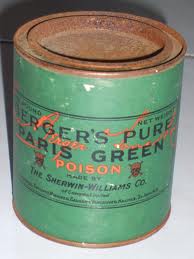
Paris green was the first arsenical insecticide used on apples. Developed in the 1870s, it was developed to control the codling moth, a pest accidentally brought to North America by European settlers.

Before the late 19th century, pesticides and insecticides were not widely used in North America. Many of the pests that would eventually become troublesome had not yet made the trip to the New World. Public perceptions of how fruit should look also discouraged the use of pesticides – some pest damage was een as natural and unavoidable. Many people saw no problem with bumpy, pock-marked fruit. Still-life paintings from before the 19th century clearly show insect damage and disease. Insects simply came with the territory of fresh fruit consumption.

All this began to change in the 19th century as more growers began producing fruit for market and fresh eating rather than for cider and home consumption. Blemish-free fruit became the new standard.

By the 1940s, apple growers used up to seven applications of lead arsenate each season. And after World War II, DDT found a place in the orchard.

While concerns over pesticide use led to the development of integrated pest management for apples, pesticide use on apples remains higher than on most other crops as fruit growers strive to meet marketplace demands for inexpensive and perfect, shiny fruit.


A History of the Apple in 10 Objects: Ships

William Halsall, Mayflower in Plymouth Harbor (1882)

In 1620, Separatists from England (otherwise known as the Pilgrims) arrived in what would become the United States aboard the Mayflower. The onboard menu was far less attractive than what draws travelers to the cruise buffet lines today – hard biscuits, salt pork, dried meats, oatmeal, fish, and a few pickled things. The Pilgrims were not the somber kill joys we tend think of them as – the ship also included stores of alcohol (legend has it that the Pilgrims only stopped in Massachusetts because the beer was running low and not because they actually wanted to settle on Cape Cod) as well as apple seeds for growing the fruit that would make hard cider. The Pilgrims shared a widespread belief that water was unwholesome and dangerous and so preferred to drink the fruits of fermentation.

Like the horses that carried apples overland, ships carried apples overseas. European explorers and colonists brought favorite apple varieties with them to the New World. Some of the first colonists tried planting grafted Old World apple trees but most did not fare well in their new environment. Fortunately, they also planted seeds, which tended to do better. As people moved further inland, they took their apples with them, establishing orchards in the Midwest and on the Pacific coast by the late 19th century.

Apples also traveled to South America with Spanish and Portuguese explorers. The apple trees became so thick and vigorous that by the time Charles Darwin landed in Chile in 1835, he claimed to have nearly missed the Chilean port of Valdivia for the tangle of foliage and fruit.

Apples arrived in Australia in 1788 when Captain Arthur Phillip established the English colony of Port Jackson (today’s Sydney). And the infamous Captain Bligh had a soft spot for plants, sending the Bounty’s  botanist to plant apple seedlings on the coast of Tasmania.

In 1862, writer Henry David Thoreau praised the apple’s sea legs, declaring that the apple “emulates man’s independence and enterprise. It is not simply carried… but like him, to some extent, it has migrated to this New World.”

A History of the Apple in 10 Objects: Seeds

apple seeds
Source: Aka

I know what you’re thinking – “seeds aren’t made by humans! This isn’t an object as defined by the rules of this game!” Yes, yes, I know. But we’re looking at seeds to talk about something humans do to (deliciously) interfere with the reproduction of apples: grafting.

Apples, like humans, produce offspring that can be radically different from the parent plants. They are heterozygous. This means that left alone, an apple tree will produce hundred of seedlings each a little (or a lot) different than the other. This genetic diversity allowed the apple to spread through the temperate regions of the world since at least one of those seeds had what it took to survive in new conditions. The only way to ensure that you get the same type of apple is by grafting.

Humans have been grafting plants for thousands of years, and apples may have been one of the first grafted fruits. To graft a plant, growers attach the root of one tree to the shoot of the desired fruit to clone it. It’s the only way to get reliable apple quality and consistent fruit.

The Persians, Greeks, and Romans each used grafting to produce favorite apple varieties. The Romans had at least twenty-four cultivated apple varieties, one of which, the Lady Apple, is still commonly grown and is one of the oldest known fruit varieties. It isn’t often you can get a real taste of the past, particularly one that dates back to ancient Rome.

History of the Apple in 10 Objects: Medicine Jar

Medical vase c. 1515 for storing herbs, roots, syrups, pills, ointments, and sweetmeats.
Source: Victoria and Albert Museum

Apples are good to eat and drink – but they could also heal. Long before we thought that “an apple a day kept the doctor away” (a relatively recent development), doctors and other healers used the fruit medicinally. A 14th century Italian medical book mentions that apples cure more effectively when served hot and sprinkled with sugar and other spices (medicinal apple pie, if you ask me). These roasted or baked apples were thought to ease digestion after a big meal. If you needed an excuse to eat pie, now you have an ancient medical justification for its benefits.

Cooked apples could also be found in the Arab pharmacopeia. Some of the first recipes for fruit pastes, sweets, and jams involving apples came from medical books not cookbooks. People in the Middle East pioneered the growing and refining of sugar on a large scale and more often used this sugar as medicine rather than as a tasty sweetener.

Raw apples also had their benefits. The fibrous apples kept English monks regular in the 14th and 15th centuries, and some believed that an apple at the start of the meal stimulated the stomach and heart. Eaten at the end of the meal, apples gave teeth a fairly good clean. While certainly not a substitute for a toothbrush, in the Middle Ages, this was pretty advanced preventative dentistry.

Apple pulp provided a vehicle for many medicines in the medieval pharmacy. Apple-based medicines were applied to the skin and some apples also appeared on ingredient lists for beauty products. The origin of the word pomade, the waxy substance used to style hair, traces its name to apple pulp.


History of the Apple in 10 Objects: Cider Press

Cider press in Madley, Herefordshire, UK
Source: mira66

Apples taste delicious. But they make an even better drink. Squish them up, enough to release the juice, and they quickly turn into a bubbly fermenting brew. Humans have made alcoholic apple cider for hundreds of years. It was thought to be a nutritious and healthful beverage as well as a good way to preserve what could otherwise be an overwhelming apple harvest. Cider was also one step on the path to cider vinegar, a fantastic preservative for foods for the winter months.

In Britain, nearly every farm had a few apple trees for eating and drinking. This tradition came to North America with the colonists where cider served as an important medium of exchange. Colonists paid for school and goods with barrels of cider. Everyone – children, too – drank cider.


History of the Apple in 10 Objects: Bronze Horse

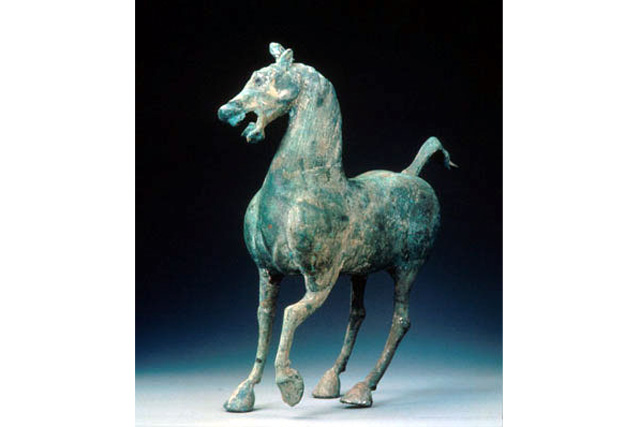
Bronze figure of a horse, Eastern Han dynasty, 2nd century C.E., Excavated from a tomb in Letai, Wuwei county, Gansu, H. 36.5 cm., Gansu Provincial Museum. Source: Asia Society

Born in the mountains of Kazakhstan, the apple hitched a ride to the rest of the world in the packs of humans and stomachs of animals traveling on the Silk Road. Humans picked up the delicious fruit to eat along the way, dropping the cores that house the seeds and all future apples.

But animals are an essential part of the story of the Silk Road. Horses, among other animals, played a key role, providing both milk for local use and transportation for the development of international relations and trade. The clever apple evolved to have smooth, tear-dropped shaped seeds perfectly proportioned to pass intact through the intestinal tract of a horse. In the belly of a horse, an apple could travel 40 or 50 miles a day, gaining tremendous ground in its takeover of the temperate world.

No Gluten, More Cider

Flipping through a magazine the other day, I discovered that Michelob has a new beverage in its line-up: a hard cider. Cider making has been on the rise in recent years in the U.S. but a line in the ad – “a unique beverage that is naturally sweetened and gluten-free” – made me think it wasn’t the hard cider trend that Anheuser-Busch was seeking to capitalize on, but rather the rise of gluten-free eating and drinking.

Ciders are naturally gluten-free, being, in essence, nothing more than crushed apples. A few cider producers add wheat products for… flavor or something to their ciders so it’s best not to assume its gluten content on ordering.

It all makes me wonder whether the rise of gluten-free means more hard cider?

There’s nothing wrong with that per se, but being the hard-nosed historical traditionalist that I am, I’d love to see the rise of hard cider as a recognition of the drink’s long and glorious history and more importantly, its delicious flavor. Cider is the drink of our founding fathers and mothers, and the apple a fruit of immense social, cultural, and economic importance all over the temperate world. Good cider is an art and a craft, not simply a necessity or a concession to circumstances.

But I’m pragmatic, too, and happy to think that more people are discovering hard ciders, whatever the reason that brings them in. I just hope they stay for the flavor and heritage, too.


Eating and Drinking in the Badger State

All this month (red-faced about my delayed posting of this since May is half over!), I’m curating entries on the “Wisco Histo” blog from Wisconsin Heritage Online (WHO). WHO is a collaborative project to digitize the resources of libraries, museums, historical societies, and archives across Wisconsin. It’s a fantastic resource for discovering the history of Wisconsin through photos, letters, diaries, newspaper articles, and objects.

Flipping pancakes at an open house in the Paul Bunyan Room in the UW-Madison Memorial Union.

Every so often, they invite historians and others to highlight selections from the collection around a particular theme. Usually, they ask you to do one week – but, being the indecisive person that I am, I bullied them into letting me pick an entire month’s worth of entries!

So May is food history month on Wisco Histo! I had a great time picking images (mostly – a few articles) from this fantastic collection.


Mushroom Hunter

I’ve only found one. “Found” might be too generous of a term for what happened. Tripped is probably more accurate even if it makes me sound like the klutz that I probably am.

Miraculously, the morel mushroom survived the impact with my foot, its top cut clean off the stem but still whole and undamaged. I carefully picked it up and stuck it in the netting pocket of my backpack. Please don’t get crushed now, I thought, imagining what I would do with this single mushroom when we got home from our hike.

Warm spring weather sends morels popping up through the dried leaves of a Wisconsin woods. They are a wily bunch – resisting easy detection with their brown spongy heads. Accomplished morel hunters zealously guard their mushrooming grounds. I know a few of them. “Maybe I’ll take you sometime,” says a friend. “But you’ll have to be blindfolded.” I laugh but then realize she’s not joking. Morels are the truffles of Wisconsin. Now if only I could get a morel sniffing pig…

Advice on how to find morels is plentiful. Look by dead or dying elms, they say. Old apple orchards, pine trees, old ash, or old poplar. The advice all assumes I can easily identify these trees, particularly when dead or dying. I look at pictures and study tree guides.

Ferns but no morels yet...

But out in the woods, I just walk and scan, walk and scan, hoping to spot that elusive brown cap. No luck yet. I’m not yet worthy of the shirt I spotted in the window of a Czech Village store in Cedar Rapids: Morel Mushroom Master. The store boasted a full line of mushroom lovers gear and even had two 18 inch carved wooden morels in the window.

My one morel made it home safely from the hike. I carefully washed it and then sauteed it in butter. Divided into two servings, the small slices equalled about a teaspoon of food each for me and my husband. But it was an intoxicating taste of a hunt that I’ve only just begun.

Check out this great morel mushroom poem from poet Jane Whitledge.

Where the Old Fashioned is Always in Fashion

A few days ago, I read in The New York Times that the old-fashioned (the hyphen is matter of choice) is back. For those of us who live in Wisconsin, the natural response to such a story was: when did it go away?

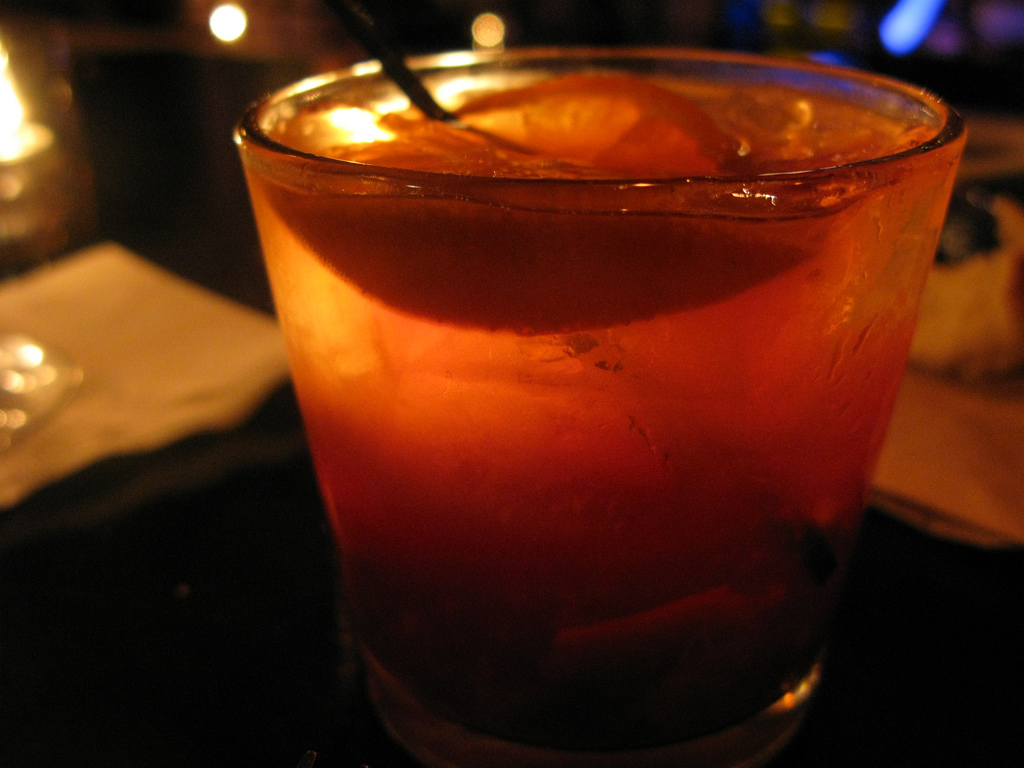
Photo: Caro Scuro

The old fashioned is Wisconsin’s drink of choice, the official unofficial state cocktail, drunk anytime, but especially on fish fry Friday. Heck, we even have a restaurant called the Old Fashioned, and the drink can be found in bars all over the state. Wisconsinites prefer theirs with brandy rather than bourbon, though recipes for the drink vary considerably. Sweet or sour. Seltzer or 7-Up. Bourbon or rye whiskey. Some contain a veritable fruit salad of garnishes – a cherry, orange slices, pineapple – while others omit the fruit entirely.

Old fashioneds date to the 19th century and were first described as a combination of spirits, sugar, water, and bitters. Some called for lemon and cherries in place of the sugar. The drink reached its height of popularity in the late 19th and early 20th centuries, before Prohibition did the old fashioned, like many other cocktails, in.

Wisconsinites have preferred brandy since the 1893 World’s Fair in Chicago where the Korbel Brothers first introduced their drink. It spread throughout the Midwest, gaining a following in Wisconsin it never lost. Korbel is still the most common brand in a Wisconsin old fashioned.

Wisconsin’s version of the drink may not be the one that’s become suddenly fashionable in craft cocktail bars all over the country. But it is a drink with a long history and tradition here that the rest of the country just seems to be waking up to again.