History of the Apple in 10 Objects: Medicine Jar

Medical vase c. 1515 for storing herbs, roots, syrups, pills, ointments, and sweetmeats.
Source: Victoria and Albert Museum

Apples are good to eat and drink – but they could also heal. Long before we thought that “an apple a day kept the doctor away” (a relatively recent development), doctors and other healers used the fruit medicinally. A 14th century Italian medical book mentions that apples cure more effectively when served hot and sprinkled with sugar and other spices (medicinal apple pie, if you ask me). These roasted or baked apples were thought to ease digestion after a big meal. If you needed an excuse to eat pie, now you have an ancient medical justification for its benefits.

Cooked apples could also be found in the Arab pharmacopeia. Some of the first recipes for fruit pastes, sweets, and jams involving apples came from medical books not cookbooks. People in the Middle East pioneered the growing and refining of sugar on a large scale and more often used this sugar as medicine rather than as a tasty sweetener.

Raw apples also had their benefits. The fibrous apples kept English monks regular in the 14th and 15th centuries, and some believed that an apple at the start of the meal stimulated the stomach and heart. Eaten at the end of the meal, apples gave teeth a fairly good clean. While certainly not a substitute for a toothbrush, in the Middle Ages, this was pretty advanced preventative dentistry.

Apple pulp provided a vehicle for many medicines in the medieval pharmacy. Apple-based medicines were applied to the skin and some apples also appeared on ingredient lists for beauty products. The origin of the word pomade, the waxy substance used to style hair, traces its name to apple pulp.



History of the Apple in 10 Objects: Cider Press

Cider press in Madley, Herefordshire, UK
Source: mira66

Apples taste delicious. But they make an even better drink. Squish them up, enough to release the juice, and they quickly turn into a bubbly fermenting brew. Humans have made alcoholic apple cider for hundreds of years. It was thought to be a nutritious and healthful beverage as well as a good way to preserve what could otherwise be an overwhelming apple harvest. Cider was also one step on the path to cider vinegar, a fantastic preservative for foods for the winter months.

In Britain, nearly every farm had a few apple trees for eating and drinking. This tradition came to North America with the colonists where cider served as an important medium of exchange. Colonists paid for school and goods with barrels of cider. Everyone – children, too – drank cider.


History of the Apple in 10 Objects: Bronze Horse

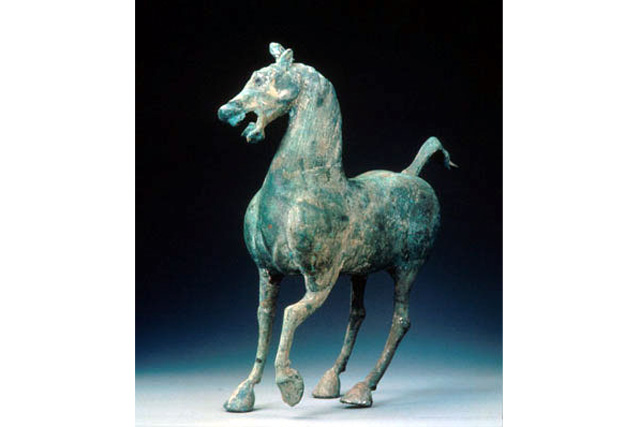
Bronze figure of a horse, Eastern Han dynasty, 2nd century C.E., Excavated from a tomb in Letai, Wuwei county, Gansu, H. 36.5 cm., Gansu Provincial Museum. Source: Asia Society

Born in the mountains of Kazakhstan, the apple hitched a ride to the rest of the world in the packs of humans and stomachs of animals traveling on the Silk Road. Humans picked up the delicious fruit to eat along the way, dropping the cores that house the seeds and all future apples.

But animals are an essential part of the story of the Silk Road. Horses, among other animals, played a key role, providing both milk for local use and transportation for the development of international relations and trade. The clever apple evolved to have smooth, tear-dropped shaped seeds perfectly proportioned to pass intact through the intestinal tract of a horse. In the belly of a horse, an apple could travel 40 or 50 miles a day, gaining tremendous ground in its takeover of the temperate world.

An Object History of Apples

In 2010, 100 curators from the British Museum unveiled a massive project to tell the history of the world through objects – 100 objects to be exact. The results were unveiled on BBC Radio 4 first before becoming a fantastic book, A History of the World in 100 Objects. 

It’s such a fascinating idea and such a perfect medium for telling historical stories since so much of what we think of as “history” is ephemeral – events we can’t see for ourselves, people we can’t really imagine as real people, dates that seem so long ago that we can’t even imagine them.

Because I love this idea so much – and because it is September (even though I really just can’t believe it – the changing leaves tell me it must be true) and apple season – I’m going to tell do my own, slightly pared down version: the history of apples in 10 objects, based on my book, Apple: A Global History.

The fun begins tomorrow.

No Gluten, More Cider

Flipping through a magazine the other day, I discovered that Michelob has a new beverage in its line-up: a hard cider. Cider making has been on the rise in recent years in the U.S. but a line in the ad – “a unique beverage that is naturally sweetened and gluten-free” – made me think it wasn’t the hard cider trend that Anheuser-Busch was seeking to capitalize on, but rather the rise of gluten-free eating and drinking.

Ciders are naturally gluten-free, being, in essence, nothing more than crushed apples. A few cider producers add wheat products for… flavor or something to their ciders so it’s best not to assume its gluten content on ordering.

It all makes me wonder whether the rise of gluten-free means more hard cider?

There’s nothing wrong with that per se, but being the hard-nosed historical traditionalist that I am, I’d love to see the rise of hard cider as a recognition of the drink’s long and glorious history and more importantly, its delicious flavor. Cider is the drink of our founding fathers and mothers, and the apple a fruit of immense social, cultural, and economic importance all over the temperate world. Good cider is an art and a craft, not simply a necessity or a concession to circumstances.

But I’m pragmatic, too, and happy to think that more people are discovering hard ciders, whatever the reason that brings them in. I just hope they stay for the flavor and heritage, too.


Wassailing the New Year

Here we come a-wassailing 
Among the leaves so green; 
Here we come a-wand’ring 
So fair to be seen. 
Love and joy come to you, 
And to you your wassail too; 
And God bless you and send you 
a happy New Year.

We all know the song, as familiar as nearly any other holiday song. And while I often happily sing along to songs that I have no idea what they mean (or perhaps I’m just singing all the wrong words – a post for another time), this one made me pause. I’m coming a-what? And we’re wishing it love and joy?

Wassailing is the practice of thanking the deity of the apple orchards to encourage fertility and ensure next year’s crop. The term wassail probably comes from the Old Norse ves heil and the Old English was hal meaning to “be in good health.” It was originally used as a greeting but became so integrated into drinking rituals in England that the invading Normans who arrived in 1066 thought it was a toast distinctive to the island. Wassail also came to mean the drink used for the toast, which was usually a spiced wine known as Renwein. Because the wine and the spices had to be imported, it was a precious commodity among early English families. Recipes varied among families based on who could afford which ingredients.  Later, beer became an acceptable and widely used wassail.

Dancing in the Cider Orchard

Wassailing became an important practice (and the seeming social event of the season) in cider growing areas of England at least as far back as the 18th century. Held on the eve of Twelfth Night in early January, revelers placed a jug of cider or a piece of cider-soaked bread or cake on the biggest apple tree to honor the gods. In other places, trees are sprinkled with cider. A chant or song nearly always accompanied the offering, and the ceremony generally concluded with the banging of pots and kettles, the firing of guns, and the blowing of horns. These noises were either intended to awake the tree gods or to scare away evil spirits – or maybe a little bit of both. Some people still celebrate today.

So next time you hear the song, bless the apple trees for the coming of spring and maybe make yourself some wassail to ward off evil spirits.

Wassail

Recipes for wassail vary widely, and can have a base of beer, wine, or cider. This recipe is based on a Tudor concoction.

10 small apples

10 teaspoons brown sugar

2 bottles dry sherry or dry Madeira

1/2 teaspoon grated nutmeg

1 teaspoon ground ginger

3 cloves

3 allspice berries

1 stick cinnamon

2 cups superfine sugar

1/2 cup water

6 eggs, separated

1 cup brandy

Heat oven to 350°F. Core the apples and fill each with a teaspoon of brown sugar. Place in a baking pan and fill the bottom with 1/8-inch of water. Bake for 30 minutes or until tender. Set aside.

Combine the sherry or Madeira, nutmeg, ginger, cloves, allspice berries, cinnamon, sugar, and water in a large, heavy saucepan and heat without letting the mixture come to a boil. Leave on very low heat.

Meanwhile, beat the egg yolks until light and lemon-colored. Beat the whites until stiff and fold them into the yolks. Strain the wine mixture and add gradually to the eggs, stirring constantly. Add the brandy. Pour into a metal punch bowl and float the apples on top. Makes about 10 servings.


A Christmas Orange

Did you get an orange in the toe of your stocking for Christmas? Despite the piles of glistening oranges tempting us year ’round at the grocery store, winter really is citrus season. And oranges, like all citrus fruits, used to be a rare and precious treat – hence the fruit’s appearance in Christmas stockings. Even after oranges became more widely and regularly available in the mid-20th century, my parents still threw a few in my stocking each year (though it may have been an effort to counterbalance my all  – Christmas cookie diet of the preceding week).

Oranges are believed to be natives of China. In some languages, the word for ‘orange’ actually means Chinese apple – apfelsein in German and sinaasappel in Dutch, for example. The ‘apple’ name got tossed around a lot in fruit history as many round, brightly colored edibles got tagged with the name before finally getting their own unique identifier.

Despite being linked to apples by name, oranges didn’t travel overland to colonize Asia and Europe like the apple. As Waverley Root notes in Food, “there were no oranges in the hanging gardens of Babylon, they are not mentioned in the Bible, and it is questionable whether the ancient Greeks knew them.” Oranges, instead, came by sea, carried to Europe by Arab traders and explorers. The Romans grew them but they were rare and expensive so they didn’t gain the cult following of the apple, which the Romans cultivated at least 24 varieties. Oranges mostly disappeared with the fall of Rome.

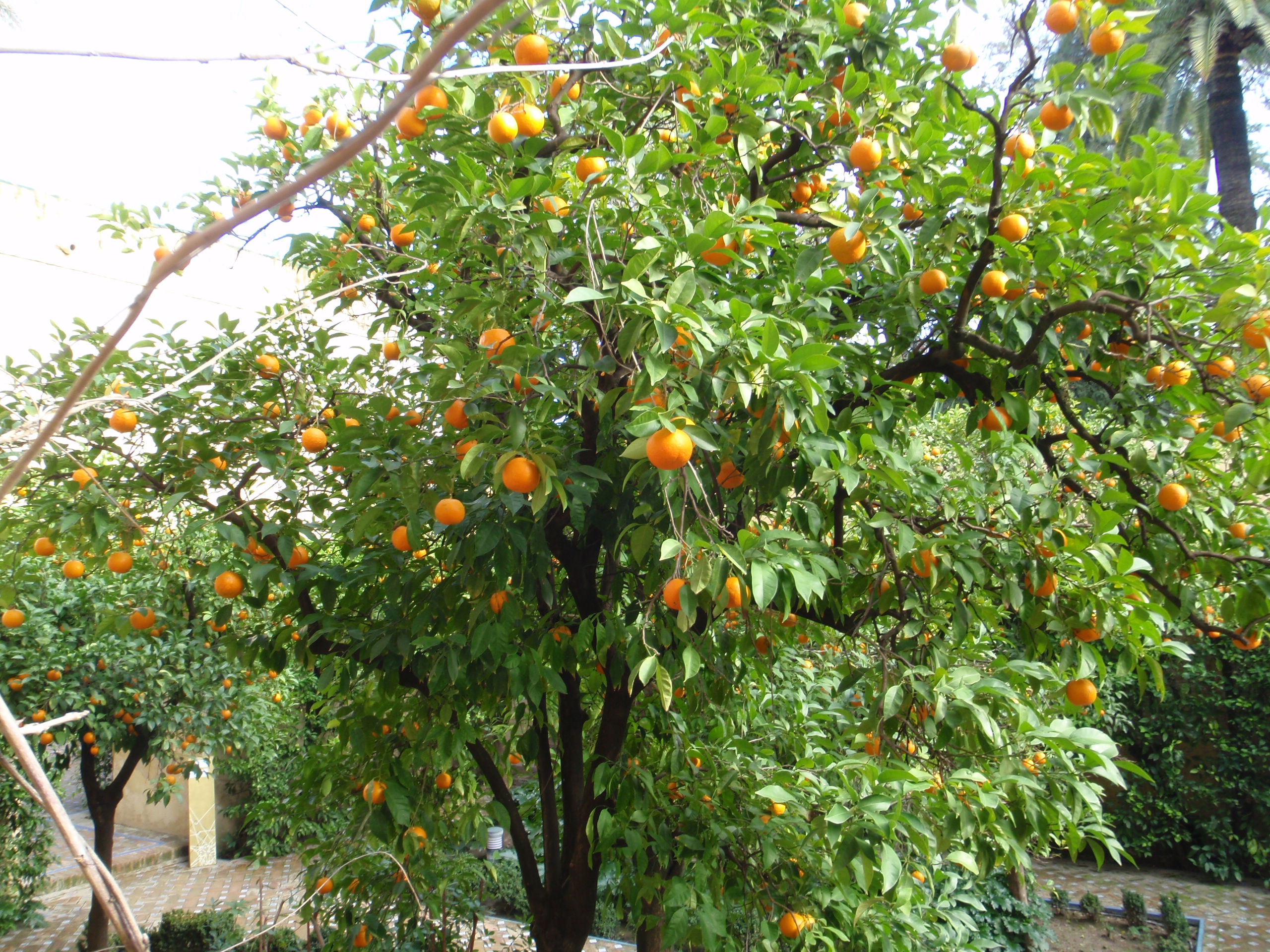
The Moors revived the orange in Europe, conquering Spain and covering the region from Granada to Seville in citrus orchards that remain prevalent to this day. The streets of both cities, but especially Seville, are lined with orange trees that sag under the weight of the fruit in the winter. I made the mistake of eating one of the oranges on a tree in Seville, not realizing they were the bitter, Seville orange that is the principle component of what I only half-jokingly refer to as my mortal food enemy: marmalade. It now made sense why the Spaniards just walked by the free food hanging above their heads.

The bitter oranges of Seville

Christopher Columbus brought oranges to the New World, one of the rare instances of a European explorer bringing something good along with them. Columbus planted them on Hispaniola in 1493, and the climate of the West Indies proved so conducive to the fruit that the islands were soon covered with orange groves.

Hernando de Soto is on record as bringing the first oranges to what is now the United States, though he may not have been the first.  Either way, oranges were growing in abundance in Florida by the late 16th century, and the state remains the country’s leading producer of oranges. And the leading producer of Christmas oranges.

Chinese Apples

Regionalisms, like regional foods, are everywhere. Even in our constantly connected and commercialized world, linguistic variations persist in communities around the country. There’s something heartening to me about the idea of the persistence of language idiosyncrasies in the face of so many leveling forces.

Last week, I learned a few new ones while visiting New York, Connecticut, Rhode Island, and Massachusetts. Speaking at the New York Public Library about my new book Apple: A Global History, a woman asked me why pomegranates are sometimes called “Chinese apples.” Beats me. I’d never heard that before! It turns out it’s a regionalism, fairly specific to the New York City/New Jersey area. It turns out the Chinese apple = pomegranate lobby even has a Facebook group devoted to it. Pomegranates are from Asia originally so that’s probably where the name originated, but that name didn’t seem to spread outside the northeast.

A few more, though, not necessarily food – or even apple – related:

  • What I call a roundabout or a traffic circle (perhaps I’m unsure myself) is a “rotary” in Massachusetts
  • Water fountains are supposedly “bubblers” in Massachusetts, just as they are in Wisconsin, though I never heard anyone reference this
  • Hero is a sandwich in New York City
  • A milkshake is a “cabinet” in Rhode Island and a frappe in Massachusetts (wish I’d had one but my desire to try things outmatches the number of meals in the day and room in my stomach)

What other food-related regionalisms do you know? Any other apple-related ones?


Apples on the Radio

Apples are on the minds of the folks at the public radio program “To the Best of Our Knowledge” where I recently spoke with Anne Strainchamps about the history of apples.

Check out the story of the Rambo apple on “Wisconsin Life,” too.

Ultimate Hitchhikers

Last week, I had the great honor of having my apple book excerpted on Salon.com. They took a portion of the first chapter, which explores how apples made it from Kazakhstan to your backyard (or somewhere near it at least). It’s a pretty neat trick.

Apples are perhaps the world’s greatest hitchhikers, seducing you to pull over with a flash of their sweet and delicious flesh. They stole a ride in your bag or rode along in the stomach of your horse, traveling dozens of miles by dint of their captivating taste and aroma.

They don’t just travel well.  Apples also tend to make themselves at home almost anywhere, insinuating themselves into the local culture and never leaving. It’s why we think of apples as very American fruit despite their origins in a place about as far away as you can imagine.

Apples produce offspring that can vary quite dramatically from their parents. Each seed contains the genetic material for a whole other kind of apple that can taste and look radically different than the parent fruit. Every apple has several seeds and every tree has hundreds of apples so one of these seeds is bound to have the street smarts to survive in their new home.

Thankfully for us and the fruit, apples taste pretty good so we don’t mind that they tend to stick around uninvited.