No Gluten, More Cider

Flipping through a magazine the other day, I discovered that Michelob has a new beverage in its line-up: a hard cider. Cider making has been on the rise in recent years in the U.S. but a line in the ad – “a unique beverage that is naturally sweetened and gluten-free” – made me think it wasn’t the hard cider trend that Anheuser-Busch was seeking to capitalize on, but rather the rise of gluten-free eating and drinking.

Ciders are naturally gluten-free, being, in essence, nothing more than crushed apples. A few cider producers add wheat products for… flavor or something to their ciders so it’s best not to assume its gluten content on ordering.

It all makes me wonder whether the rise of gluten-free means more hard cider?

There’s nothing wrong with that per se, but being the hard-nosed historical traditionalist that I am, I’d love to see the rise of hard cider as a recognition of the drink’s long and glorious history and more importantly, its delicious flavor. Cider is the drink of our founding fathers and mothers, and the apple a fruit of immense social, cultural, and economic importance all over the temperate world. Good cider is an art and a craft, not simply a necessity or a concession to circumstances.

But I’m pragmatic, too, and happy to think that more people are discovering hard ciders, whatever the reason that brings them in. I just hope they stay for the flavor and heritage, too.


Medicine on the Radio

On February 18, 1922, B.J. Palmer took to the airwaves of radio station WOC:

“WOC is coming to you from the Up-E-Nuf tower atop the Palmer School of Chiropractic, the Chiropractic Fountain Head, in Davenport, Iowa, where the west begins and in the state where the tall corn grows!  Broadcasting by authority of the Federal Radio Commission…”

Palmer at the WHO mic

Palmer was the son of chiropractic’s founder, D.D. Palmer. A lover of technology and a savvy businessman, Palmer quickly saw the potential of this new technology to communicate messages to a large audience. He hoped that by spreading the message of chiropractic that he could “broaden listener’s intellectual power” and ultimately, “uplift the American standard of intelligence.” Although the station call letters were arbitrarily assigned, Palmer seized on a marketing opportunity when he saw one and proclaimed that WOC stood for “Wonders of Chiropractic.” It became the nation’s first commercial radio station west of the Mississippi.

Broadcasting from the Palmer School of Chiropractic, the Wonders of Chiropractic” drew nearly one million listeners daily. Programming extended beyond spines and adjustments to include sports, news, farm reports, stock updates, music, and church services. In fact, one of its early sportscasters was a young Ronald Reagan who recreated sports events for fans in the Quad Cities. Games weren’t called live as they are today. Instead, sportscasters would dramatize the game based on information picked up from the tele-type. So the job required an interest in sports as well as decent storytelling skills.

But chiropractic education remained a big part of the schedule and Palmer would take to the airwaves each evening to explain the benefits of chiropractic care. “The Mission of WOC is to establish Good Will for Chiropractic,” Palmer explained. “WOC is educating millions to a favorable mental receptivity to Chiropractic.” He proudly proclaimed that the name chiropractic was said on air an average of 28 times daily.

Thousands of people came to visit the WOC studios, anxious to see radio in action. Visitors saw the recording studios but also the music room where the Palmer School of Chiropractic Orchestra performed.

Palmer later went on to purchase another station in Des Moines. Its call letters were WHO, or “With Hands Only,” the standard method of chiropractic adjustment.  Palmer also wrote a book for radio broadcasters called Radio Salesmenship in 1942 that became a standard in broadcasting schools. He later added television stations to his broadcasting venture, truly embracing all avenues to spread the gospel of chiropractic.

Both stations are still around today, though chiropractic education has slipped from the schedule. Palmer’s story is a fascinating piece of early radio history.

Eating and Drinking in the Badger State

All this month (red-faced about my delayed posting of this since May is half over!), I’m curating entries on the “Wisco Histo” blog from Wisconsin Heritage Online (WHO). WHO is a collaborative project to digitize the resources of libraries, museums, historical societies, and archives across Wisconsin. It’s a fantastic resource for discovering the history of Wisconsin through photos, letters, diaries, newspaper articles, and objects.

Flipping pancakes at an open house in the Paul Bunyan Room in the UW-Madison Memorial Union.

Every so often, they invite historians and others to highlight selections from the collection around a particular theme. Usually, they ask you to do one week – but, being the indecisive person that I am, I bullied them into letting me pick an entire month’s worth of entries!

So May is food history month on Wisco Histo! I had a great time picking images (mostly – a few articles) from this fantastic collection.


Homeless Book Club

On Tuesday morning, I had the honor of speaking at Madison’s Homeless Book Club.  I give a lot of talks, mostly on Wisconsin history but also on writing, being a writer, apples, and whatever else someone somewhere thinks I know anything about. And while I’ve learned to enjoy giving talks, this one was particularly fun.

The group meets once a week to discuss a book in a local church. It’s a respite, an escape from the hardships of daily life. Everyone in the group had read my book, A Short History of Wisconsin. It’s always a different experience going in to a group already familiar with your work rather than trying to “sell” them on it through the caliber (really, how entertaining you are ) of your talk. They asked great questions about the choices I made as a writer in selecting what to include and exclude, and for more detail about certain topics. One person even suggested that the conclusion should have been the introduction, which was fascinating to me since the introduction and conclusion are the most handwringing parts of any writing project in my mind – it was also the first time in what must be more than 100 talks about this book that anyone has suggested that structural change.

The group has had an impressive roster of guest authors, including Michael Perry (Population 485, Coop, Truck: A Love Story), Luis Alberto Urrea (The Devil’s Highway, Queen of America) and Garth Stein (The Art of Racing in the Rain), so it was a pleasure to be asked and included among this group. I had a great time and I hope they did, too!

Read about my visit on the “Streets of Madison” blog.

Silver Award for eHistory

My book A Short History of Wisconsin recently (in the last few months anyway) became available as an ebook. And it’s digital self just won a silver prize in the history category from eLit Awards, which, according to their website, recognizes the “very best of English language digital publishing entertainment.” That’s right – my history book has ceased to be just a book and is now “digital publishing entertainment.” Awesome. Thanks eLit!

Mushroom Hunter

I’ve only found one. “Found” might be too generous of a term for what happened. Tripped is probably more accurate even if it makes me sound like the klutz that I probably am.

Miraculously, the morel mushroom survived the impact with my foot, its top cut clean off the stem but still whole and undamaged. I carefully picked it up and stuck it in the netting pocket of my backpack. Please don’t get crushed now, I thought, imagining what I would do with this single mushroom when we got home from our hike.

Warm spring weather sends morels popping up through the dried leaves of a Wisconsin woods. They are a wily bunch – resisting easy detection with their brown spongy heads. Accomplished morel hunters zealously guard their mushrooming grounds. I know a few of them. “Maybe I’ll take you sometime,” says a friend. “But you’ll have to be blindfolded.” I laugh but then realize she’s not joking. Morels are the truffles of Wisconsin. Now if only I could get a morel sniffing pig…

Advice on how to find morels is plentiful. Look by dead or dying elms, they say. Old apple orchards, pine trees, old ash, or old poplar. The advice all assumes I can easily identify these trees, particularly when dead or dying. I look at pictures and study tree guides.

Ferns but no morels yet...

But out in the woods, I just walk and scan, walk and scan, hoping to spot that elusive brown cap. No luck yet. I’m not yet worthy of the shirt I spotted in the window of a Czech Village store in Cedar Rapids: Morel Mushroom Master. The store boasted a full line of mushroom lovers gear and even had two 18 inch carved wooden morels in the window.

My one morel made it home safely from the hike. I carefully washed it and then sauteed it in butter. Divided into two servings, the small slices equalled about a teaspoon of food each for me and my husband. But it was an intoxicating taste of a hunt that I’ve only just begun.

Check out this great morel mushroom poem from poet Jane Whitledge.

Making Radio

Most of my work days look like this:

I sit for hours cutting a word from here and a phrase from there; deleting the sound of swallows and licked lips (you’d be amazed how loud they are in a microphone – and perhaps once you do know, how self-conscious you become about them); searching for the perfect music and then fitting it in to complement but not overpower the voice, to emphasize a point and then fade away; and trying to make sentences I’ve cut from 10 different places sound like they flow naturally from one into the next. It’s the glamorous world of radio.

But if maybe not glamorous – there’s nothing stylish about the enormous black headphones strapped to my head – it’s certainly magical. Even after hours listening to the same paragraph over and over and over… and over… to the point that I have memorized the entire essay or interview answer (or more recently, a song), it never fails to excite me when it finally falls together. It’s just like writing the perfect sentence or finding just the right word to describe a moment, a scene, a person. It just feels… right.

Creating radio is an intimate experience, too. Radio is itself the most intimate of mediums – a voice talking to you, the listener, over the airwaves. Voices you know in a second but couldn’t identify the face of its owner. And yet you somehow feel connected. You feel that you know her.

The same thing happens in my headphones as the subject tells me a story, over and over, that I just have to get right. I owe it to her, I think, as I make the painful decisions of what is essential and what can be left behind. The soundwaves may not look so personal on my screen but most special things are hard, if not impossible, to see.

I can’t imagine the day when this will ever get old – when I’ll stop getting excited about someone’s story and determining how to share it. Sure, my ears throb after hours encased in headphones and my pointer finger aches from endless mouse clicking, but even so, the end result always sounds like magic to me.

Here a few recent radio pieces I’ve produced* for Wisconsin Life on Wisconsin Public Radio:

Count This Penny – songs based on letters of Wisconsin Civil War soldiers (love them, love this)

Stand-Up Paddleboarding (I can’t wait to try it!)

Distill America (I did the recording for this one, too)

Sugaring Season

* Many people ask me what a producer actually does. Good question. In radio, producers do a variety of things but generally book guests for talk shows, find music and sound clips, sometimes write questions for interviews, conduct interviews, and edit audio. Essentially everything but take to the microphone themselves.

Colorful Pills for Colorful People

In the 19th century, Pink Pills for Pale People offered hope. And if that didn’t work, there was always Dr. Wilson’s Blue Pills for Blue People. Or Red Pills for Pale and Weak Women.

Directions for use of the Pink Pills for Pale People

At a time when little about the human body or medicine was understood, millions of people sent away for patent medicines. These remedies were sold on street corners and in theaters, and in the pages of newspapers and periodicals. Despite the name, few were actually patented. To do so would have meant revealing the secret ingredients that made these pills, powders, and elixirs so appealing. Instead, the names were trademarked and the ingredients proprietary.

These patent medicines are what most people think of when they hear the word “quack.” Bottles filled with dangerous mixes of alcohol or opium, aromatics, and coloring, sold by charlatans masquerading as doctors or scientists preying on the innocent and uninformed. But the actual story is a bit more fuzzy.

Sure, some people out to make a quick buck sold potentially lethal remedies. But many were sold by people who truly believed in the remedies they sold. Lydia Pinkham, for instance, sold a vegetable compound for female complaints based on a remedy she had used for years that riffed on several recipes found in John King’s American Dispensatory, a popular botanical handbook. Pinkham’s remedy contained a lot of alcohol – 18% – a not uncommon phenomenon among these remedies, but it’s harder to say if she was a true charlatan. As medical historian Roy Porter has written, “The historian cannot peer into the souls of ‘quacks’ and find foolproof evidence of fraud.”

Many other proprietary remedies were sold by actual doctors. Doctoring didn’t quite pay in the 19th century what it does today (in fact, as unbelievable as it sounds today, many doctors had two jobs to get by) so some doctors came up with their own remedies to sell and support their families. Others believed they had found a truly miraculous remedy that they wanted to offer to the public. Still other doctors prescribed patent remedies to patients.

All of this is to say that patent medicines, the realm of the quack in the popular imagination, are far more complicated than they at first appear.  Right or wrong, patent remedies promised affordable relief to many people who could not afford or did not have access to medical care.

Where the Old Fashioned is Always in Fashion

A few days ago, I read in The New York Times that the old-fashioned (the hyphen is matter of choice) is back. For those of us who live in Wisconsin, the natural response to such a story was: when did it go away?

Photo: Caro Scuro

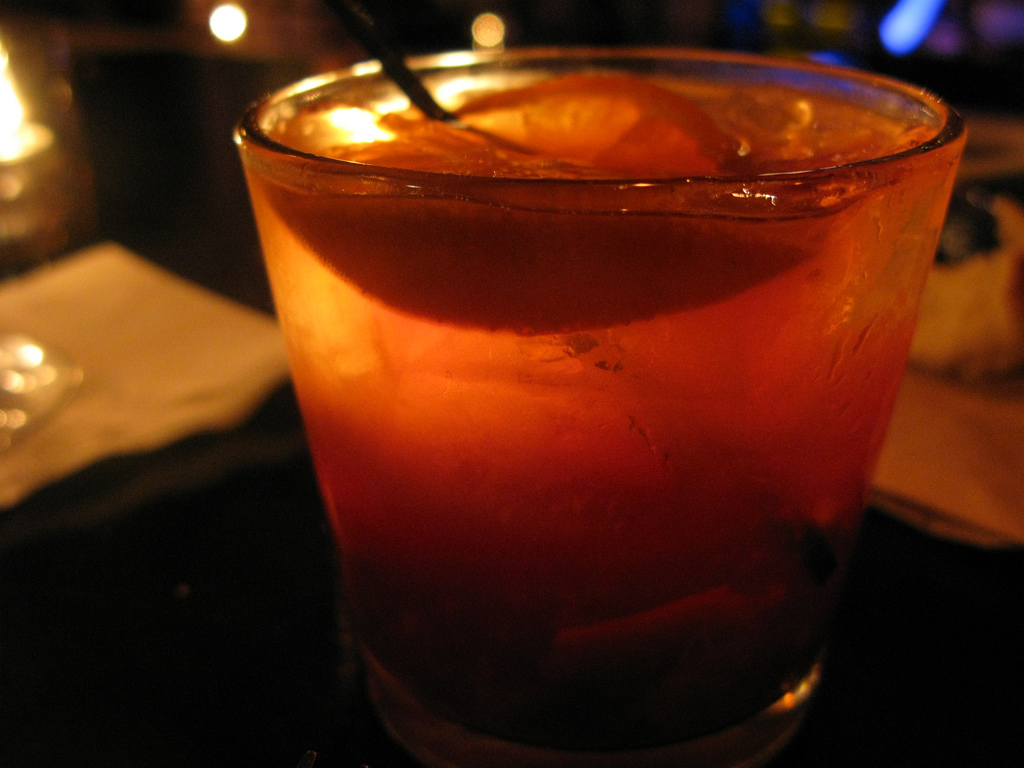
The old fashioned is Wisconsin’s drink of choice, the official unofficial state cocktail, drunk anytime, but especially on fish fry Friday. Heck, we even have a restaurant called the Old Fashioned, and the drink can be found in bars all over the state. Wisconsinites prefer theirs with brandy rather than bourbon, though recipes for the drink vary considerably. Sweet or sour. Seltzer or 7-Up. Bourbon or rye whiskey. Some contain a veritable fruit salad of garnishes – a cherry, orange slices, pineapple – while others omit the fruit entirely.

Old fashioneds date to the 19th century and were first described as a combination of spirits, sugar, water, and bitters. Some called for lemon and cherries in place of the sugar. The drink reached its height of popularity in the late 19th and early 20th centuries, before Prohibition did the old fashioned, like many other cocktails, in.

Wisconsinites have preferred brandy since the 1893 World’s Fair in Chicago where the Korbel Brothers first introduced their drink. It spread throughout the Midwest, gaining a following in Wisconsin it never lost. Korbel is still the most common brand in a Wisconsin old fashioned.

Wisconsin’s version of the drink may not be the one that’s become suddenly fashionable in craft cocktail bars all over the country. But it is a drink with a long history and tradition here that the rest of the country just seems to be waking up to again.


World Posture Queen

I have a bit of a “thing” for beauty queens. Not Ms. America or Ms. Universe. But agricultural queens like Alice in Dairyland and the Wisconsin cranberry queen, food product queens like the Swiss Miss (an actual “Miss” at one point), and my newest discovery, the World Posture Queen.

The World Posture Queen was the queen of chiropractic, a way to publicize the fledgling healing system. The contest began in Michigan in 1955 as a way to bring attention to the annual meeting of the Michigan Academy of Chiropractic. The young woman with the straightest spine and the most perfect poise and personality would win. Contestants were given X-rays to determine whose spine was the straightest. Crooked spines were grounds for elimination. While strictly a local event the first year, the World Posture Pageant went national in year two, and international by year three.

Posture queens appeared on TV, including “What’s My Line” and “The Tonight Show.” In 1967,  World Posture Queen Ruth McCarter visited the White House and got a personal tour of the Rose Garden by President Johnson.

For fifteen years, World Posture Queens brought attention to chiropractic, prompting the 1958 issue of Chiropractic Economics to announce that “Posture Contests are BIG Business.” Despite its apparent success, the contest for perfect posture was discontinued in 1969. The demands of the contest were simply too much for its organizers.